Wednesday, March 09, 2011

Big Sur rocks!


I'm standing on a crag jutting out into the Pacific, waves crashing on the rocks below and laughter floating through the air and I can't stop smiling. This morning we left the city behind and drove through insane traffic and constant shifts in terrain, through pine forests and artichoke fields, sand dunes and wind-weathered rock, arriving in Big Sur in time for lunch and stone-skipping lessons followed by a hike up a steep hill to a scenic waterfall in Pfeiffer State Park, which would have been wonderful enough in itself, but then we pulled off the highway at a serendipitous spot and found a rough path down to the cliff edge where we stood like Walt Whitman facing west from California's shores, "Inquiring, tireless, seeking what is yet unfound."

Like Whitman we are children reveling in the wonders of earth and feeling both very old and utterly new. Not so long ago I lay awake with a bad case of the jitters after a bout of chemotherapy and to calm myself I planned long road trips including one along this highway between Big Sur and Monterey (read it here), but at the time I wondered whether I would ever drive this road and walk these cliffs. Tomorrow we travel to Salinas and Monterey to commune with John Steinbeck and in a few days I'll be ready, like Whitman, to "face home again, very pleas'd and joyous." Today, though, I'm here and I'm happy and I wonder how anyone could live here and not be a poet.

Tuesday, March 08, 2011

The house that Jack built

"Rest/Read" says the sign on the green mailbox. Next to the box is an inviting bench, and inside the box is a collection of short stories by Jack London. London himself rests not far from here, or his ashes do, buried in an urn beneath a mossy boulder. We're visiting the Jack London State Historic Site, the farm where the author spent his final days.

First we visit the ruins of the dream house London built in 1913, a massive structure of stone and redwood that burned before he could move in. It makes a lovely ruin. At the cabin where the author wrote his last books we see how he organized his ideas: scraps of paper covered with his notes are clipped with clothespins to ropes festooned across his sleeping porch. The view from the porch features a koi pond and herb garden and vineyards stretching into the distance.

We share a picnic lunch and listen to a guest lecturer by Dr. Charles Crow, who taught the California Lit class I took in grad school years ago but is now retired to California. We sit beneath trees and discuss London's work as Charles draws Jungian diagrams on an invisible blackboard. We rest. We read. We carry on, as Jack would want us to do.

Heard on the street

Woman on cell phone: "Yeah, I'm unhappy with my eyebrows, I'm trying to grow them out...."

Sign on the cash register at a coffee shop: "We would be happy to take your order after you've finished your cell-phone conversation."

Student finding sticks on the ground on the path to Coit Tower: "Look, they have magic wands!"

Helpful tour guide in Coit Tower elevator: "[indiscernible] the [unintelligible] when [incomprehensible] the [unimaginable]."

Woman trying to lure us into a restaurant in Chinatown: "Yummy yummy, yummy yummy, yummy yummy" (repeat x 8000).

Monday, March 07, 2011

Wordswalk

We walked most of the day through the streets of San Francisco and sometimes we walked on words. This morning in Jack Kerouac Alley next to City Lights Books a student read us poetry by Lawrence Ferlinghetti, and this evening another student translated the characters written on the gateway to Chinatown and read from Maxine Hong Kingston's China Men.

In between we walked and walked: to Fisherman's Wharf to see the sea lions and the view across the bay, to eat fish and chips and bacon fudge and turn up our collars against the wind. Then we were off again, up to Coit Tower and down Lombard Street and then up again to Chinatown, where my students introduced a classmate to the joys of chopsticks and enjoyed an amazing meal.

Tonight my ankles and feet are complaining and my face feels tight from windburn, and I have a feeling I'll start the day tomorrow stiff and sore. But it makes me happy to recall how excited my students were to browse among the books at City Lights and then tramp around a city where words are underfoot everywhere we look.

Unhostile hostel

The light fixtures in the lobby of our hostel make me smile. Sidney opera house (upended) meets 60s mod to suggest modular clouds or birds with spectacular plumage or fat floating angels. Whatever they are, they amuse me.

The hostel as a whole amuses me. It's noisy and busy and full of lively voices chattering in many languages, but it's bustling with a freshness I find relaxing. I've never stayed at a youth hostel before and although I chose this one primarily because it provides very cheap lodging in a great location, it's turning out to be a terrific experience. The students are staying in dorm-style rooms with visitors from other countries, but I have a private room about the size of my childhood bedroom (except I don't have to share the bathroom with my brothers). True, we have to make our own breakfast and wash our own dishes, but we can do that. Besides, it's a small price to pay for lodging in the heart of San Francisco, just three blocks from Union Square.

Now I just need to get my internal clock adjusted so I can sleep past 4 a.m.

Sunday, March 06, 2011

Trees and fog and mud and trees


Raindrops plop gently on umbrellas, shoes slop through mud, and students chatter down the trail until, suddenly, silence and a whispered "Wow." That's how our tramp through Muir Woods started this morning, and it proceeded from mud to slop to Wow to "where are we?" A two-hour hike, a satisfying lunch, and an illuminating presentation made for an invigorating day. Tomorrow: Beat walk and Chinatown. Today: mud and wet and wow, and now it's time to relax.

Step across this line

I think it started with the liminal nesting dolls. There we all were enjoying our four-hour layover in the Minneapolis/St. Paul airport (which showed up on the boarding passes as "Minneapolis SPA" but we never found the spa) when a student said, "This is like liminal nesting dolls!" Meaning, I think, that we were straddling several overlapping thresholds, in the middle of our trip and the middle of the midwest while preparing to cross over to our California adventure.

We stepped across that line and made it to San Francisco, but not before attempting to assemble a syllabus for a Concepts of Place class focusing on Hell. What would you put on the reading list? A student suggested House of Leaves and another called for Dante's Inferno, but when I asked how we could plan a class trip to Hell, the answer was simple: Virgil Airlines.

Maybe next time. This week I think we'll stick with California.

Friday, March 04, 2011

Countdown

Ready to go? I suppose so: midterm exams graded, grades submitted, classes prepped for my return to campus.

Bags packed (mostly), petty cash picked up, maps and receipts and itineraries all present and accounted for.

Editing project submitted. Desk cleared (mostly). Bills paid? Not yet.

Cell phone, camera, netbook charged and packed and chargers packed. Still figuring out how to send text-messages. Can't find the apostrophe. Use question mark instead?

The countdown has started; we leave first thing tomorrow morning. I'm ready for California--but is California ready for me?

Thursday, March 03, 2011

Listing

I live by To-Do Lists but this week as I prepare for our class trip to California I'm also working on a list of things not to do--may I call it a To-Don't List?

Don't think about bedbugs.

Don't worry about what the spouse will eat all next week. The spouse can take care of himself.

Don't start reading any big fat novels that can't be finished before Saturday.

Don't think about earthquakes. Or plane crashes. Or bedbugs.

Don't worry about the weather.

Don't pro-actively apologize for the weather. The weather can take care of itself.

Don't pack until the laundry is done. And don't pack stupidly. In fact, don't do anything stupidly.

Finally, don't forget to have fun--after everything gets crossed off the list!

Tuesday, March 01, 2011

Excuse the schmooze

I need an excuse. Well, I have an excuse, but it simply won't do, so I need a better one--more plausible. Somehow I don't believe my freshman composition students will be impressed if I confess that I haven't quite finished grading their midterms because I was too busy schmoozing and noshing.

Do young people these days even use the words schmoozing and noshing? And if they do, are they likely to believe that I'm the kind of person who shoves the grading aside in order to spend an entire day chatting randomly with colleagues while nibbling at the cheese tray and popping into my mouth the occasional olive?

Nevertheless, that's how I passed most of day. Today we held an open house for the Center for Teaching Excellence where I live and breathe and do my best work, so all day long we entertained faculty, staff, and administrators who dropped by for a schmooze and a nosh. The biggest crowd showed up around noon for lunch and the prize drawings, but we had a steady stream of visitors all day long, leaving me only a few brief disconnected moments to prepare for class. I can't grade papers while schmoozing and noshing, and by the time the open house closed its doors, I had to dash off to another long and complicated meeting, which left me too exhausted to remember to take any work home.

My freshpersons will expect their graded essays early tomorrow but I've read just over half of them. Can I possibly get up early enough to grade nine freshman essays before 9 a.m.? If not, I'll just have to fess up: Sorry, students. My dog ate your papers.

Monday, February 28, 2011

California dreaming

Across a rocky expanse of classes, papers, meetings, and annoying responsibilities, I see California looming in the distance--except looming sounds so negative, so threatening. California is not looming ominously but instead stands at the end of the week waiting to embrace me and carry me away from Ohio--except that sounds like an old commercial for dishwashing liquid: "Calgon, take me away!"

Readers were getting carried away by California long before Europeans caught sight of its shores. Around 1508, Garci Ordonez de Montalvo described his own private fantasy island: "Know ye that on the right hand of the Indies there is an island called California, very near the Terrestrial Paradise and inhabited by black women without a single man among them and living in the manner of Amazons. They are robust of body, strong and passionate in heart, and of great valor. Their island is one of the most rugged in the world with bold rocks and crags. Their arms are full of gold, as is the harness of the wild beasts which, after taming, they ride. In all the island there is no other metal."

This description shaped explorers' expectations of California, but I've seen California and I know better than to look for an island populated by Amazons bearing gold. Instead, I'll be looking at California through the eyes of its authors. All next week my California Literature students will present information connecting literature and place: we'll hear about John Muir while visiting Muir Woods, commune with the spirit of John Steinbeck in Monterey, evoke the Beat poets in San Francisco and Big Sur, discuss Maxine Hong Kingston in Chinatown, and hear Robinson Jeffers's voice while visiting the house he built in Carmel.

That's the California that beckons at the end of the week, but between me and that dream stands a mountain of midterm grading. I can't get to California without crossing the Sierras, so the best thing to do is just start climbing and hope I don't end up stranded in Donner Pass.

Friday, February 25, 2011

"Well done!" or "Weld on!"

Don't get me wrong: I love my job. I love my colleagues and I love my office and I love playing with words alongside my students, looking at terrific literature and trying out interesting ways to assemble ideas into sparkling syntax. But sometimes when I get tired of answering the same MLA format question for the 27th time this week, or when I'm facing a stack of student drafts starting off "In society today" or, for a little variety, "In today's society," or when I've been spending too much time in meetings full of busy people who seem content to merely tread water--when it all piles up a little too high I find myself thinking, "I could have been a welder."

Why a welder? I've never welded anything and I don't have any idea whether a welder's job is any less demanding or more satisfying than mine. Nevertheless, when I get discouraged with the way things are going, the alternate career I imagine for myself is welding.

Wouldn't it be better to imagine a more colorful career plan? I could have been a hot-air balloonist or a brain surgeon or President of the United States (except I get motion sickness and blood makes me queasy and political debates give me hives).

I could have run away and joined the circus. (As what, exactly? Trapeze artist? No spandex and spangles for me!)

I could have been a beach bum (except I hate getting sand in my shoes).

I could have been a princess (except look what happened to Princess Di, who would be my age if she weren't dead).

I could have been (and was) a journalist, but now journalism is morphing into something I don't recognize and I don't know whether what I used to do still fits anywhere.

I probably could not have been a welder, but sometimes it's appealing to think about wrapping myself up in protective gear and wielding powerful equipment that can make stuff stick together. The thought of producing something tangible, of setting goals and knowing when I've reached them, is very attractive. I don't always know whether my students have learned whatever I'm trying to convey in class on any given day, but if I welded something, success would be measurable (and so would failure): either the weld would hold or it wouldn't.

Today I'm collecting drafts in one class and giving a midterm essay exam in the other. I'll be collecting evidence of whether the welds between words and ideas are strong enough to hold, but the evidence is sometimes clear but more often incomplete or ambiguous or incomprehensible. And when things fall apart, it's often not at all clear why or what I could have done differently.

I love my job enough to keep doing it even when welding starts looking like an appealing alternate career. I couldn't have been a welder, but sometimes considering the possibility helps keep me committed to being a teacher.

Thursday, February 24, 2011

Flotsam

Recent heavy rains caused my creek to rise, and when it fell it left behind a hubcap and a rusty muffler. If we stand on the bank long enough, perhaps the creek will cough up the rest of the car.

In the seven years we've lived with this creek, it has brought us many gifts but few of any worth: a battered bathtub, a rusted barrel, lengths of tattered rubber hose, a deflated raft, shards of glass and clay pots, a child's car seat, twisted fenceposts and antenna wire and a stand for a basketball hoop. Once the creek brought us a chunk of coal weighing more than 60 pounds, and sometimes it brings silt for our garden and gravel for our driveway--not nearly enough, though, to replace the gravel the creek took away in our first big flood.

The creek brings other things, of course, enriching our lives with intangible gifts: the soothing chatter of water rushing over rocks, the beauty of fall leaves reflected on the water, the lacy patterns at the edge of winter ice. This week we've seen wood ducks paddling in the creek, perhaps just passing through but still an encouraging sight. The creek attracts herons and deer, frogs, fishes, and birds; the sight of a kingfisher swooping along its surface is enough to make my heart sing. The creek nourishes the columbines and dutchman's breeches that grow along its banks and feeds the stately sycamores that mark its course.

Will it ever bring me a car? Probably not, but even when it insists on washing away gravel and tossing up rusty mufflers, a creek like mine is a good friend to have around.

Wednesday, February 23, 2011

Juxtaposing the penultimate liminal palimpsest

"Who wants to get liminal?"

Two students jump up and say "I'll do it!" Then they walk across the room and stand in the doorway as I start singing that great old Olivia Newton John hit, "Let's Get Liminal."

I don't know what's more frightening about this scenario: the fact that I am singing in class or the fact that several of my students know that the easiest way to demonstrate liminality is to stand on the threshold. Apparently they've seen me get liminal before. It happens. "Liminal" is a word I work into many of my classes, along with "palimpsest" and "juxtapose."

"Palimpsest" takes me back to my first semester in grad school, when I studied Beowulf in a dim, musty seminar room that always made me wonder whether Grendel's mother might be hiding behind the curtains. I can still hear the great Kevin Kiernan explaining in his gravelly voice how scribes used to scrape ink off in order to re-use vellum but some of the original text would remain, creating layers of meaning with varying degrees of legibility. I don't teach Beowulf or anything involving vellum, but I find metaphorical palimpsests all over the place--and so, sometimes, do my students.

They also learn how to juxtapose, a tricky skill I demonstrate with a silly bit of theater: "Silence, please, while I juxtapose these two books" (or pens or papers or dry-erase markers). I move the two items slowly, carefully, closer together, a look of intense concentration on my face, and as soon as they are adjacent I say, "Look! Just like magic! They're juxtaposed!"

"Wait, that's all it means?"

I don't mind being a bit silly if it helps students realize that a word they employ as if it had profound and magical meaning really just indicates that two items are side by side. And then when we're all done juxtaposing and getting liminal and finding palimpsests all over the place, we can take up the penultimate challenge, which is informing students that all penultimate means is second to last.

"Wait, you mean it doesn't mean, like, really really ultimate?"

Sadly, no. But don't ask me to sing about it. I don't know any penultimate songs.

Tuesday, February 22, 2011

Hidden in plain sight

I'm making my usual rounds in the library when I notice a door I've never before walked through and suddenly I want to see what's on the other side.

I've always wanted to live in a library and for the past two years I have, more or less. My office and classroom and work area are in the library; I teach and write and research and lead workshops here, and I have taken students to Special Collections and read ghost stories to listeners in the stacks (read it here). But as much as I know and love my library, it still offers occasional surprises.

I walk through that unfamiliar door, and if this were a thriller I would find something shocking on the other side--a blood-drenched corpse, a Cheshire cat, a chance for romance or heroic action. But instead I find a stairwell. I've never used that stairwell before, but it's good to know it's there if I ever need it.

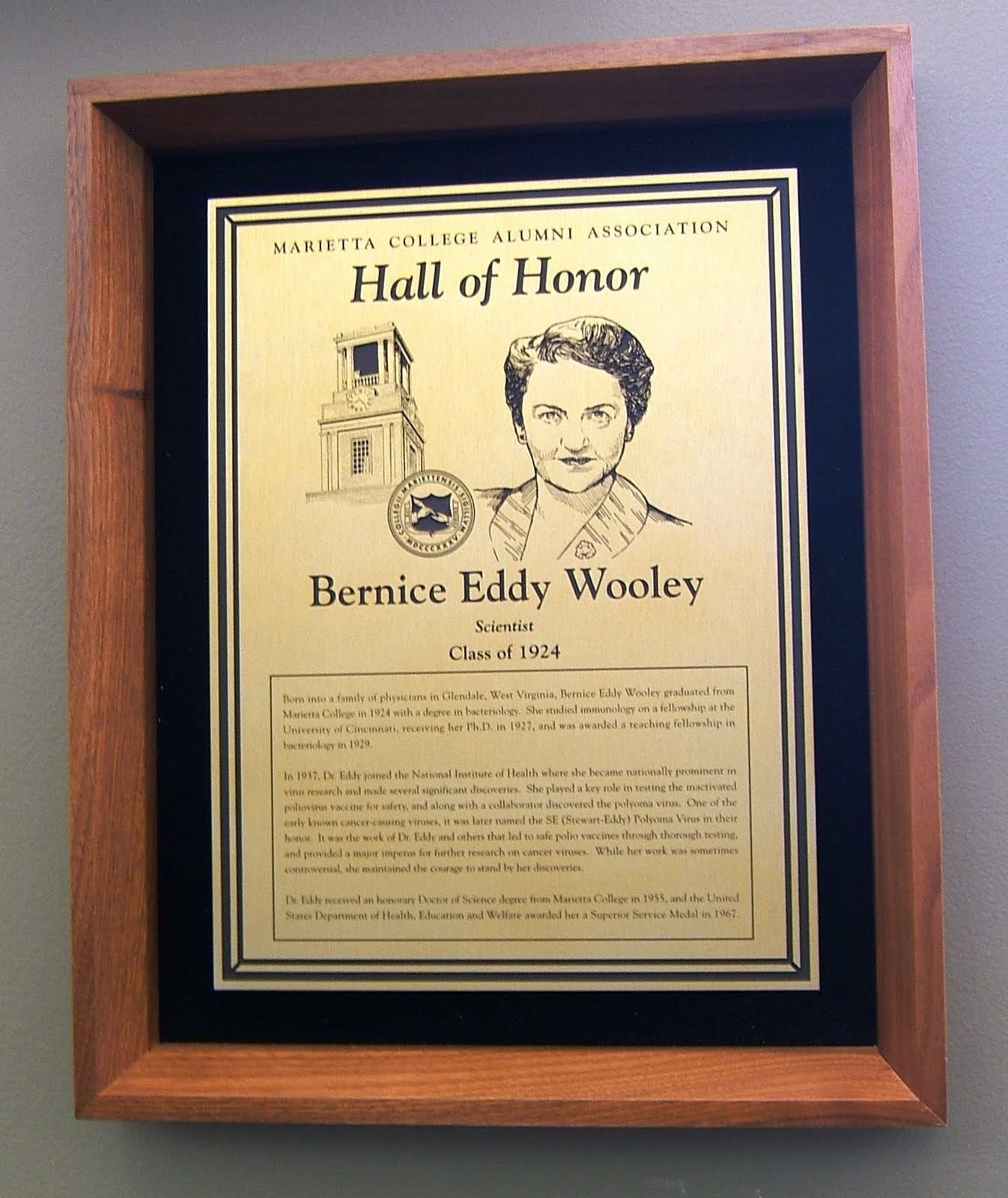
I look around some more and find corners I've never explored, cabinets full of microfilm I've never read, periodicals bound in marbled covers I've never cracked. On the top floor I find a new hero: Bernice Eddy Wooley, class of 1924, whose work contributed to the development of the polio vaccine and "provided a major impetus for further research on cancer viruses." Three cheers for Bernice! She's been hanging on the wall up there all this time and I never bothered to know her.

How many other heroes are hiding in my library? The only way to find out is to keep opening doors to see what's on the other side.

Monday, February 21, 2011

Phoney

This is the week I buy a phone.

Am I ready to give up my cell-phone-free status and start carrying around an annoying little beeping object? I don't know, but I need a cell phone for some upcoming events so it's time to take the plunge.

What kind of cell phone? Cheap and simple. We live too far out in the woods for cell-phone reception, so I can't give up my land-line and I'm too cheap to pay multiple phone bills. I need a phone I can carry with me when I drive my ancient Volvo to Texas for my son's commencement in May or to Florida for my sabbatical next January. More than anything, though, I need to take a cell phone with me during spring break when I'm taking my California Literature students on a journey through literary California. If I get lost on the way to Muir Woods or stranded on the Pacific Coast Highway, I want to have an easy way to call for help--and I want my students to be able to reach me if they can't find their way from Chinatown back to our hotel or if, God forbid, they should get mugged or need to be bailed out.

Frankly, I don't really want a cell phone; I've lived without one this long and I don't feel any urgent need for constant connectibility. But it's time to take the plunge, enter the fray, walk through the door to the world of tomorrow--

If someone will just tell me which phone I ought to buy.

Sunday, February 20, 2011

Q & A (without the Q)

People have been asking me all kinds of questions about the impending administrative changes on campus and it's about time I offered some clear answers:

1. Yes.

2. No.

3. No really, I mean no.

4. Cupcakes.

5. Only on Thursdays when the moon is full.

6. No no no no no.

7. The Grapes of Wrath.

8. Gila monsters.

9. Section III.D.1 of the Faculty Handbook.

10. What part of "No" don't you understand?

Thursday, February 17, 2011

High-fashion slide shows


Right now the New York Times offers two colorful online slideshows featuring fantastic photographs representing the height of fashion. "Best of Breed" highlights prime canines photographed by Fred Conrad at the Westminster Dog Show (click here), while this link takes you to highlights of runway shows at New York Fashion Week. I'm sure I'm not the first to notice some similarities amongst the subjects. Where do they go to master that steely gaze? Same finishing school, no doubt.


Tuesday, February 15, 2011

A bad idea that just might work

Inside Higher Ed features an article today about an idea that's really bad--and not just for the obvious reasons. In "Punching In at Kean U" (click here), Scott Jaschik reports that Kean University's administration has angered its faculty by "requiring them to fill out time sheets reporting how many hours they have worked each day, to demonstrate that they are working at least a 35-hour week."

Find me a faculty member who's working less than a 35-hour week. The profs I know attend meetings during lunch and late in the afternoon, grade papers late at night and all weekend long, respond to student e-mails in the wee hours of the morning, and spend vacations visiting archives, writing articles, and planning new classes. Compared to my current load, a 35-hour work week would feel like a walk on the beach.

Jaschik's article cites a study suggesting that most full-time faculty members work well over 40 hours a week, with the average working 48.6 hours. He also offers a telling quote from Cary Nelson, president of the AAUP, who told Jaschik, "Many of us work 12 or 15 hour days, seven days a week. If it became clear how many hours we put in, there'd be an unimpeachable argument for better compensation and more faculty positions."

So maybe requiring time sheets is not such a bad idea after all.

Alarms and diversions

First the septic tank backed up and sent sewage spurting all over the house and then my sister-in-law (who has never smoked) tossed a lighted cigarette into a trash can full of paper while a total stranger snorted cocaine on my living-room sofa, and then a diapered toddler went wandering off into the dark damp scary furnace room while a kid who couldn't have been more than three years old sat on the basement steps cursing.

I think it was the cursing child who finally woke me up. I intended to turn to my husband and comment on how odd it was to find a cursing child on the basement steps, but I looked at the clock first and said, "We've overslept! Up and at 'em!"

Who needs an alarm clock? My mind is creates its own alarms.

Monday, February 14, 2011

Whole lotta lovin'

We had a full plate of important faculty business at the faculty meeting today, but a plate of cookies took the cake. The Advancement office provided some really luscious heart-shaped Valentine cookies to let the faculty know how much we are loved, but those cookies sat on the big table up front through the course of most of the meeting. Finally, in the last 15 minutes, a rumble arose from the upper right corner of the big room and a brave colleague came forward to take the cookies and start passing them around. Who cares about curriculum? Let 'em eat cookies.

Saturday, February 12, 2011

Pre(pom-pom)posterous

We were sitting in the stands watching a stressful but exciting basketball game when the cheerleaders came out and started doing backflips and splits and tossing each other up in the air. A colleague asked me whether I've ever been a cheerleader and I responded with a bitter laugh. "I can't even do a cartwheel," I admitted.

"But maybe if you tried doing cartwheels, you'd enjoy it."

"Oh I've tried. Spent hours and hours in my childhood hanging around my friends' yards trying to do cartwheels, but I always sort of flopped about halfway over."

We watched a cheerleader go flying into the air, do a split, and land without a wobble.

"That's what you should do on your sabbatical," he said. "Learn a new skills. Cartwheels. You could lead the faculty cheerleading squad."

Sign me up! Where do I get some pom-poms?

Friday, February 11, 2011

Fringe benefits


When I see a picture of Justin Bieber, I always want to brush his hair out of his eyes. I can't help it: it's a mom thing. If my mom could see me right now, she would reach out and brush my hair out of my eyes and say in a soothing voice, "There now, sweetheart. Doesn't that feel better?"

I've needed a haircut for weeks but I can't seem to find the time to make an appointment, so instead I just gripe all day long about how much I hate having hair in my eyes. Today, though, as I sat at the cancer center waiting for my monthly port flush, I realized that there are worse things than having hair in my eyes. A year ago I was still pretty bald, but hey, I have hair! And my fingernails aren't falling off! No one is trying to pump me full of poisonous chemicals! I'm not suffering from radiation burns! I don't have to parade around half naked in front of medical personnel every afternoon! And sometimes I go for days at a time without even thinking about cancer!

Hair in my eyes may be an annoyance, but it's also a reminder of the passage of time and the process of healing. Considering where I've been, I don't mind so much looking at the road ahead through that fringe of wayward hair

Unfolding

Yesterday President Obama said in a speech that we are "witnessing history unfold" in Egypt, and while that may be true, I'm bothered by his syntax and I can't quite figure out why. Let's do some comparisons:

watching history unfold
witnessing history unfold
watching history unfolding
witnessing history unfolding

Watching and witnessing don't differ much in meaning, but witnessing history unfold sounds wrong to me while witnessing history unfolding sounds fine. Let's try some more:

watching a murder

witnessing a murder
watching a person murder someone else
witnessing a person murdering someone else

Why do I need to switch from murder to murdering in that last example? I need a noun phrase after witnessing: I witness a murder or I witness a person murdering, but I don't witness a person murder or witness history unfold.

But apparently our President (or his speechwriter) does. He's probably not the only one. In fact, a simple Google search shows 2.3 million hits for witnessing history unfold but 6.8 million for witnessing history unfolding. My way is more than twice as popular, but it would take a trained linguist to explain why.

Thursday, February 10, 2011

A new view

Here I am teaching a group of colleagues (faculty, staff, even a few random librarians) how to set up a blog, and they're coming up with such wonderful designs for their blogs that mine looks pathetic by comparison. Time for a change! How about a window on a world that's not covered with snow? Here we go!

Wednesday, February 09, 2011

Viscerally speaking

So my freshman comp class is talking about what sort of opening line makes us want to keep reading and a student offers the following from Dan Brown: "Physicist Leonard Vetra smelled burning flesh, and he knew it was his own."

"Gross," they say, but we agree that the line arouses curiosity and appeals to the senses. "It creates a visceral reaction," I said, but then I pause. Does "visceral" mean anything to these first-year college students?

So I ask, and it turns out that "visceral" is peripheral to my students' experience. But it's not every day that I get to use words like "guts" and "entrails" in a writing class, so I guess I ought to enjoy it while I can.

Tuesday, February 08, 2011

Writing in the dark

Denise Levertov prefaced her 1978 poetry collection "Life in the Forest" with a quote from Henry James's odd story "The Middle Years," penned in James's 50th year, in which the main character describes the artist's plight: "We work in the dark. We do what we can. We give what we have. Our doubt is our passion. Our passion is our task. The rest is the madness of art."

Later, though, Levertov offered more practical advice to artists and poets whose ideas well up in the middle of the night. "Wait till morning, and you'll forget. / And who knows if morning will come," she writes, but flipping on the light will startle you "stark awake" while the vision fades back into darkness. Instead, she encourages writers to keep paper and felt-tip marker at hand by the bed and to practice writing in the dark, using one hand to guide the pen and the other to feel the paper and "keep each line / clear of the next":

Keep writing in the dark,
a record of the night, or
words that pulled you from depths of unknowing,
words that flew through your mind, strange birds
crying their urgency with human voices...

Keep writing, she says, because writing in the dark "may have the power / to make the sun rise again."

Now if only Henry James and Denise Levertov could have taken paper and felt-tip markers along on their final rest!

Monday, February 07, 2011

De minimis non curat lex

I took a quilt to class this morning not because I was cold but because my American Lit Survey students were discussing Susan Glaspell's "Trifles," in which a key plot device hinges upon determining whether Mrs. Wright was planning to "quilt it or knot it." To fully comprehend the complexity of the question, students need to know that quilts are made of fragments of fabric carefully pieced together, just as the play portrays characters trying to piece together a jailed woman's life based on the fragments she's left behind. They need to know that quilts are assembled in distinct stages, from cutting the squares to piecing the top to connecting the top to the batting and bottom, and they especially need to distinguish between different methods of sewing together the layers in the final stage.

And then, like good detectives, they need to look at the evidence presented in the text and see whether it's possible to find the correct answer to the question "quilt it or knot it?" If Mrs. Wright is still piecing the quilt top and has not yet started connecting the layers, how can anyone possibly know whether she was planning to quilt it or knot it? And if no one can know the answer to that question, why do the women in the play insist that Mrs. Wright was planning to "knot it"?

Knot what?

My students have seen enough CSI and Law and Order to know that evidence doesn't lie, but like the men in "Trifles," they don't always know what counts as evidence. There are no smoking guns in this case, no big obvious answers to questions of motive; instead, we have to pay very close attention to very small matters: a row of crooked stitching, a broken birdcage, a lump of rising bread dough. "Quilt it or knot it" could be a life-or-death question if the lawman on the case put his mind to it, but he can't be bothered to notice the difference because, as Susan Glaspell knew, the law does not concern itself with trifles.

Sunday, February 06, 2011

Just another dip on the sofa

There's a Bev-shaped dip in the sofa where I like to sit by the big front window and watch the birds, and for the past few days I've been mostly living in that dip. No, I didn't go to Our Nation's Capital to give a paper at AWP. Yes, I backed out. No, I don't feel guilty. Much. Most of the time.

Instead, I stayed home and graded papers, and then I graded exams, and then I graded another set of papers, and then I dug into a big project editing a collection of conference proceedings. Since Thursday evening, I've spent so much time glued to this same spot on the sofa that I'm afraid I'm about to merge with the furniture. A few more hours of this and I'll be transformed into a lumpy spot toward the end that gets in the way when you try to vacuum.

Okay, I did leave the house a few times--a walk with the dog on Friday, a basketball game on Saturday, and church this morning--but other than that, I've been living right here in this spot, my butt glued to the sofa and my laptop glued to my lap. Now, though, it's time to put away the computer and break free, to step away from the sofa and turn toward whatever awaits on campus this week. Will the sofa let me go? If you don't hear from me soon, send in the St. Bernards.

Thursday, February 03, 2011

Don't ask, don't yell

Some questions I never remember to ask visiting job candidates:

1. If you were a tree, what tree would you be and how would you feel about having distant branches of your family chopped down to make paper for printing multiple hard copies of reports for those who dislike electronic document sharing?

2. Did you ever inhale? If so, where did you find any breathing room at all within the strenuous schedule we set up for your visit?

3. For faculty members who fail to complete their assessment reports, what punishment would you favor: tar and feathers, denial of tenure, ten lashes with a wet Excel spreadsheet, or permanent assignment to the Assessment Committee?

4. What color magic wand will you bring? Is it insured?

Wednesday, February 02, 2011

Don't tread on me

Whenever I hear someone talk about our "liberal arts foundation," I get a warm glow inside. That's me! The English Department is at the heart of our liberal arts foundation! We may not be the sparkly dress the starlet wears when she walks the red carpet, but we're the hidden stays that give the dress shape! And we may not be the marble facade that makes a building glitter in the sunlight, but we're the buried concrete on which it stands! Our work may be hidden, buried, walked all over, but without the foundation, the dress drags and the building sags.

But let's face it: when Joan Rivers stands on the red carpet and shoves a microphone in the starlet's face to ask who she's wearing, she's not asking about underwear. And when they're doling out the Pritzker prize and slapping the winning architect on the back, no one even thinks about the guy who poured the foundation.

I didn't get a PhD in English expecting to win an Oscar. Those of us who teach at the core of the liberal arts foundation have to accept the fact that we exist to be buried underground and walked all over. But every once in a while when someone with especially big feet stomps on me, I think I can be forgiven for wanting to rise up and say Ouch.

Tuesday, February 01, 2011

I'm not the right kind of doctor to do this diagnosis

Comedian and singer Mark Lowry recalls that when he was a child and tried to claim that he was too sick to go to church, his father would say, "Throw up and prove it." Then if he managed to throw up, his father would say, "Now don't you feel better? Let's go to church!"

All morning I've been trying to decide whether I'm too sick to go to--well, anywhere. I don't teach today but I have two important meetings plus two big piles of stuff to grade, and I need to finish the paper I'm supposed to present at the AWP conference in Washington, D.C., provided that I'm healthy enough to attend the conference, which at this point looks unlikely.

What's my problem? All I want to do is sleep.

Am I too sick to drive to campus? Clearly not since I've been here since 8. Am I too sick to think clearly? There is some evidence to suggest that this is the case, beginning with the incredibly stupid thing I said to a Very Important Person first thing this morning. Am I sick enough to visit a doctor? I have many symptoms of a sinus infection except I'm not running a fever, so I don't know. I would feel silly calling a doctor and saying I'm just really really tired and I might be sick but I can't throw up and prove it and even if I could I would feel so much better I'd probably just go right back to work.

I'm obviously too sick to write a scintillating blog post, but if you ask me to throw up and prove it, I'm afraid you'll be sorely disappointed.

Monday, January 31, 2011

Invasion of the annoying aunts

Yesterday a student e-mailed to ask whether she needs to know the titles and authors of the works covered on the exam my American Lit Survey students are taking right now. Well, um, yeah. I wonder now, though, how I managed to make it through three weeks of classes without ever indicating that it's helpful to know the title and author of the work under discussion.

The exam includes only a few quotation identification questions, pairing quotes from different works and asking students to identify the titles and authors and then briefly compare the ideas expressed in the quotes, but the titles and authors are worth only one point each while the comparison is worth six. It would certainly be possible to pass this exam and even make a pretty good grade without knowing titles and authors, but we're talking about a dozen works here. How difficult would it be to learn their names?

My favorite section on the exam deals with gender roles reflected in late-nineteenth-century literature. Two questions, ten points each: 1. Imagine that Winterbourne (from "Daisy Miller") and the husband from "The Yellow Wallpaper" could get together to talk about women. What would they talk about? On what points would they agree or disagree? 2. Imagine that Daisy Miller could get together with the woman narrating "The Yellow Wallpaper" to talk about men. What would they talk about? On what points would they agree or disagree?

I've never used these particular questions before but I love questions that require students to put two works into conversation with each other. Knowing the authors and titles might help, but I'm really more interested in whether they can synthesize information from two works and draw conclusions based on a deep understanding of the texts.

But that doesn't mean I don't care whether they know authors and titles. By the time we've lived with these authors for three weeks, I hope my students know them as well as they know their roommates, but I fear they view these authors more as a host of annoying great-aunts who totter out of the nursing home periodically for a rare family visit before disappearing again into anonymity. When all the people who loved these aunts enough to know their names are dead, they'll fade into obscurity as if they had never even existed.

Friday, January 28, 2011

In praise of the apostrophe

I sing the humble apostrophe, tiny but neglected, essential for indicating possession but absent from many students' papers--or present when unnecessary. Students write about "the stories end," "the characters actions," "nobodys business," while others refer to "many story's," "two character's," or that popular board game, "Apple's to Apple's."

They tell me apostrophes are superfluous in text-messaging so why use them anywhere else? "This is just a draft," they say; "I'll add the apostrophes later," as if the apostrophe, like a cummerbund, should be stored in a dark closet and donned only for the most formal occasions.

Apostrophes ought to be common as socks but worn, like socks, where they'll do the most good. Using an apostrophe to form the plural of a noun is as silly as wearing socks on your ears, and leaving the apostrophe out of a possessive noun is like going out to play in the snow in bare feet. You buy one apple but two apples, perform one experiment but many experiments. What about forming possessives of plural nouns? Easy: write the plural noun; if it ends in s, add an apostrophe, and if it doesn't, add an apostrophe and an s: one child's apple is green while many children's apples are red; one scientist's experiment failed while many scientists' experiments did not (and many scientists' experiments' conclusions conflicted).

Some of my students are writing about characters with names that end in s, so I'm seeing poor singular Mr. Haskins referred to as Mr. Haskin's and Mr. Haskins' while the entire Haskins family is referred to as the Haskins, which would be fine if there were such a thing as a singular Haskin. In MLA style, names work just like other nouns: if Mr. Haskins has a hat, it is Mr. Haskins's hat, and if a whole mess of Haskinses have hats, they are the Haskinses' hats.

I explain these principles patiently, repeatedly, unendingly, but I fear that the apostrophe, common as socks, is going the way of the cummerbund. Such an elegant and useful little mark! Neglect it too long and someday we'll find ourselves standing barefoot in a blizzard and wondering whether to look for socks, sock's, socks', sockses, or s'ock. Hug an apostrophe today! The life you save may be your own. (But not your's or you'res or yours').

Prankster portfolio

Mystery solved: 16-year-old Nicholas Harrington claims that he and some friends hauled a grand piano to a sandbar in Biscayne Bay in an attempt to create "art for a portfolio in a future college application" (read it here). So young Nicholas could be coming soon to a campus near you!

Which makes me wonder about all those urban legends of undergrads putting cows in the bell tower and Volkswagens on the roof: maybe they weren't pranksters at all. Maybe they were making art.

Thursday, January 27, 2011

McTeague and the multiple goldgasms

Last night my California Literature class discussed the first half of Frank Norris's McTeague and watched some clips from Erich Von Stroheim's 1924 silent film adaptation, Greed. We giggled at the silent-film conventions that seem so dated today--ZaSu Pitts's attempt to express the inner longings of her soul through her darkly shadowed eyes, Gibson Gowland's gobbling down chicken like a shark chomping a swimmer's leg, Cesare Gravina as Zerkow the junkman going into multiple orgasms over Maria Macapa's hysterical legend of lost gold, a legend portrayed in the film by disembodied golden hands caressing piles of brilliant gold plates.

In the novel, references to gold begin subtly but grow in frequency and intensity, starting with the the description on the opening page of McTeague's yellow canary in its gilded cage; von Stroheim highlighted these references to gold by selectively tinting certain frames (the canary, a gold nugget, McTeague's immense gleaming gold tooth), but by the end of the film, the gold tone overwhelms everything. Characters who begin with a vague longing for something more move toward a lust for gold and end chained to gold, trapped by gold, engorged with gold.

One scene in the film made me think of The Great Gatsby: McTeague and a salesman are bargaining over the giant gold tooth McTeague wants to hang outside his window to advertise his "Dental Parlors," and while the tooth takes center stage in the scene, the two men stand in front of an advertisement showing a huge pair of eyeglasses with eyes looking straight at McTeague and the viewer, very much like the eyes of Dr. T.J. Eckleberg in Gatsby. Could Fitzgerald have seen Greed? Both works feature characters attempting to buy their way to a better life and descriptions of vast damp flats covered with heaps of dust and trash, and the scene in which McTeague caresses Trina's clothes resembles Daisy's caressing Gatsby's beautiful beautiful shirts. Perhaps someone has done a study on this, or maybe I can persuade one of my students to pursue this as a project.

We stopped our discussion at McTeague and Trina's wedding and I asked students to predict how the novel would end. "Happily ever after" was not a popular choice. Next week we'll see where all those multiple goldgasms take the characters and take a look at the closing scenes of the film that are drenched with gold, exploding with gold, dissolving in an all-consuming solution of gold. Of all the gold-obsessed characters in the novel, which will end up in the gilded cage?

Wednesday, January 26, 2011

Water music

The Miami Herald reports that a grand piano has appeared on a sand bar in Biscayne Bay, "at the highest point of the sandbar so that it's not underwater during high tide" (read it and see photos here). Officials have no plans to move the piano "unless it becomes a danger to wildlife or boaters," but how could a little water music hurt anyone? The article tells us that "seagulls can be seen landing on the instrument," but it doesn't reveal what melodies they might be tapping out on the keys. Perhaps seagulls can develop advanced musical skills if offered the opportunity. If you were a seagull, what song would you play?

Tuesday, January 25, 2011

Delivering smiles on demand

Dr. Paula Niedenthal thinks she knows what's so fascinating about the Mona Lisa's smile. In "More to a Smile than Lips and Teeth," and article by Carl Zimmer in the New York Times (read it here), she says that viewers respond to the Mona Lisa's smile because "you achieve eye contact with her...and so the fact that the meaning of her smile is complicated is doubly communicated, because your own simulation of it is mysterious and difficult."

Dr. Niedenthal's research suggests that eye contact and the ability to mimic others' expressions provide keys to unlocking the secrets of smiles and judging whether they are real or fake, friendly or intimidating: "Embodying smiles not only lets people recognize smiles, Dr. Niedenthal argues. It also lets them recognize false smiles. When they unconsciously mimic a false smile, they don’t experience the same brain activity as an authentic one. The mismatch lets them know something’s wrong."

This could be a useful tool--mimic someone's expression and see what my gut tells me about motivations--but it's also a double-edged sword. I've never been any good at producing smiles on demand, which is why my driver's license photo always looks like someone who's trying to sell you a used car with a hidden oil leak and a bald tire and a transmission on the verge of catastrophic failure. My job sometimes requires me to deliver professional smiles, but I wonder how well they dissemble the turmoil that lies beneath.

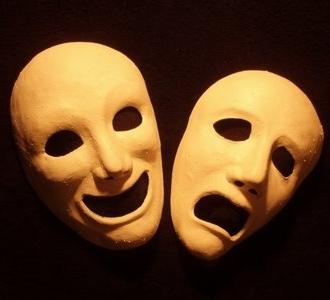
Our daily campus dramas may not be quite as colorful as those of that fun-loving Oedipus family, but they might be more interesting if we followed the Greeks' lead and wore masks suggesting emotions appropriate to our roles. But how would those masks fit over the ones we're already wearing?

Sunday, January 23, 2011

Of fire and fish

If you hear a voice sadly intoning "Magic is fading from the universe," can you guess what universe you are inhabiting? Middle Earth? Narnia? The slightly skewed version of England featured in Douglas Adams's The Long, Dark Tea-Time of the Soul?

These days you could encounter that nostalgia for fading magic just about anywhere, so it's not surprising when it turns up on page 132 of Salman Rushdie's new novel, Luka and the Fire of Life. I've gone on record (here) proclaiming my devotion to Haroun and the Sea of Stories, the 1991 novel that introduced the setting and many of the characters that reappear in Luka, so I'm sorry to report that much of the magic that so charmed me in Haroun is lacking from Luka.

Haroun and the Sea of Stories functioned admirably on two levels: as a child's adventure story and as a cautionary tale about the dangers of censorship. Published just two years after The Satanic Verses provoked the fatwa that sent Rushdie into hiding, Haroun engages readers in a crusade to protect the endangered Sea of Stories, and while the dangers feel real and urgent, the novel never loses its spirit of playfulness and joy.

Luka and the Fire of Life takes readers to another quadrant of the magical world created in Haroun and sets another child hero on a quest to save his father, his family, and his magical storytelling ability. As in Haroun, Rushdie sometimes exults in the sheer joy of language, such as in his description of the Sea of Wisdom:

Shining schools of little cannyfish could be seen below the surface, as well as the brightly colored smartipans, and the duller, deepwater shrewds. Flying low over the water's surface were the hunter birds, the large pelican-billed scholarias and the bald, bearded, long-beaked guroos. Long tendrils of the lake-floor plant called sagacity were visible waving in the depths...

Young Luka, though, drinks no great thirsty draughts from the Lake of Wisdom because he's already wise enough without it. He's far too knowing for a child, far too quick to uncover the secrets of this unknown world, and while he relies on some entertaining friends, they lack the depth of development and charm of the helper characters in Haroun.

For an inexperienced child, Luka makes an awful lot of smarty-pants speeches. For instance, facing the massed forces of all the forgotten fairies and demons and deities that ever appeared in myth or legend, he delivers a stem-winder:

Listen to me: it's only through Stories that you can get out into the Real World and have some sort of power again. When your story is well told, people believe in you; not in the way they used to believe, not in a worshiping way, but in the way people believe in stories--happily, excitedly, wishing they wouldn't end. You want Immortality? It's only my father, and people like him, who can give it to you now...

He goes on like this for half a page of uninspired prose, and remarkably, it works. I guess Magic hasn't entirely faded from the universe!

What Luka doesn't mention in this speech is that his father's storytelling ability isn't the only source of Luka's power. He has learned the topography of the World of Magic by listening to his father's stories, but navigating that world and surviving its dangers requires a different sort of skill, the kind that can only be developed by spending hours on end playing Super Mario Brothers. Yes: Luka is a gamer, and his long hours with a joystick in his hand have uniquely equipped him to save the day. I won't explain how the World of Magic and the World of Mario overlap because it's just too silly, but every time Luka piles up a few spare lives or hits the "save" button, I'm reminded that the dangers here are far less urgent and believable than those in Haroun and the Sea of Stories.

Luka and the Fire of Life has its charming moments, but I don't feel the fire that sparked in the earlier novel or see the life that swirled in that Sea of Stories. If Magic is fading from the universe, I doubt that Super Mario Brothers is going to help.

Saturday, January 22, 2011

Rebooting

Why do I get angry when students perform poorly on writing assignments? It makes no sense: they're not hurting me! My life goes on even if every student gets an F on this assignment (unlikely). So why get all bent out of shape over bad writing?

Plagiarized papers make me angry because they require tons of extra work and at some point I'm bound to be lied to. I hate being lied to.

Underachieving students make me angry. It bothers me when an intelligent student who ought to earn an easy A in my class decides he can't be bothered to turn in writing assignments. Taking the same class over and over is a waste of time and potential, and I hate the implication that the skills these assignments are designed to teach are not worth learning.

Mostly, though, I get angry when I put more effort into the student's writing than he (or she!) does. I design reading assignments, in-class exercises and online discussions to build on each other and develop the skills students need to succeed on the writing assignment, but the student won't buy the textbook, won't do the reading, and puts his head on the desk during class, and then turns in a sloppy draft and expects me to "fix" it. Why should I re-teach concepts for which the student daily betrays contempt?

But this kind of anger isn't productive. Comments I write on student drafts while angry aren't likely to improve anyone's writing. Time to take some deep breaths, think happy thoughts, walk around the house or look at birds for a change of scenery, and keep reminding myself that even the best writing can start with a sloppy first draft. Better to reboot my emotions than to give a student the boot.

Friday, January 21, 2011

The freeze that frees

One of my students wanted to cancel class so we could go out and have a snowball fight, but I pointed out that this isn't good packing snow.

"Packing snow? What's that?"

This is her first Ohio winter. I encouraged her classmates to take her out and educate her about the varieties of winter experience--but wait until after class.

I love giving students opportunities to educate each other because it creates a sense of shared inquiry, encourages students to be lifelong learners, and helps them function as a community of scholars, but this morning I was reminded of the fine line between community education and indoctrination. My American Lit Survey class examined the way Henry James's characters keep trying to "educate" Daisy Miller about the correct way to comport herself while visiting Rome and how their expectations stifle her inquiring spirit. Mrs. Walker invites Daisy into her carriage to offer knowledge of good and evil, but Daisy says, "I don't think I want to know what you mean." If she had submitted to her friends' instruction, she might have remained alive--but would she have remained Daisy?

Shared inquiry frees students to explore the world of knowledge and enrich the community's understanding, but Daisy's friends squelch questioning and move from education to indoctrination. Daisies don't thrive in that kind of environment.

But snow angels thrive in Ohio's environment. I hope my snow-deprived student will learn that important lesson from her classmates.

Wednesday, January 19, 2011

Writing replies

When a group of student writers asked Dan Chaon yesterday where he got the idea for the opening chapter in Await Your Reply, he said, "I was interested in severed hands just because they're cool."

Students were surprised to learn that the three separate narratives intertwining in Await Your Reply were not planned out in advance but just grew out of his interest in things like severed hands and Hitchcock movies. "It's important to go in not knowing what's going to happen," he said, and then "it kind of branches out fractally in a lot of directions." This leads to very messy first drafts and a lot of deleted writing, but it results in writing full of energy and amazing surprises.

"I learned a lot about cliffhangers from Lost," he explained, but his writing is also informed by a lifetime of reading. "All fiction is a kind of fan-fiction," he said. "You're writing back to the people that you love."

Now Dan Chaon is one of the people that we love. I wonder how our students will write back to him?

Monday, January 17, 2011

But what about The Deadliest Catch?

If academic searches were run like reality television:

Iron Chemist
Three contestants, three well-equipped labs, one hour, and one mystery chemical. Points deducted for blowing up the building.

Marietta Ink
Finalists demonstrate their understanding of and devotion to the college's mission by means of tattoos, with search committee members evaluating the colorful results.

Survivor: Faculty Retreat
Applicants for an academic dean's position are sequestered in a remote location where they compete in gruelling challenges--balancing the staffing needs of various departments, shoving pots of money from one remote silo to another, running the fifty-meeting dash--while trying to persuade trustees, administrators, and faculty members not to vote them off the island.

Real Housewives (and husbands) of Academia
Candidates' spouses take center stage as a camera crew follows them through their ordinary lives. Which spouse will bring the most zing to the campus social scene? Stay tuned to find out!

Profzilla
Tenure-track job offer? Happiest day of your life!--Unless the contract gets revoked before you move into your office.

The Academic Apprentice
Finalists spend a semester demonstrating their willingness to teach multiple gigantic sections of intro courses, grade piles of papers, and change the toner in the copier, all for a vague promise that there might possibly be a tenure line available at some undefined point in the future. Let's call them "Adjuncts"!

Sunday, January 16, 2011

Avoiding the easy epiphany

"In fiction classes," writes Darin Strauss in Half A Life, "you find that epiphany has a pretty high rate of occurrence. It's a story, it's tidy. At the end, the hero finds himself standing under just the right tree, reaches up without quite meaning to, and plucks down just the right fruit."

And this, I tell myself, is a flaw I find in my own writing: the temptation to reach for the easy epiphany. Strauss explains why he forced himself to resist this temptation:

But when you tell your own story honestly, that epiphany thing is rare: there is no walk, there is no fated grab. You try every fruit, or forget there even are trees, and wander from forest to forest, losing sight of the destination. The only changes are emergencies or blessings: when you wake up, notice the surroundings, then fall back, and wander more. And if you're lucky you end up walking again through a life where you're never called on to do too much noticing.

Strauss is called on to do a great deal of noticing in Half A Life, a memoir of the author's attempt to come to terms with his youthful involvement in a car accident that killed a girl--but even that sounds like a thousand epiphany-filled stories, while Strauss's story resists and interrogates cliches of the suffering survivor. Fresh metaphors cast new light on experience, such as when the young Strauss returns to his high school for the first time after the accident and becomes the chief topic of conversation in the cafeteria: "I felt like a paper cutout, poised there, being snipped into conversations at every table." Memory plays tricks; major events resolve into a muted thud or a smear on a windshield while minor details accrete more meaning as time goes on, none so much as a simple glass of iced tea. Strauss's keen eye for detail is evident when he describes the random assemblage of people lining the halls of the courthouse:

Teenage housewives and their husband-tyrants; a napper hogging the whole bench outside a courtroom; pre-divorce couples irreconciling their differences publicly; facial bruises; some lawyer yelling drill-sergeantly loud commands at his client; a professional witness checking something in his briefcase, preparing to testify for show and profit; teary faces, tattooed faces; a weeping thug and his parents against a wall; crying millionaires; one defendant poking her court-appointed attorney in the lapel....And I was here, too, however I looked to these people, holding my plastic Coca-Cola bottle--a kind of affiliation with the bright and normal world--a few inches ahead of my body, like a lantern. All these people: all of our lives were in doubt.

Doubt is the dominant emotion in the book, doubt and fear seasoned with occasional flourishes of bravado. Epiphanies are few and fragile, as they tend to be in messy life. The adolescent freshly questioning his response to tragedy is simply not equipped for epiphany:

I didn't understand that everyone's tepid emotions were reasonable. The panicky little drum that kept me going required that this event, this death, be epochal. Of course, it was that: this was an incomprehensibly sad occurrence for our school, our town. But I didn't yet know that there are some truths--that even young people die occasionally; that there's only so much gnashing of teeth and weeping over another person's tragedy--there are some truths that only come to us softened by beautiful strategems of self-deception. Nobody wants to be reminded. Nobody wants to hear the sad song again.

In Half A Life, Darin Strauss sings the sad song again in order to lay bare his own self-deception. It's a brief but pithy book, beautifully written and leading to an ending that satisfies without being neat or tidy. It's unreasonable, after all, to expect half a life to conclude neatly when the other half is still out there running riot through the orchard and flinging rotten fruit in your face.

Thursday, January 13, 2011

What I learned at school today

1. I still know how to drive a manual-transmission truck, even in a parking garage full of slopes and tight corners.

2. If the receptionist at the cancer center no longer remembers my name, that's a good sign.

3. The Law of Conservation of Curmudgeonliness on Campus is still in effect: when one curmudgeon leaves, another arises to take his place.

4. An empty office attracts students while a full office repels them. In other words, all I have to do to make a horde of people show up needing my help is to leave campus for a little while.

Wednesday, January 12, 2011

Elephants in the room

Today I asked my students to tell something interesting they'd read over break, and I heard a lot of references to Cosmo. One student read the entire Harry Potter series, and several others read books they'll be reading for classes this semester--Await Your Reply by Dan Chaon or McTeague by Frank Norris. It occurred to me that I haven't reported on my holiday reading. Not that anyone asked:

Encyclopedia of an Ordinary Life by Amy Krouse Rosenthal. The cover copy states, "I have not survived against all odds. I have not lived to tell. I have not witnessed the extraordinary. This is my story," except it isn't a story so much as a collection of fragments, most of them immediately forgettable. In fact, every time I try to talk about this book, I forget both the title and the name of the author. She's charming and clever and funny at times, such as when she juxtaposes common but confusing acronyms (NASDAQ, NASCAR, ASCAP, NAACP, NAPSTER, NASA, NETSCAPE, NESCAFE), but the book as a whole feels slight and self-indulgent.

At Home: A Short History of Private Life by Bill Bryson. It wasn't on any of my wish lists and it's not as falling-on-the-floor funny as Bryson's travel books, but this guided tour of a particular house allows the author to examine some interesting history and ideas about home. "It is always quietly thrilling to find yourself looking at a world you knew well but have never seen from such an angle before," he writes, and this book offer just such an angle into the deepest recesses of house and home. Thrilling indeed.

Wolf Hall by Hilary Mantel. I kept delaying reading this because I thought it couldn't possibly be as good as everyone says it is. It is. Six hundred pages but what a trip: a fresh and suspenseful account of Thomas Cromwell's rise to power in Henry VIII's court. The characters spring into messy life, trailing clouds of chaos behind them. Bryson's book goes into some detail about childbirth practices in Victorian homes, but Mantel takes us even further into characters' souls:

When a woman withdraws to give birth the sun may be shining but the shutters of her room are closed so she can make her own weather. She is kept in the dark so she can dream. Her dreams drift her far away, from terra firma to a marshy tract of land, to a landing stage, to a river where a mist closes over the farther bank, and earth and sky are inseparate; there she must embark toward life and death, a muffled figure in the stern directing the oars. In this vessel prayers are said that men never hear. Bargains are struck between a woman and her God. The river is tidal, and between one feather-stroke and the next, her tide may turn.

Did I mention Mantel's remarkable ear for sound and rhythm? Read that passage out loud and you'll hear the muffled oars and stifled screams.

The History of Love by Nicole Krauss, another book I've delayed reading and now I wonder why. Krauss introduces separate narratives told by characters whose lives become intertwined in unexpected ways, all orbiting around a manuscript written by a man haunted by the Holocaust. One character tries to live with his past but finds that it's like "living with an elephant. His room was tiny, and every morning he had to squeeze around the truth just to get to the bathroom. To reach the armoire to get a pair of underpants he had to crawl under the truth, praying it wouldn't choose that moment to sit on his face. At night, when he closed his eyes, he felt it looming above him."

The Holocaust also looms over The Finkler Question by Howard Jacobson, and not just because various characters keep insisting that it's time to stop obsessing about the Holocaust. The elephant in the room sits down on your face on every page of The Finkler Question as Finkler tries to figure out what it means to be a Jew in 21st-century England, along with his friends Libor and Treslove, who isn't a Jew at all but suffers a "tendency to sudden gloom" that motivates his "search for some identity that came with more inwrought despondency than he could manufacture out of his own gene pool." This Booker Prize novel combines broad social satire with finely wrought characters and a plot full of small, gentle, mundane surprises.

The Finkler Question is worth reading but I don't need both copies I received for Christmas. I will send my extra copy of The Finkler Question free of charge to the first person who posts a comment containing a brief review of a book recently read. So come on: what did you read over winter break?

Driving snow

Ask me what the roads are like this morning and I'll say, "They're pretty." While all that pristine sparkly whiteness might look quite nice, I don't even want to talk about driving conditions.

But I will say this: Good tires make a world of difference.

And this: It's comforting to know I'm ensconced in a tank-like Volvo.

And this: I don't mind taking twice as long to get to work as long as I arrive alive.

And: If any of my commuting students decide to stay home today, I won't complain.

Tuesday, January 11, 2011

And a few answers

Yes, you need the textbook for this class. If you can't buy one, try renting or borrowing. A good place to start would be the library catalog.

No, failure to procure a textbook does not excuse you from completing the homework assignment due tomorrow. This might be a good time to make friends with a classmate with some foresight.

No, I can't tell you what will be on the final exam, but I suggest that you look more closely at the part of the syllabus that states that there are no exams in this class. Can I trust you to draw the appropriate conclusion from that statement? There's a question I can't answer.

A few questions

When someone says "I don't care about pedagogy; I just care about teaching," what is that supposed to mean? And what am I supposed to say in response?

We're still using carbon paper for check requests? Seriously? Carbon paper still exists?

Is the system slow this morning or is it just me? And if it's just me, what am I supposed to do about it? Sweet-talk the server?

Monday, January 10, 2011

Out of the starting gate

A flutter of activity--coats and backpacks unzipping, pens and paper emerging--and the race is on. Too many chairs in this classroom, too many obstacles, too many opportunities for me to trip and fall. The syllabus goes zipping past on the screen, suggesting that I need more practice on our new Smartboard. I toss information out there like confetti. The students look stunned.

Why don't they laugh at my joke about the Tiddlywinks team? Have they ever heard of Tiddlywinks? I tell them my grading policy: everyone who laughs at my jokes gets an A; everyone else flunks. No one laughs. "You all just flunked."

We're done with the syllabus and now it's time to write, but what time is it, exactly? They took down the clock to install the Smartboard projector. How can I teach without a clock? "You have half an hour to write this, more or less."

They're working on writing and I'm working on how to make this classroom environment work. Practice on the Smartboard. Reconfigure the desks. Take out the extra chairs. The previous class has 28 students while this one has only 18...how can I make this environment work for both classes?

Fifteen more weeks. Deep breath. The race is on.

Sunday, January 09, 2011

Feet to the fire

The preacher held our feet to the fire this morning but somehow mine never got warm. Furnace malfunction. The temperature stayed in the single digits outside and in the mid-50s inside, but in a drafty church with cold wood floors, 55 is not warm enough.

Now it's not unusual for me to be cold in church; most winter Sunday mornings I layer up the long johns, wool socks, and multiple sweaters, and I keep an afghan on hand in the pew for added warmth. Some Sundays I don't even take off my coat in church. But today was different: today everyone kept their coats on. (Except the preacher. He never gets cold.)

Maybe if we made a habit of moving around a little more we wouldn't be so cold. This might be a good time to start waving our arms and running up and down the aisles. Would it hurt to genuflect? The exercise would get the blood flowing, and the creaking of arthritic knees would distract us from the cold.

I ought to be able to worship without warmth,. Think of the early Christians meeting in the musty catacombs! Think of medieval cathedrals with their drafts and dampness and cold stone floors! Think of worshipers huddling together in the heart of Siberia!

Or think of the time a few years ago when another church had a furnace malfunction on the day the children's choir was prepared to perform the annual Christmas program. The children had been practicing for weeks and they were bursting with excitement, but would their moms and dads and grandparents be willing to sit for an hour in an unheated sanctuary on the coldest day of the year?

The were and they did. The church was packed with worshipers sitting shoulder-to-shoulder in wool coats, hats, and gloves while the children dressed in flimsy angel and lamb costumes sang their little hearts out at the front of the church. I was so busy directing the show that I never noticed the cold, and the children seemed to produce their own heat. No one complained about cold feet.

I want to be like those children, and not just when the furnace is broken. If a congregation can't produce a little heat and light, what's the point of being there? I want to focus so much on the mission and the message that I won't even notice the temperature, but I'm clearly not there yet. Maybe my cold feet will send me to my knees. It's never too late to learn to genuflect.

Friday, January 07, 2011

Friday poetry challenge: THUNK again

The other day I wrote about the THUNK that occurred when I drove a rental car into a stone in my driveway and dislodged the front bumper (read it here), and I resolved that I would not allow such a minor incident to destroy my holiday trip. "Ignore the stone; embrace the trip," I told myself, and all week I have excelled at putting that pesky stone right out of my mind.

Today, though, I had to THUNK again: I finally learned how much that stone is going to cost me, a number too large to ignore. I'd like to sit down and cry for a while but I need to prepare for the start of classes and the faculty meeting on Monday and crying is not conducive to efficient paper-shuffling.

What I need is some distraction, and I'm counting on you to provide it: write a poem of any sort that will distract me from the distressing existence of things that go THUNK in the driveway. Make me laugh, make me smile, make me think about elephants...anything to make this annoying stone leave me alone.

Thursday, January 06, 2011

From plan to product in a single day

In one study room a psychology professor helps a French professor record a vodcast, while in a nearby study room a physics prof shows two colleagues how to create a pencast. In other rooms faculty members who teach biology, speech, education, and creative writing learn to add narration to their powerpoint presentations or post podcasts to Moodle or videotape their own teaching.

This is the reason I love my job: there's nothing more exciting than bringing together colleagues from different disciplines and setting them loose to teach and learn from each other. "Arrive with a plan and leave with a product" was the motto for an all-day workshop designed to inspire faculty members to brush up their active teaching skills and equip them to use technology to engage students in learning outside class.

We started the day with a keynote address called "Active Teaching: Transitive Verbs and Transformational Pedagogy" in which a theater professor challenged us to examine the verbs we act out inside and outside the classroom. If students think "to read" means "letting the black ink on the white page smack me in the cognition and just not stick," then we need to unpack that verb for our students and engage them with sexier verbs, like "to discover" or "to explore" or "to wrestle."

"We need to increase our verbulary," he asserted. "If you're feeling uncomfortable in front of your students, fall back on the verbs that got you where you are: to experiment, to invent, to dissect."

And then attendees dispersed to small rooms to learn a skill from a colleague or to try out an iPad or a Smartboard or classroom clickers. Getting all the volunteers lined up, the rooms reserved, and the schedule worked out was a monumental task requiring a great deal of cooperation, but many people worked together to make it happen and to cope with the inevitable glitches that arose along the way.

At the end of the day we gathered as a group once again for our Showcase of Stars, where we looked at a few of the projects my colleagues created during the day. At the beginning I asked the group, "How many of you tried something today that you've never done before?" Nearly every hand went up. I wish I had gold statuettes for all of them.

Wednesday, January 05, 2011

What I'm not blogging about today

No time to blog! But if I had time, this is what I'd blog about:

Reading: what's so great about Nicole Krauss, why Bill Bryson rocks even when he's not being very funny, what to do with my extra copy of The Finkler Question, which books didn't quite perform as promised.

Writing: how little progress I'm making on the conference paper I'm presenting next month, why I haven't gotten around to revising three different essays I ought to be sending out again, and how great it feels to finally hold in my hand a journal containing an article I wrote nearly three years ago.

Teaching: what a relief it is to have all three syllabi done, how much fun I'm having preparing for the California Literature class and trip, what neat new writing assignment I'm trying in that class, how annoyed my American Literature Survey students will be when I make them read just the three opening chapters of Dan Chaon's suspenseful novel Await Your Reply in preparation for his visit.

Everything else: why it's so much easier to un-decorate a Christmas tree, which last-minute details for tomorrow's pedagogy workshop are consuming my life, how exhausting search committees can be, why I'm not attending MLA this year, where I intend to spend the first part of my sabbatical next year.

It's a good thing I don't have time to write about all that. Writing about not writing about it has just about worn me out.

Tuesday, January 04, 2011

Side-stepping the stone

After driving 2200 miles without a hitch, I got distracted coming out of my driveway, slammed into a big stone, and dislodged the front bumper on the rental car. Typical, right? What's really typical is the fact that I keep obsessing about that one tiny incident instead of the rest of the trip.

In just over a week we drove safely through snow, sleet, ice, and high winds, visited family and old friends, heard two terrific college marching bands, watched True Grit (truly great), walked on the beach, watched birds, read some good books, visited a crazy flea market, heard my baby brother preach a terrific sermon, drove a car in which absolutely everything worked (including XM radio), and made it home without a single problem--but all I can think about is the moment when I drove the rental car (THUNK!) into a stone.

Finally I've found a New Year's Resolution: ignore the stone; embrace the trip. It's easier said than done, but the longest journey starts with a single step right past that pesky stone.

Sunday, January 02, 2011

Starry night

After seven hours on the road we arrived home in darkness so deep that we couldn't see the steps or the house key or the dog but we certainly saw the stars, zillions of 'em shining clear and bright in the night. The last two or three hours of the trip were deadly dull: no scenery visible in the darkness, no dramatic weather to make the drive interesting, and an utterly unabsorbing hockey game on the radio. Who can listen to hockey on the radio?

But the stars! I have missed the stars. Tomorrow I'll get back to work bright and early but tonight I'll end my vacation with a visit to the stars.

Saturday, January 01, 2011

Unresolved

Two years ago at this time I was at a particularly low place in a variety of ways and when the time came to formulate New Year's resolutions, all I could think of was, "I resolve to survive." That was January 2009. Within six months I would be appointed to a terrific new position, present a paper at a wonderful conference, preside over my daughter's wedding, and start coping with cancer diagnosis. It looked touch-and-go a few times, but I certainly fulfilled my resolution. On the other hand, "I survived" doesn't quite cover the events of that year.

If I made any resolutions last year, I don't remember them. Yesterday on our long drive from Florida to North Carolina we tried to come up with some resolutions, but they were all pretty lame. I kept losing the alphabet game because I had to squint to read the billboards, so I resolved to get new glasses--but I've needed new glasses for months so that's nothing special. My husband resolved to eat fewer chips and cut down on cholesterol. There's a one-size-fits-all resolution for you! How about we all just resolve to be slightly better people?

This ought to be an interesting year: I'll finish serving as Faculty Chair and see some changes at the college, and my son will graduate from his college and enter the job market. In March I'll take some students to California and a year from now I'll start my sabbatical. How can I predict what resolutions will carry me through the unknown events of the coming year? I can't see what's ahead any better than I could in 2009.

Maybe new glasses will help. Resolved: to stop squinting at roadsigns.