Friday, September 02, 2011
Curiosity and the cat
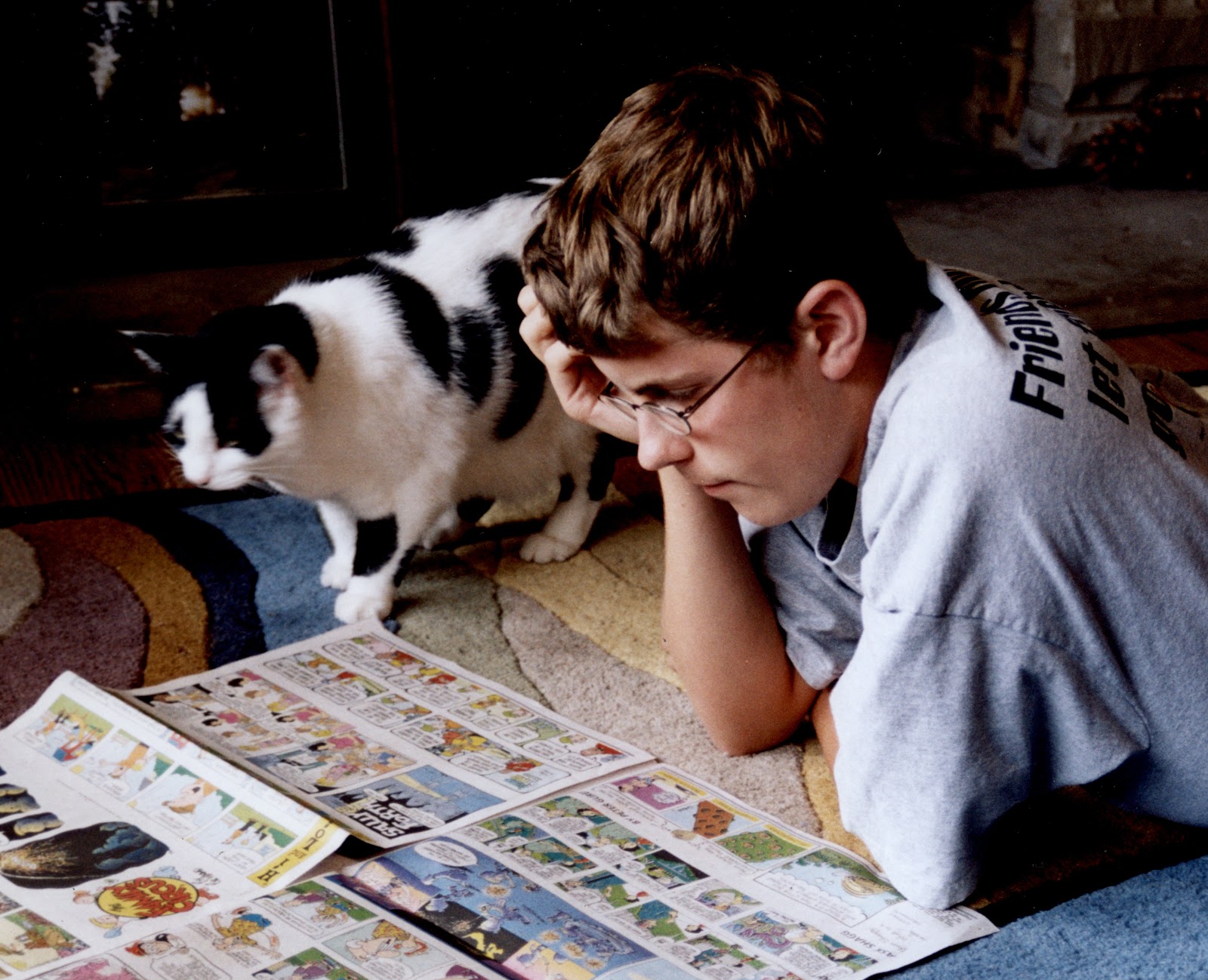
A photo on the wall at home shows my son sprawled on the floor reading the Sunday comics while the cat stands beside him looking curious.
That was back when Whiskers could see well enough to take an interest in the world around her. She used to perch by the big front window watching birds fluttering and frolicking out at the feeders, but for a while now she hasn't even noticed birds--or anything else. Somewhere along the way she got wobbly, stopped jumping up on the furniture and going down the steps.
On Monday she stopped walking altogether. For a few days my husband kept carrying Whiskers to her food dish and the litter box, and in the evenings he sat with the cat in his lap just petting and soothing her for an hour at a time. Yesterday he took her on that last lonely visit to the vet, driving with the cat in his lap because he didn't want to let her go one minute too soon.
She always preferred the men in the family, and now I think the men will miss her most. These last days have been unpleasant for all of us, so I prefer to think of Whiskers curled up beside my sleeping son as if to protect him from intruders, or standing by his side as he reads the comics. Curiosity didn't kill this cat, but when she lost her curiosity, a little something died inside all of us.
Wednesday, August 31, 2011
Warming up to teaching
Here's what we need to do: once a week all summer long we should go into a room and pace around yammering for an hour without taking a break (audience optional). That way we'll be in shape for teaching when classes start in the fall.
I don't know about anyone else but I got winded in my class today. It was a lecture-and-discussion format in a big room where I like to wander around and wave my arms a lot, and by the end I was ready to lie down. My teaching muscles get flabby in the summer!
And it didn't help that the technology was cranky. The Smartboard worked in Monday's class, but today it was totally unresponsive. Naturally this was the one day of the semester when I planned to use PowerPoint, but I couldn't advance to the next slide without walking all the way to the back of the room and then up front again. Finally a student sitting near the computer console offered to advance the slides for me; otherwise, I might have simply collapsed halfway through the show.
Teaching provides a mental and physical workout and workouts go better with warm-ups. When will we start offering Teachersize classes? Lecture-robics?
I don't know about anyone else but I got winded in my class today. It was a lecture-and-discussion format in a big room where I like to wander around and wave my arms a lot, and by the end I was ready to lie down. My teaching muscles get flabby in the summer!
And it didn't help that the technology was cranky. The Smartboard worked in Monday's class, but today it was totally unresponsive. Naturally this was the one day of the semester when I planned to use PowerPoint, but I couldn't advance to the next slide without walking all the way to the back of the room and then up front again. Finally a student sitting near the computer console offered to advance the slides for me; otherwise, I might have simply collapsed halfway through the show.
Teaching provides a mental and physical workout and workouts go better with warm-ups. When will we start offering Teachersize classes? Lecture-robics?
Tuesday, August 30, 2011
Abnormal but enjoyable
Classes started yesterday so I suppose I ought to write about my fall teaching schedule, but I'm a little embarrassed to admit it and I don't really know the right way to say this without sounding smug so I should probably just shut up about it right now before I set off a massive envy-bomb, but here goes anyway: I have a really easy schedule this fall.
Maybe it just seems easy in comparison to previous outrageous schedules: I'm not teaching an overload or a learning community, and I have no freshman classes. I'm not serving as department chair or faculty chair or participating in any search committees, which means I'm on only two committees instead of four. I am directing the center for teaching excellence, but my sabbatical starts in January so I'm unlikely to be appointed to any other major tasks.
And my teaching load is fun: only three classes, two of them quite small.
The larger class is Concepts of Nature, a sophomore-level course that attracts both English majors and students seeking General Education literature and writing credits. We'll read a variety of short stories, essays, and poems in the first half of the semester, and then we move on to A River Runs through It by Norman Maclean, Their Eyes Were Watching God by Zora Neale Hurston, and Oryx and Crake by Margaret Atwood. We start in paradise and end with Atwood's dystopian vision, stopping along the way to explore many literary portrayals of nature. Neat.
The nature theme will carry over to the senior seminar, which will focus on ecocriticism. For the past few years we've had relatively large classes of senior English majors, with a low of 8 and a high of 17. We have some large classes coming up in the next few years too, but this year is a fluke--with only five senior English majors, we'll have a nice cozy seminar with plenty of individual attention.
My third class is creative nonfiction, which I love so much I would be happy to teach it every semester. This time I'll draw on some of the techniques I tried in my summer online nature writing class to bring some new insight to a familiar course. Only seven students! That gives me a total of 37 students in writing-intensive courses instead of the more usual 60 or more.
How did I end up with such an abnormal schedule? We take turns teaching the senior seminar and my number came up; I would normally teach creative nonfiction in the spring, but I can't do that because I'll be on sabbatical. The result is a semester loaded with courses I love. I know I'm unlikely to get a schedule this good ever again, so I intend to enjoy it while I can.
Maybe it just seems easy in comparison to previous outrageous schedules: I'm not teaching an overload or a learning community, and I have no freshman classes. I'm not serving as department chair or faculty chair or participating in any search committees, which means I'm on only two committees instead of four. I am directing the center for teaching excellence, but my sabbatical starts in January so I'm unlikely to be appointed to any other major tasks.
And my teaching load is fun: only three classes, two of them quite small.
The larger class is Concepts of Nature, a sophomore-level course that attracts both English majors and students seeking General Education literature and writing credits. We'll read a variety of short stories, essays, and poems in the first half of the semester, and then we move on to A River Runs through It by Norman Maclean, Their Eyes Were Watching God by Zora Neale Hurston, and Oryx and Crake by Margaret Atwood. We start in paradise and end with Atwood's dystopian vision, stopping along the way to explore many literary portrayals of nature. Neat.
The nature theme will carry over to the senior seminar, which will focus on ecocriticism. For the past few years we've had relatively large classes of senior English majors, with a low of 8 and a high of 17. We have some large classes coming up in the next few years too, but this year is a fluke--with only five senior English majors, we'll have a nice cozy seminar with plenty of individual attention.
My third class is creative nonfiction, which I love so much I would be happy to teach it every semester. This time I'll draw on some of the techniques I tried in my summer online nature writing class to bring some new insight to a familiar course. Only seven students! That gives me a total of 37 students in writing-intensive courses instead of the more usual 60 or more.
How did I end up with such an abnormal schedule? We take turns teaching the senior seminar and my number came up; I would normally teach creative nonfiction in the spring, but I can't do that because I'll be on sabbatical. The result is a semester loaded with courses I love. I know I'm unlikely to get a schedule this good ever again, so I intend to enjoy it while I can.
Monday, August 29, 2011
But who's keeping score?
Alternately, you can complicate the simple act of stone-skipping by using a stretch of creek studded with rocky obstacles: make the stone skip on this side of the rock and then jump past it and skip some more on the other side....and then you can complicate it even more by having a dog that thinks all thrown objects need to be retrieved. Take one creek, one pile of stones, and one dog, and add people: a recipe for fun.
Friday, August 26, 2011
Friday poetry challenge: still life
Imagine tomatoes, great big red juicy ones, right here on the screen. I'd like to put a photo in front of you, but my morning got a little jumbled so that I couldn't bring together tomatoes, camera, and clean hands all at the same time, and by the time my hands were clean and dry, the tomatoes I had just picked had been whisked away to the Farmers' Market. Now I possess only the memory of the big beautiful red tomatoes I picked just after dawn this morning.
I do have the ugly ones. There's no point in taking the cracked or misshapen or not-quite-ripe tomatoes to the Market because no one will buy them, so I have plenty of those at home. We'll cook them down to make tomato sauce, for which beauty is irrelevant. Tomorrow I'll go out and pick another batch of big red beautiful tomatoes and I may even make some pose for portraits. Meanwhile, you'll have to use your imagination:
Glowing red globe stuffed
with earthy sweetness.Tomato:
edible sunshine.
Now it's your turn: if you can't take a photo, paint a picture in words, using poetry in any form.
I do have the ugly ones. There's no point in taking the cracked or misshapen or not-quite-ripe tomatoes to the Market because no one will buy them, so I have plenty of those at home. We'll cook them down to make tomato sauce, for which beauty is irrelevant. Tomorrow I'll go out and pick another batch of big red beautiful tomatoes and I may even make some pose for portraits. Meanwhile, you'll have to use your imagination:
Glowing red globe stuffed
with earthy sweetness.Tomato:
edible sunshine.
Now it's your turn: if you can't take a photo, paint a picture in words, using poetry in any form.
Thursday, August 25, 2011
Broken but not ruined
On Monday I spent some time with a group of new Chinese students who had just returned from a visit to Washington, D.C. Small groups of students showed PowerPoint presentations sharing photos from their trip and interesting things they had learned. When I asked what they had most enjoyed, most selected the obvious choices--the Lincoln Memorial, the Washington Monument, the changing of the guard at Arlington Cemetery. One chose the Newseum, and I wanted to ask whether there are still funny headlines posted inside the stalls in the ladies' room but I wasn't sure the question would make it across the language barrier.
One Chinese student really loved the National Cathedral. Unfortunately, he did not get to climb to the top of the tower. "There's a great view up there," I explained, "And if you stand still you can feel the building gently swaying."
Two days later the building was swaying more than gently, and now it will be quite some time before tourists will be allowed to climb up that tower again. The Washington Post today features a terrific slide show on damage to the Cathedral (see it here), including a shot of a fallen angel lying shattered but with a hopeful look on its face. Fallen angels in Our Nation's Capital? There's a metaphor in there somewhere.
I remember taking my children through the National Cathedral when they were small and hearing them ooh and aah over the stained-glass windows. This was before they had seen Notre Dame, Sainte Chappelle, and Salisbury, all more deeply imbued with the romance of history than our National Cathedral, but it's still an awe-inspiring place full of beauty and wonder. I was especially moved by the Space Window, which is stunning to see even if you're not a space geek looking for the moon rock ensconced within the glass.
The last time I visited the National Cathedral, I was chaperoning a group of honors students exploring D.C. We spent the afternoon touring the Holocaust Museum, a sobering experience that challenges one's faith in humanity, and then we went straight to the National Cathedral for a time of quiet contemplation. Even for those lacking any faith tradition, the beauty and majesty of the structure provided a corrective to the fear that humanity might be irreparably broken.
Now the Cathedral itself is broken, but perhaps not irreparably.
In his preface to The Marble Faun (1860), Nathaniel Hawthorne famously described the difficulty of writing romance about "a country where there is no shadow, no antiquity, no mystery, no picturesque and gloomy wrong, nor anything but a commonplace prosperity, in broad and simple daylight, as is happily the case with my dear native land....Romance and poetry, ivy, lichens, and wall-flowers, need ruin to make them grow." The earthquake provided a modicum of ruin, but will it be enough to grow some poetry?
Something tells me Hawthorne would know what to do with that fallen angel.
Wednesday, August 24, 2011
Parking, Prague, and progress
What's the best thing about having completed my term as Faculty Chair?
I'm no longer required to care.
That's what I've been telling people even though I realize it sounds a bit callous. Of course I care deeply about many opportunities and challenges facing the college, including the proliferation of the phrase opportunities and challenges as code language for problems. And of course I am willing to be part of the solution instead of part of the problem, which is code language for making a nuisance of myself to get important stuff done.
The difference is that the Faculty Chair is required to care (or pretend to care) about every pesky little nit-picky gripe and complaint that comes before Faculty Council and, moreover, has to devote a great deal of time and energy to making other people care and then figuring out the best method for solving the problem. Those of us who are not on Council and not serving as Faculty Chair, on the other hand, can make up our own minds which problems--excuse me, which opportunities and challenges--should engage our attention.
New parking policy? Don't care.
Search for new president? I care deeply, but I'm happy to trust my colleagues on the search committee to make the right choice.
Changes in travel grants for faculty members attending conferences? I'd better care--I'd like to go to Prague again in November!
See how easy? I've delegated to others the necessity of caring about two out of three issues, so instead of giving myself headaches over Parking I can devote time and energy to getting back to Prague. To me, that feels like progress.
Which reminds me: yesterday one of the new faculty members mistook the new Faculty Chair for my son. Does he really think I'm old enough to be the new Chair's mother?!! Trust me: I care. I care deeply.
I'm no longer required to care.
That's what I've been telling people even though I realize it sounds a bit callous. Of course I care deeply about many opportunities and challenges facing the college, including the proliferation of the phrase opportunities and challenges as code language for problems. And of course I am willing to be part of the solution instead of part of the problem, which is code language for making a nuisance of myself to get important stuff done.
The difference is that the Faculty Chair is required to care (or pretend to care) about every pesky little nit-picky gripe and complaint that comes before Faculty Council and, moreover, has to devote a great deal of time and energy to making other people care and then figuring out the best method for solving the problem. Those of us who are not on Council and not serving as Faculty Chair, on the other hand, can make up our own minds which problems--excuse me, which opportunities and challenges--should engage our attention.
New parking policy? Don't care.
Search for new president? I care deeply, but I'm happy to trust my colleagues on the search committee to make the right choice.
Changes in travel grants for faculty members attending conferences? I'd better care--I'd like to go to Prague again in November!
See how easy? I've delegated to others the necessity of caring about two out of three issues, so instead of giving myself headaches over Parking I can devote time and energy to getting back to Prague. To me, that feels like progress.
Which reminds me: yesterday one of the new faculty members mistook the new Faculty Chair for my son. Does he really think I'm old enough to be the new Chair's mother?!! Trust me: I care. I care deeply.
Tuesday, August 23, 2011
The 50/50 challenge
I noticed that the president, provost, and associate provost all showed up this morning at the new faculty orientation wearing orange. Orange isn't a school color and they swore that they haven't established a color-coordination hotline, but it looked a tad suspicious. Are our top administrators involved in a conspiracy to establish a new Vice President for Fabric Swatch Approval?
I wasn't sitting at the big kids' table but I was wearing orange--on my fingernails. The handout I'll distribute to the new faculty later today is orange, and it's not every day that I can coordinate my nail polish with my handouts. Given the limited number of colors available for making photocopies, I don't intend to make it a habit.
The orange nail polish is one small part of my 50/50 challenge. I'm turning 50 in a few months, see, and I have challenged myself to do 50 unexpected, unusual, or outrageous things in the next 12 months. Yes, it's kind of pathetic that wearing orange nail polish qualifies as boldly venturing in the unknown, but work with me here. I have a few ideas but nowhere near 50, so it's time for a little help from my friends: what unexpected, unusual, or outrageous things can I do in the next 12 months that will not clean out my bank account or land me in jail?
One problem: if you tell me what you expect me to do, then it will no longer be unexpected. So the only way this will work is if you suspend all expectations. So go ahead, tell me what to do--just don't expect me to actually do it.
One of these days I may just surprise you.
Saturday, August 20, 2011
The turn of the screed
Quick! Who said this: "handed on the torch needs to be...."
a. Yoda
b. John McWhorter
c. Henry James
I would have picked Yoda for sure if I hadn't seen the quote in its original context:
"Flames, however, even the most sacred, do not go on burning of themselves; they require to be kept up; handed on the torch needs to be from one group of patient and competent watchers to another."
It's true that I've just finished reading What Language Is and Our Magnificent Bastard Tongue, two rollicking books in which our magnificent John McWhorter takes us on a wild ride through the fascinating ways that languages renew themselves despite the efforts of torch-bearers to fan the sacred flame of sameness, but McWhorter's prose is much less baroque and comma-heavy than the above passage.
Which leaves Henry James, who wrote the "handed on the torch needs to be" sentence in "The Question of Our Speech," the address James delivered to the 1905 graduating class at Bryn Mawr.
Now I am a fan of Henry James. I never get tired of teaching "Daisy Miller" and Portrait of a Lady, and I have willingly read The Golden Bowl even though it was never assigned in a class, but I pity those poor Bryn Mawr grads who had to listen to many many pages of sentences like this one:
These truths, you see, are incontestable; yet though you are daughters, fortunate in many respects, of great commonwealths that have been able to render you many attentions, to surround you with most of the advantages of peace and plenty, it is none the less definite that there will have been felt to reign among you, in general, no positive mark whatever, public or private, of an effective consciousness, namely--a sign of societies truly possessed of light--that no civilized body of men and women has ever left so vital an interest to run wild, to shift, as we say, all for itself, to stumble and flounder, through mere adventure and accident, in the common dust of life, to pick up a living, in fine, by the wayside and the ditch.
Ten dollars to the first person who can correctly diagram that sentence. It's heavy going even when you have the luxury of revisiting remote sectors of the sentence, but what those eager graduates made of it as a speech act I am unable to imagine. (See? Now he's got me writing like Yoda.)
And what is he all fired up about, our Henry? Just this: Americans don't talk so good.
Well, he states it more elegantly. There are evil forces hovering about just waiting for a Bryn Mawr grad to let down her guard and commit a solecism, forces so evil that they inspire our Henry to employ (gasp!) slang (albeit apologetically):
There are in every quarter, in our social order, impunities of aggression and corruption in plenty; but there are none, I think, showing so unperturbed a face--wearing, I should slangily say, if slang were permitted me here, so impudent a 'mug'--as the forces assembled to make you believe that no form of speech is provably better than another, and that just this matter of 'care' is an affront to the majesty of sovereign ignorance.
(It's interesting that he feels no similar need to apologize for using slang later when he refers to "the American Dago." But I digress.)
James speaks passionately about the dangers of language change, beginning with a not-so-gentle scolding on the topic of proper enunciation of vowels and consonants. He abhors the schwa, the intrusive r, the excess s that slides into "somewheres else," and he will not abide the lazy "yeah." Why harp on pronunciation? "I am asking you to take it from me, as the very moral of these remarks," he writes, "that the way we say a thing, or fail to say it, fail to learn to say it, has an importance in life that it is impossible to overstate--a far-reaching importance, as the very hinge of the relation of man to man." So, um, yeah, saying "yeah" can lead to The End of the World as We Know It.
Compared to their European counterparts, says James, Americans speak in a slovenly fashion. Imagine being one of those Bryn Mawr grads, the flower of American womanhood reaching an important educational milestone, only to have the commencement speaker characterize your language as "a mere helpless slobber of disconnected vowel noises--the weakest and cheapest attempt at human expression that we shall easily encounter, I imagine, in any community pretending to the general instructed state." How many of them wished they'd smuggled a few rotten tomatoes into the ceremony?
James insists that there are "sounds of a mysterious intrinsic meanness, and there are sounds of a mysterious intrinsic frankness and sweetness." His list of intrinsically mean or slovenly words includes "Amurrica," and if I could get a recording of Henry James saying "Amurrica" just like that, I'd market it as a ringtone and make a million dollars.
Who is at fault for this slovenly and mean degradation of the English language? James minces no words in that regard: lazy people who don't pronounce things the way Henry James pronounces them bear some of the blame, as do newspapers (no standards!) and public schools (ditto!). The bulk of the blame, though, belongs to (who would have guessed it) foreigners.
Now it's a bit specious to applaud Europeans' devotion to maintaining linguistic purity and then turn around and criticize Europeans for destroying English, but that's what he does. He complains that the Dutch, the Spanish, the Norse, the Finnish, and other immigrants "play, at their heart's content, with the English language, or, in other words, dump their mountain of promiscuous material into the foundations of the American."
If John McWhorter is to be believed, such playing with language keeps language alive and growing--but Henry James will have none of it. He poses the question, wouldn't a static language be downright dull? Except he says it in his own inimitable fashion:
The question is whether it be not either no language at all, or only a very poor one, if it have not in it to respond, from its core, to the constant appeal of time, perpetually demanding new tricks, new experiments, new amusements of it: so to respond without losing its characteristic balance.
That's 53 words and seven commas, for an average of 7.5 words per comma--and again, imagine trying to unravel the multiple negations while listening to a commencement speech!
Fortunately for those Bryn Mawr grads, James offers an answer, a Call to Arms, as it were. If handed on the torch needs to be, far be it from Henry James to stand in the way of that handing on. His answer: let the language change, so long as "the conservative interest" monitors and controls that change, remaining "an embodied, constituted, inexpugnable thing." ("Thing," if I recall correctly, came to us from the Vikings. Why can't those darn furriners leave the Amurrican language alone?!)
Yes, this "conservative interest" must protect language from the depredations of change just as it protects matrimony: "Abate a jot of the quantity, and much more, of the quality, of the consecration required, and we practically find ourselves emulating the beasts, who prosper as well without a vocabulary as without a marriage-service." So there you have it: let the flower of American womanhood start saying "yeah" and "Amurrica" and the next thing you know they'll be marrying their dogs.
Okay, Henry James didn't say that--not quite. His screed isn't all that unusual for 1905 and it could easily be updated to appeal to the Lynn Truss crowd today, but to me it sounds like the anguished cry of a man desperately in need of lightening up. Promiscuously playing with language is one of life's great joys, and as it so very rarely leads to one's marrying the dog, the danger seems rather remote.
Handed on the joy needs to be! And for that task, both Yoda and John McWhorter serve much better than Henry James.
a. Yoda
b. John McWhorter
c. Henry James
I would have picked Yoda for sure if I hadn't seen the quote in its original context:
"Flames, however, even the most sacred, do not go on burning of themselves; they require to be kept up; handed on the torch needs to be from one group of patient and competent watchers to another."
It's true that I've just finished reading What Language Is and Our Magnificent Bastard Tongue, two rollicking books in which our magnificent John McWhorter takes us on a wild ride through the fascinating ways that languages renew themselves despite the efforts of torch-bearers to fan the sacred flame of sameness, but McWhorter's prose is much less baroque and comma-heavy than the above passage.
Which leaves Henry James, who wrote the "handed on the torch needs to be" sentence in "The Question of Our Speech," the address James delivered to the 1905 graduating class at Bryn Mawr.
Now I am a fan of Henry James. I never get tired of teaching "Daisy Miller" and Portrait of a Lady, and I have willingly read The Golden Bowl even though it was never assigned in a class, but I pity those poor Bryn Mawr grads who had to listen to many many pages of sentences like this one:
These truths, you see, are incontestable; yet though you are daughters, fortunate in many respects, of great commonwealths that have been able to render you many attentions, to surround you with most of the advantages of peace and plenty, it is none the less definite that there will have been felt to reign among you, in general, no positive mark whatever, public or private, of an effective consciousness, namely--a sign of societies truly possessed of light--that no civilized body of men and women has ever left so vital an interest to run wild, to shift, as we say, all for itself, to stumble and flounder, through mere adventure and accident, in the common dust of life, to pick up a living, in fine, by the wayside and the ditch.
Ten dollars to the first person who can correctly diagram that sentence. It's heavy going even when you have the luxury of revisiting remote sectors of the sentence, but what those eager graduates made of it as a speech act I am unable to imagine. (See? Now he's got me writing like Yoda.)
And what is he all fired up about, our Henry? Just this: Americans don't talk so good.
Well, he states it more elegantly. There are evil forces hovering about just waiting for a Bryn Mawr grad to let down her guard and commit a solecism, forces so evil that they inspire our Henry to employ (gasp!) slang (albeit apologetically):
There are in every quarter, in our social order, impunities of aggression and corruption in plenty; but there are none, I think, showing so unperturbed a face--wearing, I should slangily say, if slang were permitted me here, so impudent a 'mug'--as the forces assembled to make you believe that no form of speech is provably better than another, and that just this matter of 'care' is an affront to the majesty of sovereign ignorance.
(It's interesting that he feels no similar need to apologize for using slang later when he refers to "the American Dago." But I digress.)
James speaks passionately about the dangers of language change, beginning with a not-so-gentle scolding on the topic of proper enunciation of vowels and consonants. He abhors the schwa, the intrusive r, the excess s that slides into "somewheres else," and he will not abide the lazy "yeah." Why harp on pronunciation? "I am asking you to take it from me, as the very moral of these remarks," he writes, "that the way we say a thing, or fail to say it, fail to learn to say it, has an importance in life that it is impossible to overstate--a far-reaching importance, as the very hinge of the relation of man to man." So, um, yeah, saying "yeah" can lead to The End of the World as We Know It.
Compared to their European counterparts, says James, Americans speak in a slovenly fashion. Imagine being one of those Bryn Mawr grads, the flower of American womanhood reaching an important educational milestone, only to have the commencement speaker characterize your language as "a mere helpless slobber of disconnected vowel noises--the weakest and cheapest attempt at human expression that we shall easily encounter, I imagine, in any community pretending to the general instructed state." How many of them wished they'd smuggled a few rotten tomatoes into the ceremony?
James insists that there are "sounds of a mysterious intrinsic meanness, and there are sounds of a mysterious intrinsic frankness and sweetness." His list of intrinsically mean or slovenly words includes "Amurrica," and if I could get a recording of Henry James saying "Amurrica" just like that, I'd market it as a ringtone and make a million dollars.
Who is at fault for this slovenly and mean degradation of the English language? James minces no words in that regard: lazy people who don't pronounce things the way Henry James pronounces them bear some of the blame, as do newspapers (no standards!) and public schools (ditto!). The bulk of the blame, though, belongs to (who would have guessed it) foreigners.
Now it's a bit specious to applaud Europeans' devotion to maintaining linguistic purity and then turn around and criticize Europeans for destroying English, but that's what he does. He complains that the Dutch, the Spanish, the Norse, the Finnish, and other immigrants "play, at their heart's content, with the English language, or, in other words, dump their mountain of promiscuous material into the foundations of the American."
If John McWhorter is to be believed, such playing with language keeps language alive and growing--but Henry James will have none of it. He poses the question, wouldn't a static language be downright dull? Except he says it in his own inimitable fashion:
The question is whether it be not either no language at all, or only a very poor one, if it have not in it to respond, from its core, to the constant appeal of time, perpetually demanding new tricks, new experiments, new amusements of it: so to respond without losing its characteristic balance.
That's 53 words and seven commas, for an average of 7.5 words per comma--and again, imagine trying to unravel the multiple negations while listening to a commencement speech!
Fortunately for those Bryn Mawr grads, James offers an answer, a Call to Arms, as it were. If handed on the torch needs to be, far be it from Henry James to stand in the way of that handing on. His answer: let the language change, so long as "the conservative interest" monitors and controls that change, remaining "an embodied, constituted, inexpugnable thing." ("Thing," if I recall correctly, came to us from the Vikings. Why can't those darn furriners leave the Amurrican language alone?!)
Yes, this "conservative interest" must protect language from the depredations of change just as it protects matrimony: "Abate a jot of the quantity, and much more, of the quality, of the consecration required, and we practically find ourselves emulating the beasts, who prosper as well without a vocabulary as without a marriage-service." So there you have it: let the flower of American womanhood start saying "yeah" and "Amurrica" and the next thing you know they'll be marrying their dogs.
Okay, Henry James didn't say that--not quite. His screed isn't all that unusual for 1905 and it could easily be updated to appeal to the Lynn Truss crowd today, but to me it sounds like the anguished cry of a man desperately in need of lightening up. Promiscuously playing with language is one of life's great joys, and as it so very rarely leads to one's marrying the dog, the danger seems rather remote.
Handed on the joy needs to be! And for that task, both Yoda and John McWhorter serve much better than Henry James.
Friday, August 19, 2011
Adrift or empowered?
About once a week all summer long I've checked our online library catalog to see whether a certain book was available. First it hadn't arrived and then it was being processed and then, nanoseconds after it became available for checkout, someone nabbed it. Every week I've looked at that little notation in the online catalog, the one that says "Due 8-15-11," hoping that whoever borrowed it would return it before August. It is, after all, a fairly quick read, with only 144 pages of text plus an extensive methodological appendix--and if you skip the appendix, you can read it in an afternoon. But apparently the borrower is a very slow reader, because every week all summer long it kept saying "Due 8-15-11."
Finally 8-15-11 arrived, and what did I see in the online catalog? "Due 8-15-11." In fact, it still says that. So we're dealing not only with a spectacularly slow reader but with a spectacularly slow reader who can't be bothered to return a library book.
Well, phooey on that. I ordered the book via Ohiolink and read it in an afternoon, but did that make me happy? No it did not.
The book is Academically Adrift by Richard Arum and Josipa Roksa, which I suppose every academic in the country has already read and digested and commented upon (except for Mr. Exceptionally Slow Reader Who Can't Be Bothered to Return Library Books). The argument is simple: Arum and Roksa studied whether college students show improvement in certain important skills during their first two years of college, and the answer is: not really.
Of course that's a ridiculous oversimplification but one consistent with the tone and content of the book. "Three semesters of college education thus have a barely noticeable impact on students' skills in critical thinking, complex reasoning, and writing," say Arum and Roksa on page 35, and they hammer that message over and over. Their conclusions are based on a longitudinal study of students at various types of colleges and universities who took the College Learning Assessment test before starting college and again in the second semester of the sophomore year.
The study has sparked a great deal of critique since it was published last year, but Arum and Roksa counter many of those arguments within the text--and they plan to publish additional results showing how those same students fare after four years of college. Even a skeptic should sit up and take notice of statements like this one: "With a large sample of more than 2,300 students, we observe no statistically significant gains in critical thinking, complex reasoning, and writing skills for at least 45 percent of the students in our study" (Arum and Roksa 36). That's right: almost half of the students showed no significant improvement at all.
Pretty depressing.
I was more cheered when Arum and Roksa considered the "college experiences and contexts that facilitate student learning" (57). They conclude that spending more time studying improves learning (no surprise), but only if students study alone. At first glance, the alarming graph on page 101 seems to suggest that studying with friends makes students dumber. Surely I am missing something here.
Arum and Roksa examine a variety of factors but the point they emphasize over and over is that the students most likely to show improvement in critical thinking, complex reasoning, and writing are those required to read at least 40 pages per week and write at least 20 pages per semester. It's no wonder, then, that students enrolled in programs in the humanities and sciences performed better and improved more on the CLA than those in programs like business or nursing. I'm happy to teach in a program that is part of the solution instead of part of the problem.
And I'm happy that I finally had a chance to read the book everyone's been talking about, because my colleague and I have constructed a whole series of events designed to counter the idea that we must be academically adrift. Academically Empowered is this year's theme for our Center for Teaching Excellence, with various events and workshops falling under categories called Fuel Up, Tune Up, Rev Up, Pit Stop, Recharge, and Finish Line. Workshop presenters will receive a very special thank-you gift: a copy of Academically Adrift by Arum and Roksa.
So you see why I had to read the book. I may not understand all the statistics or agree with all of its conclusions, but if it gets people to talk about why we do what we do in the classroom, then we all ought to read it.
Except Mr. Exceptionally Slow Reader Who Can't Be Bothered to Return Library Books. Someone should brutally demand his library card.
Finally 8-15-11 arrived, and what did I see in the online catalog? "Due 8-15-11." In fact, it still says that. So we're dealing not only with a spectacularly slow reader but with a spectacularly slow reader who can't be bothered to return a library book.
Well, phooey on that. I ordered the book via Ohiolink and read it in an afternoon, but did that make me happy? No it did not.
The book is Academically Adrift by Richard Arum and Josipa Roksa, which I suppose every academic in the country has already read and digested and commented upon (except for Mr. Exceptionally Slow Reader Who Can't Be Bothered to Return Library Books). The argument is simple: Arum and Roksa studied whether college students show improvement in certain important skills during their first two years of college, and the answer is: not really.
Of course that's a ridiculous oversimplification but one consistent with the tone and content of the book. "Three semesters of college education thus have a barely noticeable impact on students' skills in critical thinking, complex reasoning, and writing," say Arum and Roksa on page 35, and they hammer that message over and over. Their conclusions are based on a longitudinal study of students at various types of colleges and universities who took the College Learning Assessment test before starting college and again in the second semester of the sophomore year.
The study has sparked a great deal of critique since it was published last year, but Arum and Roksa counter many of those arguments within the text--and they plan to publish additional results showing how those same students fare after four years of college. Even a skeptic should sit up and take notice of statements like this one: "With a large sample of more than 2,300 students, we observe no statistically significant gains in critical thinking, complex reasoning, and writing skills for at least 45 percent of the students in our study" (Arum and Roksa 36). That's right: almost half of the students showed no significant improvement at all.
Pretty depressing.
I was more cheered when Arum and Roksa considered the "college experiences and contexts that facilitate student learning" (57). They conclude that spending more time studying improves learning (no surprise), but only if students study alone. At first glance, the alarming graph on page 101 seems to suggest that studying with friends makes students dumber. Surely I am missing something here.
Arum and Roksa examine a variety of factors but the point they emphasize over and over is that the students most likely to show improvement in critical thinking, complex reasoning, and writing are those required to read at least 40 pages per week and write at least 20 pages per semester. It's no wonder, then, that students enrolled in programs in the humanities and sciences performed better and improved more on the CLA than those in programs like business or nursing. I'm happy to teach in a program that is part of the solution instead of part of the problem.
And I'm happy that I finally had a chance to read the book everyone's been talking about, because my colleague and I have constructed a whole series of events designed to counter the idea that we must be academically adrift. Academically Empowered is this year's theme for our Center for Teaching Excellence, with various events and workshops falling under categories called Fuel Up, Tune Up, Rev Up, Pit Stop, Recharge, and Finish Line. Workshop presenters will receive a very special thank-you gift: a copy of Academically Adrift by Arum and Roksa.
So you see why I had to read the book. I may not understand all the statistics or agree with all of its conclusions, but if it gets people to talk about why we do what we do in the classroom, then we all ought to read it.
Except Mr. Exceptionally Slow Reader Who Can't Be Bothered to Return Library Books. Someone should brutally demand his library card.
Thursday, August 18, 2011
Shallow thoughts while stuck in traffic
Traffic was backed up because of construction on my morning commute so I had plenty of time to think. I'm not claiming that I used it wisely. Frankly, it's not easy to think Serious Thoughts when drivers who want to turn left at an intersection where the left-turn lane is closed insist on turning into a grocery store parking lot and cutting across the lot to make another left on the cross-street, but they have to wait for a break in traffic to make that turn into the lot and while they're waiting they hold up traffic behind them for two or three traffic lights and there is no way for other drivers to get around these fools because there's a river on one side and a cement mixer on the other.
I have to wonder why more commuters don't just give up and drive straight into the river.
Thinking silly thoughts is a good antidote for road rage, and NPR helped out by airing a report on the history and popularity of Bananagrams. Yay bananagrams! Would that I were playing bananagrams right now instead of sitting through three traffic lights!
Or would that I had the new issue of the AWP Writer's Chronicle, a publication for writers and writing professors that, sadly, suffers from wildly inconsistent quality in writing and editing--but I digress. The current issue includes a terrific interview with poet Mark Doty, who says interesting things about what poetry is for and offers some cogent distinctions between literary genres, but I set that issue aside to bring it to campus and now I can't find it. Maybe they'd have a copy a Border's, but Border's is closing and it's depressing to go over and see all the empty shelves and I couldn't go there now if I wanted to because--in case you'd forgotten--I'm stuck in traffic.
(And while we're on the topic of inconsistent writing and editing: while searching for a previous post the other day I became painfully aware of how often I overlook clunky constructions and outright omissions of words and punctuation here, so where do I get off criticizing the Writer's Chronicle? But let's recall that this is an unedited amateur blog while the Writer's Chronicle is an edited publication written by and for professional writers and writing professors. They ought to know better.)
(And while we're being picky, why Writer's Chronicle instead of Writers'? The AWP's online discussion forum is called the Writers' Circle. So the Circle appeals to many writers while the Chronicle appeals to only one?)
A few blocks beyond the intersection is a gas station with a sign that carries the following tasty temptation: "We stock Filipino food item." I always want to ask: just one item? What happens after that one hungry customer craving that single Filipino food item comes in and buys out your stock? But apparently that hasn't happened yet because the message hangs on week after week.
School starts soon (when, exactly?) and so does the county fair. What happens when all that school and fair traffic tries to maneuver through this intersection? Time to find another route! But every morning I tell myself that I ought to take the long way around and every morning I forget to make the turn that takes me there, and then it's too late and I'm stuck in a long line of cars with the river on one side and a cement mixer on the other and up ahead, some fool holding up traffic so he can turn left when the left-turn lane is closed. In the time I spend sitting through three traffic lights, I could walk to campus.
Or swim.
Maybe it's time to start packing an inflatable raft.
I have to wonder why more commuters don't just give up and drive straight into the river.
Thinking silly thoughts is a good antidote for road rage, and NPR helped out by airing a report on the history and popularity of Bananagrams. Yay bananagrams! Would that I were playing bananagrams right now instead of sitting through three traffic lights!
Or would that I had the new issue of the AWP Writer's Chronicle, a publication for writers and writing professors that, sadly, suffers from wildly inconsistent quality in writing and editing--but I digress. The current issue includes a terrific interview with poet Mark Doty, who says interesting things about what poetry is for and offers some cogent distinctions between literary genres, but I set that issue aside to bring it to campus and now I can't find it. Maybe they'd have a copy a Border's, but Border's is closing and it's depressing to go over and see all the empty shelves and I couldn't go there now if I wanted to because--in case you'd forgotten--I'm stuck in traffic.
(And while we're on the topic of inconsistent writing and editing: while searching for a previous post the other day I became painfully aware of how often I overlook clunky constructions and outright omissions of words and punctuation here, so where do I get off criticizing the Writer's Chronicle? But let's recall that this is an unedited amateur blog while the Writer's Chronicle is an edited publication written by and for professional writers and writing professors. They ought to know better.)
(And while we're being picky, why Writer's Chronicle instead of Writers'? The AWP's online discussion forum is called the Writers' Circle. So the Circle appeals to many writers while the Chronicle appeals to only one?)
A few blocks beyond the intersection is a gas station with a sign that carries the following tasty temptation: "We stock Filipino food item." I always want to ask: just one item? What happens after that one hungry customer craving that single Filipino food item comes in and buys out your stock? But apparently that hasn't happened yet because the message hangs on week after week.
School starts soon (when, exactly?) and so does the county fair. What happens when all that school and fair traffic tries to maneuver through this intersection? Time to find another route! But every morning I tell myself that I ought to take the long way around and every morning I forget to make the turn that takes me there, and then it's too late and I'm stuck in a long line of cars with the river on one side and a cement mixer on the other and up ahead, some fool holding up traffic so he can turn left when the left-turn lane is closed. In the time I spend sitting through three traffic lights, I could walk to campus.
Or swim.
Maybe it's time to start packing an inflatable raft.
Wednesday, August 17, 2011
Reflection abstention
A little electronic sticky note on my computer desktop informs me that I have only three more miles to walk before I reach my summer goal of 150. I'm not counting casual walks across the Wal-Mark parking lot--only brisk, strenuous walks in genuine walking shoes feed into that total. By the end of June it looked as if I would easily exceed my goal before August, but then July happened. I don't want to think about July.
I don't want to go back and look at the list of summer goals I posted back in June either. I know it was an ambitious list, but most of it would have been doable if it hadn't been for July. (Here I am not thinking about July!) I reached my walking goal, taught my summer online class, kept up with the garden (mostly), submitted a proposal for an academic conference, and submitted articles to two publications, one of which was returned with lightning speed. I decided on a color for the living room but did not pick up a paintbrush or even buy paint. I kept thinking about hosting an event at my house and kept postponing it, and then July happened (again with the July thing!) and since then I've been busy.
Now I'm looking toward fall and thinking about new goals, so the sensible thing would be to reflect on my summer goals, but it would be difficult to prevent July from entering those reflections so I have decided to abstain. When the reflection becomes a distraction, it's time to draw a curtain over the mirror and move on. Briskly. In walking shoes.
I don't want to go back and look at the list of summer goals I posted back in June either. I know it was an ambitious list, but most of it would have been doable if it hadn't been for July. (Here I am not thinking about July!) I reached my walking goal, taught my summer online class, kept up with the garden (mostly), submitted a proposal for an academic conference, and submitted articles to two publications, one of which was returned with lightning speed. I decided on a color for the living room but did not pick up a paintbrush or even buy paint. I kept thinking about hosting an event at my house and kept postponing it, and then July happened (again with the July thing!) and since then I've been busy.
Now I'm looking toward fall and thinking about new goals, so the sensible thing would be to reflect on my summer goals, but it would be difficult to prevent July from entering those reflections so I have decided to abstain. When the reflection becomes a distraction, it's time to draw a curtain over the mirror and move on. Briskly. In walking shoes.
Tuesday, August 16, 2011
Doddering vampires
I have to
admire the tenacity of jewelweed: it blooms early in June and keeps blooming all summer long. This year the more impressive late-summer wildflowers are not doing well: the ironweed is short and sparse, and the Sweet Joe Pye Weed is limp and lacking in color. But the lush green jewelweed plants are still producing masses of delicate yellow or orange blossoms. I wish I could cut them and take them inside, but I made that mistake only once. Like many wildflowers, when cut, they stink.
An evening ramble around the property revealed plenty of poison ivy and massive amounts of very tall ragweed, which is ugly and invasive in addition to making my head explode. In a few places we found tiny yellow or orange vines twining around weeds; the delicate vines look almost cute at first, but eventually they form a dense orange mat that looks diseased.
Meet dodder, AKA bindweed, strangleweed, hellbine, or the Vampire Plant (according to this report). A parasitic plant that makes no chlorophyll of its own, dodder drains host plants of nutrients--and any herbicide strong enough to destroy the dodder will also kill the host plants. We have just a few patches of it at the edge of the woods, where it's twining around a stand of ragweed. Which would you root for?

An evening ramble around the property revealed plenty of poison ivy and massive amounts of very tall ragweed, which is ugly and invasive in addition to making my head explode. In a few places we found tiny yellow or orange vines twining around weeds; the delicate vines look almost cute at first, but eventually they form a dense orange mat that looks diseased.
Meet dodder, AKA bindweed, strangleweed, hellbine, or the Vampire Plant (according to this report). A parasitic plant that makes no chlorophyll of its own, dodder drains host plants of nutrients--and any herbicide strong enough to destroy the dodder will also kill the host plants. We have just a few patches of it at the edge of the woods, where it's twining around a stand of ragweed. Which would you root for?
Monday, August 15, 2011
The readiness is almost
A sure sign that summer is over: academic secretaries have returned to the building. Now the big question on everyone's lips is "Are you ready?" And the big answer is "Ready for what?"
I am ready for the first day of classes (but not the second or third). I am ready to submit my syllabi to the online syllabus depot, but the syllabus depot is not ready for me. I am ready to submit my electronic portfolio to the teaching prize judges, but nobody seems to know when the deadline is. I am ready to meet with the new faculty members and answer a whole mess of questions, and I am ready to respond to any problems my advisees might encounter.
I am not ready to adjust to a new teaching and meeting schedule. I'm not ready to remember to pack my lunch regularly, and I'm not even close to ready to dress professionally every single day. My teaching wardrobe needs a serious upgrade and I am not ready to spend the time or the money required.
I am not ready to start working out at the rec center instead of taking long morning walks in the hills with my dog. I am not ready to give evening and weekend hours to campus events, but I'm working on being ready to invite students out to my house for some nature time.
I am not ready to submit the text of a conference paper to the conference web site in mid-September; in fact, I'm barely ready to start writing the paper. I am really really not ready to distribute my fall workshop schedule to the faculty next week. I am not ready to adjust to the cut in my pay caused by the fact that I'm not teaching an overload or a learning community this fall (for the first time in I don't remember how long).
But I am ready to teach. Eager, even. And that, after all, is why I'm here.
I am ready for the first day of classes (but not the second or third). I am ready to submit my syllabi to the online syllabus depot, but the syllabus depot is not ready for me. I am ready to submit my electronic portfolio to the teaching prize judges, but nobody seems to know when the deadline is. I am ready to meet with the new faculty members and answer a whole mess of questions, and I am ready to respond to any problems my advisees might encounter.
I am not ready to adjust to a new teaching and meeting schedule. I'm not ready to remember to pack my lunch regularly, and I'm not even close to ready to dress professionally every single day. My teaching wardrobe needs a serious upgrade and I am not ready to spend the time or the money required.
I am not ready to start working out at the rec center instead of taking long morning walks in the hills with my dog. I am not ready to give evening and weekend hours to campus events, but I'm working on being ready to invite students out to my house for some nature time.
I am not ready to submit the text of a conference paper to the conference web site in mid-September; in fact, I'm barely ready to start writing the paper. I am really really not ready to distribute my fall workshop schedule to the faculty next week. I am not ready to adjust to the cut in my pay caused by the fact that I'm not teaching an overload or a learning community this fall (for the first time in I don't remember how long).
But I am ready to teach. Eager, even. And that, after all, is why I'm here.
A legacy I can live with
If you were the founder of a powerful dynasty that would survive for six centuries after your death, would you want to be remembered for your power, courage, wisdom, and might--or by your furniture?
Slate offers a slideshow featuring people whose names have become nouns, from Jules Leotard to the Jacuzzi brothers (read it here). Compare the number of people familiar with the deeds of Osman I with the number familiar with the ottoman and ask yourself: is this the legacy Osman I would have chosen?
Or imagine if the wonders of modern technology would make it possible to wake poor old Leonhart Fuchs from the dead and take him for a walk through a few garden centers during hanging-basket season. The renowned 16th-century botanist whose name is attached to a plant and a color would see every possible approximation of that name--fuschia, fushya, foosha, fewsha--except the correct one: fuchsia.
I suppose it's better to live on as a word no one can spell than to disappear without a trace, but if the world ever adopts my name as a noun, I hope it's a legacy I can live with. (Die with?)
Let a hogue be a particularly rich chocolate that confers health benefits, or a congratulatory gesture aimed at someone who has placed a Q on the triple-word score in Scrabble ("Hogues all around!"). Let women who have lost their hair to chemotherapy tie their colorful scarves in the hogue knot, or let students struggling to organize ideas into coherent essays try the hogue technique.
I don't care to be a color or an item of clothing or a chair, even a big, soft, cushy chair; I would, however, like to be spelled correctly. I realize that this may be too much to ask--if ordinary people have so much trouble spelling my name correctly while I'm alive and kicking, who will make them shape up and spell it right when I'm gone?
Well, if my legacy gets subjected to the Fuchs treatment, at least I'll be in good company.
Scoot over, Leonhart, and pass me a sandwich. There's room in this jacuzzi for all of us.
Slate offers a slideshow featuring people whose names have become nouns, from Jules Leotard to the Jacuzzi brothers (read it here). Compare the number of people familiar with the deeds of Osman I with the number familiar with the ottoman and ask yourself: is this the legacy Osman I would have chosen?
Or imagine if the wonders of modern technology would make it possible to wake poor old Leonhart Fuchs from the dead and take him for a walk through a few garden centers during hanging-basket season. The renowned 16th-century botanist whose name is attached to a plant and a color would see every possible approximation of that name--fuschia, fushya, foosha, fewsha--except the correct one: fuchsia.
I suppose it's better to live on as a word no one can spell than to disappear without a trace, but if the world ever adopts my name as a noun, I hope it's a legacy I can live with. (Die with?)
Let a hogue be a particularly rich chocolate that confers health benefits, or a congratulatory gesture aimed at someone who has placed a Q on the triple-word score in Scrabble ("Hogues all around!"). Let women who have lost their hair to chemotherapy tie their colorful scarves in the hogue knot, or let students struggling to organize ideas into coherent essays try the hogue technique.
I don't care to be a color or an item of clothing or a chair, even a big, soft, cushy chair; I would, however, like to be spelled correctly. I realize that this may be too much to ask--if ordinary people have so much trouble spelling my name correctly while I'm alive and kicking, who will make them shape up and spell it right when I'm gone?
Well, if my legacy gets subjected to the Fuchs treatment, at least I'll be in good company.
Scoot over, Leonhart, and pass me a sandwich. There's room in this jacuzzi for all of us.
Sunday, August 14, 2011
Tastes like chicken
For a few weeks now a farm store near here has had a sign out front featuring the following stack of words with no punctuation:
FLAVORED
DEER
CORN
MUCK
BOOTS
Am I the only one who wants to distribute the adjective "flavored" across the entire group of nouns?
When we hear that someone is dressed in a black hat, coat, and gloves, it's easy to interpret the adjective (black) as modifying all three of the nouns: black hat, black coat, black gloves. A similar strategy applied to the farm store's sign gives us flavored deer, flavored corn, flavored muck, flavored boots.
Eww.
Flavored deer corn and flavored muck boots?
Double eww.
Either we're suffering an unprecedented outbreak of muck-boot fetishism here in rural America or else the sign needs some serious editing.
FLAVORED
DEER
CORN
MUCK
BOOTS
Am I the only one who wants to distribute the adjective "flavored" across the entire group of nouns?
When we hear that someone is dressed in a black hat, coat, and gloves, it's easy to interpret the adjective (black) as modifying all three of the nouns: black hat, black coat, black gloves. A similar strategy applied to the farm store's sign gives us flavored deer, flavored corn, flavored muck, flavored boots.
Eww.
Flavored deer corn and flavored muck boots?
Double eww.
Either we're suffering an unprecedented outbreak of muck-boot fetishism here in rural America or else the sign needs some serious editing.
Thursday, August 11, 2011
Addicted to updates
When I cranked up my office computer this morning, it paused to install 7629 updates. Say that out loud: seven thousand six hundred twenty-nine. They must have been mini-updates because they loaded quickly, but I still can't wrap my mind around the fact that my new computer, which automatically checks for updates every day, should suddenly feel the need to install 7629 new ones. Imagine if I felt the need to ingest 7629 cupcakes first thing in the morning. Even if they were mini-cupcakes, I would end up with crumbs all over the keyboard.
So instead I drank some not-entirely-awful coffee and wondered why it is that even not-entirely-awful coffee tastes better in a ceramic cup than in paper. (And don't get me started on styrofoam--the taste and texture set my teeth on edge.) My computer sucks up updates the way I drink coffee in the morning, but even a confirmed caffeine addict would stop somewhere short of 7629 cups.
Maybe updates are sort of like cocaine for computers: once they get the taste, they just can't quit. If so, I'm not sure I'm doing my computer any good by indulging its addiction to updates. Should I shut off its supply or send it to rehab?
While we're thinking about it--here, have a cupcake.
So instead I drank some not-entirely-awful coffee and wondered why it is that even not-entirely-awful coffee tastes better in a ceramic cup than in paper. (And don't get me started on styrofoam--the taste and texture set my teeth on edge.) My computer sucks up updates the way I drink coffee in the morning, but even a confirmed caffeine addict would stop somewhere short of 7629 cups.
Maybe updates are sort of like cocaine for computers: once they get the taste, they just can't quit. If so, I'm not sure I'm doing my computer any good by indulging its addiction to updates. Should I shut off its supply or send it to rehab?
While we're thinking about it--here, have a cupcake.
Tuesday, August 09, 2011
Pedophilosophically speaking
I've been struggling to write a new teaching philosophy, which is sometimes fun but mostly not.
No, I'm not on the job market, but I've been nominated for a teaching prize and I have to include a teaching philosophy in my portfolio so an outside committee can determine whether I'm worthy.
Yes, I've written a teaching philosophy before but it's been a few years and I've learned a thing or two about teaching since then. And yes, I've even led workshops on writing an effective teaching philosophy and I frequently coach junior faculty members on writing teaching philosophies for their tenure files, so I think I know a little bit about the subject.
Knowing doesn't make writing any easier. It's not easy to put everything I believe about teaching into a mere 500 words, especially when I want those words to stand out from all the other teaching philosophies buzzing around the academosphere.
How many teaching philosophies have I read over the years? I've served on search committees attracting dozens and sometimes over a hundred applicants and their teaching philosophies, and I've read many more teaching philosophies submitted in portfolios to our tenure and promotion committee. In all that time I can't put my finger on a single memorable idea I've gleaned from reading teaching philosophies. In my mind they all resolve into a few common buzz-words: student-centered teaching, "guide on the side not sage on the stage," enhancing student engagement. If 99 percent of teaching philosophies name-check Paulo Freire, the name loses its potency and resolves into cliche.
So instead I'm relying on a different pedagogical authority: Steve Martin.
Yes, that Steve Martin--comedian, actor, and author of, among other things, Born Standing Up: A Comic's Life, from which I draw the foundational principles for my teaching philosophy. Teaching, I claim, employs the same skill set (ooh, another buzz word!) as comic improvisation: structure, collaboration, assessment, adaptation. I use brief passages from Born Standing Up to illustrate these concepts along with examples illustrating how these concepts shape my teaching.
I'm pretty pleased with the results--until the second-guessing starts up: Will the committee be annoyed by the absence of Paulo Freire? Will they take offense at my comparing teaching to comic improvisation? Will they think I'm a lightweight, a flake, an uninformed nincompoop who refuses to take pedagogy seriously?
I hope not. What I really want is to give the committee a picture of what I do in the classroom and why I do it that way, and if Steve Martin helps me make it memorable, all the better. Taking inspiration from a comedian doesn't mean I don't take pedagogy seriously; it just means I take teaching seriously enough to want to communicate pedagogical concepts in clearly, effectively, and memorably.
But that doesn't mean I intend to stand in front of the class with a fake arrow sticking through my head.
No, I'm not on the job market, but I've been nominated for a teaching prize and I have to include a teaching philosophy in my portfolio so an outside committee can determine whether I'm worthy.
Yes, I've written a teaching philosophy before but it's been a few years and I've learned a thing or two about teaching since then. And yes, I've even led workshops on writing an effective teaching philosophy and I frequently coach junior faculty members on writing teaching philosophies for their tenure files, so I think I know a little bit about the subject.
Knowing doesn't make writing any easier. It's not easy to put everything I believe about teaching into a mere 500 words, especially when I want those words to stand out from all the other teaching philosophies buzzing around the academosphere.
How many teaching philosophies have I read over the years? I've served on search committees attracting dozens and sometimes over a hundred applicants and their teaching philosophies, and I've read many more teaching philosophies submitted in portfolios to our tenure and promotion committee. In all that time I can't put my finger on a single memorable idea I've gleaned from reading teaching philosophies. In my mind they all resolve into a few common buzz-words: student-centered teaching, "guide on the side not sage on the stage," enhancing student engagement. If 99 percent of teaching philosophies name-check Paulo Freire, the name loses its potency and resolves into cliche.
So instead I'm relying on a different pedagogical authority: Steve Martin.
Yes, that Steve Martin--comedian, actor, and author of, among other things, Born Standing Up: A Comic's Life, from which I draw the foundational principles for my teaching philosophy. Teaching, I claim, employs the same skill set (ooh, another buzz word!) as comic improvisation: structure, collaboration, assessment, adaptation. I use brief passages from Born Standing Up to illustrate these concepts along with examples illustrating how these concepts shape my teaching.
I'm pretty pleased with the results--until the second-guessing starts up: Will the committee be annoyed by the absence of Paulo Freire? Will they take offense at my comparing teaching to comic improvisation? Will they think I'm a lightweight, a flake, an uninformed nincompoop who refuses to take pedagogy seriously?
I hope not. What I really want is to give the committee a picture of what I do in the classroom and why I do it that way, and if Steve Martin helps me make it memorable, all the better. Taking inspiration from a comedian doesn't mean I don't take pedagogy seriously; it just means I take teaching seriously enough to want to communicate pedagogical concepts in clearly, effectively, and memorably.
But that doesn't mean I intend to stand in front of the class with a fake arrow sticking through my head.
Monday, August 08, 2011
Academic tat
With fall matriculation quickly approaching, faculty members turn their attention to one of the burning issues of the day (if not the week, the month--yea, even the millennium): what shall we do about regalia?
Fear not--I have a plan! But first, some background:
Academic regalia costs a fortune, never fits right, and makes us look like Darth Vader (if he traded in his light saber for a few yards of colorful velvet). The Powers That Be remind us that the only way to get our money's worth out of our regalia is to wear it often, but but more use = more need for dry-cleaning. (Did you ever try to iron an academic hood? Do NOT try this at home! That way lies madness.)
The PTBs also insist that wearing regalia increases the dignity of the professoriate--except, of course, for those members of the professoriate who trip on those too-long gowns and fall on their faces in front of the Provost--and that academic regalia communicates important facts about us. Those in the know might be aware that brown and orange indicate my doctoral institution (and why oh why didn't I take a long hard look at the school colors before selecting that program?!) while blue indicates my discipline, but regalia can also send other messages, like "I store my robe in the bottom drawer of my filing cabinet during the off-season" or "I've gained a few pounds since grad school" or even "Yes, I'm aware that I look like a peacock. Want to make something of it?"
Wouldn't it be great if we could find a way to achieve these important goals without hauling around so many yards of velvet? Well, now there is:
Faculty tattoos.
Tattoos cost less than regalia and are available in a wide range of colors and motifs, from college logos to individualized designs expressing our academic identities. No one cares that my gown's blue stripe indicates that I teach in the Humanities, but a Scrabble board tattooed on my upper arm would send a clear message, especially if the tiles spell out logophile or plagiarism police.
My colleague the microbiologist could have microorganisms tattooed on the back of his hand, while the Leadership prof could have a "Follow Me" sign on his forehead. Give the broadcast prof a microphone and equip the accounting prof with a spreadsheet, but the real show-stopper will be the Old English aficionado who has the palimpsest section of Beowulf tattooed across his chest.
I for one would pay money to see that, and so, I suspect, would students, whose usual response to academic regalia is: yeah, whatever. The years of pain and suffering through which we slog on our journey to the Ph.D. will be so much more rewarding when we know that awaiting us at the end of the road is an orange-and-brown college logo discreetly tattooed on a wrist wrapped with the opening lines of "The Love Song of J. Alfred Prufrock."
Academe resists change, particularly change that undermines our discipline at its most superficial level--what we wear--but sometimes all it takes is for a few brave souls to lead the way, burst the bonds, and non the conformists. One of these days we'll reach the tipping point and look back on academic regalia with the sort of nostalgia we now reserve for dial telephones and cars without seatbelts. First, though, some of us must take the plunge.
So who's with me? Who will join that prophetic band throwing off regalia and ushering academe into the new world of faculty tattoos?
Go ahead! The rest of us will be right behind you.
Fear not--I have a plan! But first, some background:
Academic regalia costs a fortune, never fits right, and makes us look like Darth Vader (if he traded in his light saber for a few yards of colorful velvet). The Powers That Be remind us that the only way to get our money's worth out of our regalia is to wear it often, but but more use = more need for dry-cleaning. (Did you ever try to iron an academic hood? Do NOT try this at home! That way lies madness.)
The PTBs also insist that wearing regalia increases the dignity of the professoriate--except, of course, for those members of the professoriate who trip on those too-long gowns and fall on their faces in front of the Provost--and that academic regalia communicates important facts about us. Those in the know might be aware that brown and orange indicate my doctoral institution (and why oh why didn't I take a long hard look at the school colors before selecting that program?!) while blue indicates my discipline, but regalia can also send other messages, like "I store my robe in the bottom drawer of my filing cabinet during the off-season" or "I've gained a few pounds since grad school" or even "Yes, I'm aware that I look like a peacock. Want to make something of it?"
Wouldn't it be great if we could find a way to achieve these important goals without hauling around so many yards of velvet? Well, now there is:
Faculty tattoos.
Tattoos cost less than regalia and are available in a wide range of colors and motifs, from college logos to individualized designs expressing our academic identities. No one cares that my gown's blue stripe indicates that I teach in the Humanities, but a Scrabble board tattooed on my upper arm would send a clear message, especially if the tiles spell out logophile or plagiarism police.
My colleague the microbiologist could have microorganisms tattooed on the back of his hand, while the Leadership prof could have a "Follow Me" sign on his forehead. Give the broadcast prof a microphone and equip the accounting prof with a spreadsheet, but the real show-stopper will be the Old English aficionado who has the palimpsest section of Beowulf tattooed across his chest.
I for one would pay money to see that, and so, I suspect, would students, whose usual response to academic regalia is: yeah, whatever. The years of pain and suffering through which we slog on our journey to the Ph.D. will be so much more rewarding when we know that awaiting us at the end of the road is an orange-and-brown college logo discreetly tattooed on a wrist wrapped with the opening lines of "The Love Song of J. Alfred Prufrock."
Academe resists change, particularly change that undermines our discipline at its most superficial level--what we wear--but sometimes all it takes is for a few brave souls to lead the way, burst the bonds, and non the conformists. One of these days we'll reach the tipping point and look back on academic regalia with the sort of nostalgia we now reserve for dial telephones and cars without seatbelts. First, though, some of us must take the plunge.
So who's with me? Who will join that prophetic band throwing off regalia and ushering academe into the new world of faculty tattoos?
Go ahead! The rest of us will be right behind you.
Intrepid explorers
We saw cute and colorful fungi and wildflowers galore, and at one point we went around a curve and entered a pine glade so dark it felt as if someone had suddenly turned out the lights. Accompanied by hordes of tiny mosquitoes, we clambered up slopes where we had to hang on to exposed roots to keep from falling and down through a remote woods where the remains of an old mill hold precariously
I wish you could see the beautiful curves the water has worn in the rocks and hear the refreshing sound of rushing water, but you sort of have to be there. So go! It's a great park offering plenty more to explore.
Just make sure you take along an intrepid explorer who knows the way.
Thursday, August 04, 2011
Friday poetry challenge: wild ganache chase
I'm just back from a wild goose chase through the sillier realms of online Indian humor (not Native American but south Asian), for which I blame my son.
It's not his fault, really. All he did was turn 22, something that was bound to happen with or without my approval. For the past three years he has stayed in Texas summers so I've missed seeing him on his birthday, but more importantly, I have missed baking him an annual birthday cake. One year I actually persuaded a person in Texas to bake him a cake and deliver it on his birthday, but somehow the scheme fell apart and the cake never arrived.
This year, though, I was determined to make up for lost time by baking him a cake to remember.
Well, he'll remember it all right. Its flavor and texture were unforgettable: dense chocolate layers slathered with raspberry jam and rich chocolate ganache and topped with fresh raspberries--yum!
You wouldn't want to remember its appearance, though. The ganache started out a little slippery, see, so that when someone who shall remain nameless picked up the cake platter to move the cake, the top layer started to slide first in one direction and then in another and a bunch of ganache went sloping down the sides and landed in a heap. We finally managed to stabilize the construction with toothpicks, but the finished product looked like the sort of unwholesome fungus you'd find growing under damp leaves in a graveyard.
Reluctant to let this little incident fade into the dim and distant recesses of memory, I've been busting rhymes related to birthday cake, but my attempts at doggerel have been hampered by the dearth of words rhyming with "ganache." Where do you go after "panache"? Moustache? Go smash?
"Funtoosh" has the right kind of sound to describe what happened to the cake, but first I need to find out for certain what it means. I've seen it in Salman Rushdie's writing in contexts suggesting something like "kaput," but Rushdie has been known to take the Humpty-Dumpty approach to words so I've been searching online to discover a definition for "funtoosh."
Go ahead, give it a try. Dictionary.com has no record of the word, suggesting instead "fantoosh," an adjective of Scots origin meaning pretentious or ostentatious. Wikipedia informs me that Funtoosh is the title of a 1956 Bollywood film. (Clips are available on Youtube.) A site called Funtoosh.com claims to be "India's biggest jokes and fun portal," and it certainly is big. There's a whole section devoted to jokes about cricket.
Chirp, chirp.
If I were at my office surrounded by reference books and plugged in to an excellent high-speed internet connection, I would work a little harder to find the definition, but there's a limit to how long I'll click and wait and click and wait on my slow dial-up connection at home and I have reached that limit. I don't know what "funtoosh" means and, frankly, I don't care. It sounds right so I'm using it.
Ahem:
Oh gosh! Ganache
went gush and smoosh,
and with panache
plopped down. Funtoosh!
Guard your moustache
from gloppy goo!
What's this? Delish!
Ganache por vous.
Now it's your turn: cook me up some tasty rhymes or serve up some stir-fried haiku. As long as it's memorable, who cares how it looks?
It's not his fault, really. All he did was turn 22, something that was bound to happen with or without my approval. For the past three years he has stayed in Texas summers so I've missed seeing him on his birthday, but more importantly, I have missed baking him an annual birthday cake. One year I actually persuaded a person in Texas to bake him a cake and deliver it on his birthday, but somehow the scheme fell apart and the cake never arrived.
This year, though, I was determined to make up for lost time by baking him a cake to remember.
Well, he'll remember it all right. Its flavor and texture were unforgettable: dense chocolate layers slathered with raspberry jam and rich chocolate ganache and topped with fresh raspberries--yum!
You wouldn't want to remember its appearance, though. The ganache started out a little slippery, see, so that when someone who shall remain nameless picked up the cake platter to move the cake, the top layer started to slide first in one direction and then in another and a bunch of ganache went sloping down the sides and landed in a heap. We finally managed to stabilize the construction with toothpicks, but the finished product looked like the sort of unwholesome fungus you'd find growing under damp leaves in a graveyard.
Reluctant to let this little incident fade into the dim and distant recesses of memory, I've been busting rhymes related to birthday cake, but my attempts at doggerel have been hampered by the dearth of words rhyming with "ganache." Where do you go after "panache"? Moustache? Go smash?
"Funtoosh" has the right kind of sound to describe what happened to the cake, but first I need to find out for certain what it means. I've seen it in Salman Rushdie's writing in contexts suggesting something like "kaput," but Rushdie has been known to take the Humpty-Dumpty approach to words so I've been searching online to discover a definition for "funtoosh."
Go ahead, give it a try. Dictionary.com has no record of the word, suggesting instead "fantoosh," an adjective of Scots origin meaning pretentious or ostentatious. Wikipedia informs me that Funtoosh is the title of a 1956 Bollywood film. (Clips are available on Youtube.) A site called Funtoosh.com claims to be "India's biggest jokes and fun portal," and it certainly is big. There's a whole section devoted to jokes about cricket.
Chirp, chirp.
If I were at my office surrounded by reference books and plugged in to an excellent high-speed internet connection, I would work a little harder to find the definition, but there's a limit to how long I'll click and wait and click and wait on my slow dial-up connection at home and I have reached that limit. I don't know what "funtoosh" means and, frankly, I don't care. It sounds right so I'm using it.
Ahem:
Oh gosh! Ganache
went gush and smoosh,
and with panache
plopped down. Funtoosh!
Guard your moustache
from gloppy goo!
What's this? Delish!
Ganache por vous.
Now it's your turn: cook me up some tasty rhymes or serve up some stir-fried haiku. As long as it's memorable, who cares how it looks?
Odd, even
There's no special prize for turning 22 but my son likes his new age anyway. Why?
"It's a multiple of 11," he said. "Multiples of 11 are cool."
That's when I confessed my dislike of odd-numbered graduation years. Graduation years ought to be even. Odd-numbered graduation years strike me as, well, odd.
He pointed out that both he and his sister graduated in odd-numbered years.
"I know," I said, "and it made me squirm. Why couldn't you have flunked some things so you could postpone your graduation to an even-numbered year?"
I also confessed my discomfort with the current state of my walking log. At home I normally walk 3 or 6 miles so that my total number of miles is always divisible by 3, but in Florida I walked 2 or 4 miles at a time, making my current summer total 134 miles, which is not evenly divisible by 3.
This bothers me.
I keep my walking log on a small electronic sticky-note on my computer desktop so that I see it many times every day, and it annoys me every single time I see it.
I realize that this is irrational. It's the goal that matters, not the increments along the journey, but I simply don't find the number 134 as inherently satisfying as, say, 135 or even 132--which is even better because it's divisible by both 3 and 11!
Boy, wait until my son turns 132! That'll be something to celebrate!
"It's a multiple of 11," he said. "Multiples of 11 are cool."
That's when I confessed my dislike of odd-numbered graduation years. Graduation years ought to be even. Odd-numbered graduation years strike me as, well, odd.
He pointed out that both he and his sister graduated in odd-numbered years.
"I know," I said, "and it made me squirm. Why couldn't you have flunked some things so you could postpone your graduation to an even-numbered year?"
I also confessed my discomfort with the current state of my walking log. At home I normally walk 3 or 6 miles so that my total number of miles is always divisible by 3, but in Florida I walked 2 or 4 miles at a time, making my current summer total 134 miles, which is not evenly divisible by 3.
This bothers me.
I keep my walking log on a small electronic sticky-note on my computer desktop so that I see it many times every day, and it annoys me every single time I see it.
I realize that this is irrational. It's the goal that matters, not the increments along the journey, but I simply don't find the number 134 as inherently satisfying as, say, 135 or even 132--which is even better because it's divisible by both 3 and 11!
Boy, wait until my son turns 132! That'll be something to celebrate!
Wednesday, August 03, 2011
Slow-motion teaching
The pile of books dotted with scribbled sticky-notes suggests that I've been hard at work assembling syllabi for fall courses even though I'm not quite done with my summer online course. For me, it's all over but the grading; my students, on the other hand, still have their noses to the grindstone (if they know what's good for them!). Their final portfolios are due Friday, so right now I hope they're hard at work revising their essays and preparing them for submission.
It feels good knowing that my students are working harder than I am, especially since I spent so many weeks working really hard to set up the class before my students ever opened their textbooks. That's what made this online teaching experience both pleasant and rewarding: advance preparation. Because I spent the month of May writing assignments, posting resources online, and preparing narrated powerpoints, after the course opened I was able to relax and devote no more than four hours a week to reading and responding to my students' discussion posts and writing assignments. I was easily able to keep up with the work while attending to my parents' health problems in Florida.
The one drawback, though, was the uncanny sense that I was involved in a conversation running in extreme slow-motion. Last week, for instance, my students listened to a mini-lecture that I wrote and recorded two months ago, so ideas that struck them as fresh and new were already, in my mind, old and stale. It's especially disconcerting when students respond to something I can't remember having said.
Two students dropped out early when they realized that "online" is not a synonym for "easy" and others have missed occasional assignments, but the class has cohered around a core group of diligent students willing to attempt some really interesting writing and offer helpful suggestions to their classmates. After all that work putting the course together, actually running it felt like a holiday.
The holiday ends on Friday when students submit their final portfolios to the online drop-box. Reading and grading them will be the final hurdle before I can close the books on my summer course--just in time to open the books for fall.
It feels good knowing that my students are working harder than I am, especially since I spent so many weeks working really hard to set up the class before my students ever opened their textbooks. That's what made this online teaching experience both pleasant and rewarding: advance preparation. Because I spent the month of May writing assignments, posting resources online, and preparing narrated powerpoints, after the course opened I was able to relax and devote no more than four hours a week to reading and responding to my students' discussion posts and writing assignments. I was easily able to keep up with the work while attending to my parents' health problems in Florida.
The one drawback, though, was the uncanny sense that I was involved in a conversation running in extreme slow-motion. Last week, for instance, my students listened to a mini-lecture that I wrote and recorded two months ago, so ideas that struck them as fresh and new were already, in my mind, old and stale. It's especially disconcerting when students respond to something I can't remember having said.
Two students dropped out early when they realized that "online" is not a synonym for "easy" and others have missed occasional assignments, but the class has cohered around a core group of diligent students willing to attempt some really interesting writing and offer helpful suggestions to their classmates. After all that work putting the course together, actually running it felt like a holiday.
The holiday ends on Friday when students submit their final portfolios to the online drop-box. Reading and grading them will be the final hurdle before I can close the books on my summer course--just in time to open the books for fall.
Monday, August 01, 2011
For the love of okra
It's possible to divide all people into those who love okra and those who hate it, but the second group would convert if they could just taste the okra dish I made tonight. Gumbo is good and deep-fried okra is a wonderful treat as long as you don't mind all that fat, and for winter I have a terrific recipe involving barley and bacon and frozen okra--pure comfort food. But the okra recipe that can make a believer out of anyone--the recipe I think about in the spring when we plant okra and all summer as we weed and wait to harvest those first tender pods--is an okra and tomato dish sparkling with Indian spices. It's based on a recipe from New Indian Home Cooking by Madhu Gadia, with a few twists of my own.
Okra with Tomatoes
1 or 2 pounds fresh tender okra
4 tsp vegetable oil or olive oil
1/2 tsp cumin seeds
1 medium onion, thinly sliced
1 green chili pepper, chopped
2 large ripe tomatoes, peeled, seeded, and chopped
1/2 tsp turmeric
1 tsp salt
1 tablespoon ground coriander
1/2 tsp cayenne pepper
2 tsp fennel seeds, coarsely ground
Wash the okra and pat dry. Remove stem ends. Slice each okra longways. Set aside.
Heat oil in large heavy skillet or stockpot. Add cumin seeds and fry until golden brown, a few seconds. Add onion and chili pepper and fry until soft. Add remaining ingredients and stir until vegetables are coated with seasoning. Cover tightly, reduce heat, and simmer until okra is tender, about 10 minutes, stirring occasionally.
I served this tonight alongside rice, a lovely sunshiny spicy yellow dal, and chicken, but it sits well alongside potatoes or pasta or fish. The flavors make my lips sing and my tastebuds do their happy dance.
I'd like to teach the world to sing that song and do that dance. Okra-haters of the world, dig in! It's time to come into the light.
Okra with Tomatoes
1 or 2 pounds fresh tender okra
4 tsp vegetable oil or olive oil
1/2 tsp cumin seeds
1 medium onion, thinly sliced
1 green chili pepper, chopped
2 large ripe tomatoes, peeled, seeded, and chopped
1/2 tsp turmeric
1 tsp salt
1 tablespoon ground coriander
1/2 tsp cayenne pepper
2 tsp fennel seeds, coarsely ground
Wash the okra and pat dry. Remove stem ends. Slice each okra longways. Set aside.
Heat oil in large heavy skillet or stockpot. Add cumin seeds and fry until golden brown, a few seconds. Add onion and chili pepper and fry until soft. Add remaining ingredients and stir until vegetables are coated with seasoning. Cover tightly, reduce heat, and simmer until okra is tender, about 10 minutes, stirring occasionally.
I served this tonight alongside rice, a lovely sunshiny spicy yellow dal, and chicken, but it sits well alongside potatoes or pasta or fish. The flavors make my lips sing and my tastebuds do their happy dance.
I'd like to teach the world to sing that song and do that dance. Okra-haters of the world, dig in! It's time to come into the light.
Getting cranky
Saturday, July 30, 2011
The SOSO dance
I set out on my walk early this morning with a swarm of worries buzzing around my head like mosquitoes ranging in size from mammoth (What if my mom doesn't get well enough to go home from rehab, or what if she gets well enough to go home but isn't able to respond appropriately if my dad has another stroke?) to middling (What if my car breaks down again or my health insurance won't cover this h0nking big bill?) to minuscule (Mice in my car: gone for good or merely hiding?). Two hours later I returned with an entirely different set of worries buzzing around my mind and a brilliant plan for solving the debt-ceiling stalemate.
Let's start at the beginning: oppressive heat and humidity have shortened my walks this week, but last night a heavy rain cooled things down considerably so that this morning I was determined to walk the full six-mile loop. Fog still clung to the creek and clouds hid the sun when I left the house, so I didn't bother wearing a hat, which was my first mistake, unless you think that getting out of bed this morning was my first mistake, which is certainly a defensible position.
I climbed the twisty road up the hill through the foggy woods, wishing for gills to help me breathe the moist, drippy air. I was about two miles into my walk on the top of the ridge when the clouds suddenly parted and the sun broke through, walloping me on the head like a whale falling from the sky. I should have interpreted this as a portent: Go back! No good can come from following this mad course! But I ignored it and pressed on, and soon the clouds returned and provided some relief from the oppressive heat, although I kept wishing I could trade in my puny water bottle for a tanker truck full of water and a very long straw.
I had just reached the halfway point when my bum hip went "click." Now I've heard that click before and I know what it portends: pain, discomfort, and difficulty walking. If I change my gait to lessen the hip pain, my knees starts screaming. I can't quite believe that I've reached the age when I can whine tediously and at great length about my aching joints, but out there in the middle of nowhere there was no one to hear me whine so why bother?
Halfway through the route--nothing to do but to keep walking. I did some stretches in the middle of the road and then hobbled down the hill (step, ouch, step, ouch, step, ouch), worrying about maintaining my footing on the steep gravel slope until I finally reached level ground near the creek.
Where mosquitoes live. By the millions. Hungry mosquitoes looking for a meal--me!
And then I went around the curve by a cornfield and the horseflies found me.
And then the thunder started.
It didnt' take me long to perfect a new dance step: Step (Ouch) Slap (Ouch) Swat (Ouch) Sweat (Ouch) Step (Ouch)--repeat enough times and it'll take you home in a hurry. Mission accomplished! There's nothing like a little mind-numbing pain to motivate superhuman speed.
Which brings me to the current debt-ceiling crisis. Here's my proposal: take all our elected officials and strand them in the middle a hot, humid, pest-ridden swamp; take away their cell phones, give them each a single water bottle, and tell them they can't go back to their cushy offices until they work out a solution. A few rounds of the Step (Ouch) Slap (Ouch) Swat (Ouch) Sweat (Ouch) Step (Ouch) Dance are bound to motivate some progress.
Let's start at the beginning: oppressive heat and humidity have shortened my walks this week, but last night a heavy rain cooled things down considerably so that this morning I was determined to walk the full six-mile loop. Fog still clung to the creek and clouds hid the sun when I left the house, so I didn't bother wearing a hat, which was my first mistake, unless you think that getting out of bed this morning was my first mistake, which is certainly a defensible position.
I climbed the twisty road up the hill through the foggy woods, wishing for gills to help me breathe the moist, drippy air. I was about two miles into my walk on the top of the ridge when the clouds suddenly parted and the sun broke through, walloping me on the head like a whale falling from the sky. I should have interpreted this as a portent: Go back! No good can come from following this mad course! But I ignored it and pressed on, and soon the clouds returned and provided some relief from the oppressive heat, although I kept wishing I could trade in my puny water bottle for a tanker truck full of water and a very long straw.
I had just reached the halfway point when my bum hip went "click." Now I've heard that click before and I know what it portends: pain, discomfort, and difficulty walking. If I change my gait to lessen the hip pain, my knees starts screaming. I can't quite believe that I've reached the age when I can whine tediously and at great length about my aching joints, but out there in the middle of nowhere there was no one to hear me whine so why bother?
Halfway through the route--nothing to do but to keep walking. I did some stretches in the middle of the road and then hobbled down the hill (step, ouch, step, ouch, step, ouch), worrying about maintaining my footing on the steep gravel slope until I finally reached level ground near the creek.
Where mosquitoes live. By the millions. Hungry mosquitoes looking for a meal--me!
And then I went around the curve by a cornfield and the horseflies found me.
And then the thunder started.
It didnt' take me long to perfect a new dance step: Step (Ouch) Slap (Ouch) Swat (Ouch) Sweat (Ouch) Step (Ouch)--repeat enough times and it'll take you home in a hurry. Mission accomplished! There's nothing like a little mind-numbing pain to motivate superhuman speed.
Which brings me to the current debt-ceiling crisis. Here's my proposal: take all our elected officials and strand them in the middle a hot, humid, pest-ridden swamp; take away their cell phones, give them each a single water bottle, and tell them they can't go back to their cushy offices until they work out a solution. A few rounds of the Step (Ouch) Slap (Ouch) Swat (Ouch) Sweat (Ouch) Step (Ouch) Dance are bound to motivate some progress.
Thursday, July 28, 2011
Memory what?
In Memory Wall, Anthony Doerr's new collection of short stories, memory is a collage of sticky notes, a consolation, a treasure map or torture chamber, even a commodity. In the title story, memories are mined from failing minds and sold to provide solace to the despairing, while in the stunningly beautiful "Village 113," memories are submerged like seeds beneath the floods of change.
In these stories, a woman tries to preserve the memory of her village while another tries to forget the pain of the Holocaust; a couple struggles to remember their passion and a child tries to forget her pain by fishing in forgotten rivers.
The one false note in this collection arises in "The River Nemunas," in which the first-person narrator claims to be fifteen years old but speaks and thinks like a much younger child. The child characters in "Afterworld" are more believable, even those who are never allowed to grow up. Esther's seizures send her on silent nightmare journeys: "Soot rains from the sky. Every doorway she passes is crammed with dirty, silent people. They sip gray broth or squat on their heels or study the lines of their hands. Crows flap from gutters. Leaves fly along the streets and die and rise into the air once more."
It's astonishing that a story so suffused with suffering and death should rise in the end toward joy: "Every hour, Robert thinks, all over the globe, an infinite number of memories disappear, whole glowing atlases dragged into graves. But during that same hour children are moving about, surveying territory that seems to them entirely new. They push back the darkness; they scatter memories behind them like bread crumbs. The world is remade."
Something similar happens in the title story, "Memory Wall," in which a woman's bitter memories of her marriage propel a teen to scatter memories like breadcrumbs while seeking to recover a forgotten fossil. Uncovering the past requires skill, patience, fortitude, and a little luck, but the result brings hope.
"Memory Wall" also features a sci-fi gadget that harvests memories from the elderly and records them on disks that can be bought, sold, and traded, allowing others to enter into a stranger's remembered experiences. Doerr's collection of stories functions in much the same way, inviting readers into the richly realized lives of strangers. These memories, though, won't disappear as long as there are readers to open the book.
In these stories, a woman tries to preserve the memory of her village while another tries to forget the pain of the Holocaust; a couple struggles to remember their passion and a child tries to forget her pain by fishing in forgotten rivers.
The one false note in this collection arises in "The River Nemunas," in which the first-person narrator claims to be fifteen years old but speaks and thinks like a much younger child. The child characters in "Afterworld" are more believable, even those who are never allowed to grow up. Esther's seizures send her on silent nightmare journeys: "Soot rains from the sky. Every doorway she passes is crammed with dirty, silent people. They sip gray broth or squat on their heels or study the lines of their hands. Crows flap from gutters. Leaves fly along the streets and die and rise into the air once more."
It's astonishing that a story so suffused with suffering and death should rise in the end toward joy: "Every hour, Robert thinks, all over the globe, an infinite number of memories disappear, whole glowing atlases dragged into graves. But during that same hour children are moving about, surveying territory that seems to them entirely new. They push back the darkness; they scatter memories behind them like bread crumbs. The world is remade."
Something similar happens in the title story, "Memory Wall," in which a woman's bitter memories of her marriage propel a teen to scatter memories like breadcrumbs while seeking to recover a forgotten fossil. Uncovering the past requires skill, patience, fortitude, and a little luck, but the result brings hope.
"Memory Wall" also features a sci-fi gadget that harvests memories from the elderly and records them on disks that can be bought, sold, and traded, allowing others to enter into a stranger's remembered experiences. Doerr's collection of stories functions in much the same way, inviting readers into the richly realized lives of strangers. These memories, though, won't disappear as long as there are readers to open the book.
Tuesday, July 26, 2011
Skulking or supping?
The Cornell Ornithology Lab's online bird guide
describes the Common Yellowthroat as a "skulking masked warbler of wet thickets" that says "wich-i-ty, wich-i-ty, wich-i-ty." I didn't hear any witchity sounds and I don't recall ever seeing this bird before, but on the wing he's easily mistaken for a goldfinch, of which we have bazillions. The Common Yellowthroat's calling card is that distinctive black mask, which goes so well with the word "skulking," although he didn't appear to me to be skulking. He appeared to be snapping at insects and swallowing them for supper.
Monday, July 25, 2011
The Imperfectionists
In the middle of Tom Rachman's novel The Imperfectionists, Kathleen Solson, the editor in chief of a struggling international newspaper, speaks at a media conference in Rome. Asked whether the newspaper industry can survive the wired era, she responds with familiar assurances: "news will survive, and quality coverage will always earn a premium. Whatever you want to call it--news, text, content--someone has to report it, someone has to write it, someone has to edit it. And I intend for us to do it better, no matter the medium."
I could have written that statement--and in fact, I wrote something very similar in my ninth-grade career report, explaining why the then-distant threat of personalized news content delivered via computer would never drive journalists out of existence. The difference between my youthful self and Kathleen Solson is that I believed those assurances, while she's stuck in a fictional world in which traditional journalism is failing hopelessly.
But not humorlessly. The Imperfectionists is a very funny book that tells the bittersweet story of the life and death of a newspaper through the perspectives of a variety of characters, most of them richly complex and believable: a raw intern gets steamrollered by a manipulative veteran correspondent; a self-centered accountant gets a rude awakening; a grammar-nazi prig shows his warm human side.
The force uniting all these interconnected vignettes, though, is the newspaper itself. Rachman evokes the gritty day-to-day realities of print journalism in a way that will charm those whose understanding of journalism derives entirely from cable news shows, but the book will resonate even more deeply with anyone drilled in the finer points of headline-counting.
Not since Annie Proulx's The Shipping News (1993) has a novel played so delightfully with the fine art of headline-writing. In that book, Quoyle the inept newsman sees "the commonplaces of life as newspaper headlines. Man Walks Across Parking Lot at Moderate Pace. Women Talk of Rain. Phone Rings in Empty Room." And later:
"Man Dies of Broken Heart."
"Car Disintegrates on Remote Goatpath."
"Stupid Man Does Wrong Thing Once More."
Quoyle himself strikes another character as "a huge roll of newsprint form the pulp mill. Blank and speckled with imperfections." The characters in The Imperfectionists are similarly speckled, but the story written on them and through them will survive long after the final newspaper rots in the landfill.
I could have written that statement--and in fact, I wrote something very similar in my ninth-grade career report, explaining why the then-distant threat of personalized news content delivered via computer would never drive journalists out of existence. The difference between my youthful self and Kathleen Solson is that I believed those assurances, while she's stuck in a fictional world in which traditional journalism is failing hopelessly.
But not humorlessly. The Imperfectionists is a very funny book that tells the bittersweet story of the life and death of a newspaper through the perspectives of a variety of characters, most of them richly complex and believable: a raw intern gets steamrollered by a manipulative veteran correspondent; a self-centered accountant gets a rude awakening; a grammar-nazi prig shows his warm human side.
The force uniting all these interconnected vignettes, though, is the newspaper itself. Rachman evokes the gritty day-to-day realities of print journalism in a way that will charm those whose understanding of journalism derives entirely from cable news shows, but the book will resonate even more deeply with anyone drilled in the finer points of headline-counting.
Not since Annie Proulx's The Shipping News (1993) has a novel played so delightfully with the fine art of headline-writing. In that book, Quoyle the inept newsman sees "the commonplaces of life as newspaper headlines. Man Walks Across Parking Lot at Moderate Pace. Women Talk of Rain. Phone Rings in Empty Room." And later:
"Man Dies of Broken Heart."
"Car Disintegrates on Remote Goatpath."
"Stupid Man Does Wrong Thing Once More."
Quoyle himself strikes another character as "a huge roll of newsprint form the pulp mill. Blank and speckled with imperfections." The characters in The Imperfectionists are similarly speckled, but the story written on them and through them will survive long after the final newspaper rots in the landfill.
Saturday, July 23, 2011
Heads up!
The physical therapist was watching my father stand and sit and walk so she could suggest improvements in form (and I wonder how much of her job involves trying to teach old dogs new tricks). "I notice that you walk with your shoulders slumped and your head down," she said, and Dad explained that he's always worried about tripping over something. The therapist ticked off the ways this posture could make his life miserable--shoulder pain, back pain, neck pain, headaches--and I realized: I do that. I walk with my shoulders slumped and my head down as if on the lookout for a gaping chasm that might suddenly open up in front of my feet. It's hard to take the long view when you're constantly looking into the chasm.
So this morning on my walk I resolved to walk with my shoulders back and my head up, which was particularly difficult when I was walking up a steep hill on gravel. (In Florida all my walks were on flat, smoothly paved sidewalks, which resulted in knee pain and blisters. Apparently my body is so accustomed to walking in deplorable conditions that it considers the smooth path an insult.)
I walked up the steep hill through the woods with my head up and when I reached the ridge on top my head was still up so that the first thing I saw when I got out of the woods was lightning striking in the distance and black clouds rolling my way. You don't want to be walking on the highest ridge in the area when the lightning bolts start to fly, so I moved off the ridge and hustled on home with thunder urging me on my way.
We need the rain and I made it home without getting blisters or being struck by lightning or falling into any gaping chasms--and I kept my head up. Some days that's about as good as it gets.
So this morning on my walk I resolved to walk with my shoulders back and my head up, which was particularly difficult when I was walking up a steep hill on gravel. (In Florida all my walks were on flat, smoothly paved sidewalks, which resulted in knee pain and blisters. Apparently my body is so accustomed to walking in deplorable conditions that it considers the smooth path an insult.)
I walked up the steep hill through the woods with my head up and when I reached the ridge on top my head was still up so that the first thing I saw when I got out of the woods was lightning striking in the distance and black clouds rolling my way. You don't want to be walking on the highest ridge in the area when the lightning bolts start to fly, so I moved off the ridge and hustled on home with thunder urging me on my way.
We need the rain and I made it home without getting blisters or being struck by lightning or falling into any gaping chasms--and I kept my head up. Some days that's about as good as it gets.
Wednesday, July 20, 2011
In the uneasy chair
Here I am at the Orlando airport (no sign of Casey Anthony!) where an adorable little blond girl who looks about three years old is begging to be taken to Starbucks. We're surrounded by gift stores touting Disney toys and Sea World t-shirts and Space Center hats but all this toddler wants is a trip to Starbucks. Orlando: a whole different world.
Or maybe it's just Airportland that's different--Atlanta, Minneapolis, Dallas, Milwaukee, or wherever big airplanes gather to ingest and spit out passengers. In John Henry Days, Colson Whitehead's much-traveled protagonist calls the international airport environment Terminal City, as if travel were an incurable disease.
Not many people are capable of being at ease in an airport. I see parents trying to reign in the exuberance of children who've had a few too many days of constant Disneyfication, and to my left a large section of seating is bubbling with teens in yellow t-shirts touting a soccer team. In the center of the concourse two guys are tossing a football back and forth and trying to avoid trampling travelers who lead luggage by a leash. No one sits still except one old guy snoozing in his chair, drool dribbling down his chin, his neck assuming an angle suggesting an urgent need for chiropractic care.
Scheduling conflicts brought me to the airport three hours before my flight, but as airports go, Orlando is not a bad place to spend a few hours. I have a book and the Atlantic's summer fiction issue and the airport offers excellent free wi-fi. I briefly considered getting a haircut while I'm waiting, but do I really want to be confined to an airplane seat while little bits of hair slide down the middle of my back? That would be one uneasy chair.
So instead I'll sit and watch and take my ease in Terminal City. I'll open my book and jump into some fictional world until the restless airport life resolves into a persistent low hum, Terminal City's version of the music of the spheres.
Or maybe it's just Airportland that's different--Atlanta, Minneapolis, Dallas, Milwaukee, or wherever big airplanes gather to ingest and spit out passengers. In John Henry Days, Colson Whitehead's much-traveled protagonist calls the international airport environment Terminal City, as if travel were an incurable disease.
Not many people are capable of being at ease in an airport. I see parents trying to reign in the exuberance of children who've had a few too many days of constant Disneyfication, and to my left a large section of seating is bubbling with teens in yellow t-shirts touting a soccer team. In the center of the concourse two guys are tossing a football back and forth and trying to avoid trampling travelers who lead luggage by a leash. No one sits still except one old guy snoozing in his chair, drool dribbling down his chin, his neck assuming an angle suggesting an urgent need for chiropractic care.
Scheduling conflicts brought me to the airport three hours before my flight, but as airports go, Orlando is not a bad place to spend a few hours. I have a book and the Atlantic's summer fiction issue and the airport offers excellent free wi-fi. I briefly considered getting a haircut while I'm waiting, but do I really want to be confined to an airplane seat while little bits of hair slide down the middle of my back? That would be one uneasy chair.
So instead I'll sit and watch and take my ease in Terminal City. I'll open my book and jump into some fictional world until the restless airport life resolves into a persistent low hum, Terminal City's version of the music of the spheres.
Monday, July 18, 2011
A call in the night
At 6 a.m. in my parents' neighborhood, the moon hangs like a spotlight above the oaks and the gentle ssssp-ssssp of automatic sprinklers is the only sound that breaks the morning silence. A man jogs past with four dogs on leashes--no, five--and then another man pedals past wearing a bike helmet topped with flashing red lights. "Where's the emergency?" I want to ask, but instead I turn away from traffic and toward a quieter neighborhood near a lake. My internal map is out of date here I spend some time going in circles on brick streets where tiny granny houses sit side-by-side with McMansions of the Rich and (maybe) Famous. Finally I find the lake and step back onto Genius Drive.
This is the point where we used to get off our bikes and push them through heavy sand through an orange grove. We would carry a bag of stale bread to toss toward the peacocks that wandered among the trees or perched on branches sending out their piercing call.
In 1972 when my father preceded the family to Florida, he rented a house in a quiet neighborhood but kept being awakened in the middle of the night by what sounded like a woman calling for help. A few times he got up in the night and went out to the yard trying to pinpoint the direction of the call, and he kept expecting to see news reports about murder and mayhem invading the area. Finally, a neighbor filled him in on the source of the calls: peacocks in the orange groves on the other side of the lake.
I heard that distinctive "Help!" again today but didn't see any peacocks--or any orange groves either. The old dirt road is paved now and lined with fresh new ostentatious houses all looking as if they were squeezed out of the same McMansion factory. It's a great place to walk and even though I didn't see any peacocks, I did spot a blue heron soaring over the lake. On the way back I walked past our first home in Florida, the house where my dad first heard the peacocks. It's orange. It wasn't a particularly attractive house when it was green, but now it's simply hideous.
Orange house but no orange groves: I can see why people would want to live in such a lovely place, but the heat is oppressive and walking on hard pavement gives me blisters. I feel selfish for wanting so badly to get back to Ohio, but I need my gravel roads and my hills and my dog and my birds and my blackberries. Today we'll help my mom celebrate her 75th birthday in the rehab center and tomorrow I'll pack my bag. It was a call for help that brought me to Florida and when I'm back in Ohio, I'll be constantly alert for that distinctive call that can pierce the night and reach across the miles: "Help!"
Only one of these times it won't be peacocks.
This is the point where we used to get off our bikes and push them through heavy sand through an orange grove. We would carry a bag of stale bread to toss toward the peacocks that wandered among the trees or perched on branches sending out their piercing call.
In 1972 when my father preceded the family to Florida, he rented a house in a quiet neighborhood but kept being awakened in the middle of the night by what sounded like a woman calling for help. A few times he got up in the night and went out to the yard trying to pinpoint the direction of the call, and he kept expecting to see news reports about murder and mayhem invading the area. Finally, a neighbor filled him in on the source of the calls: peacocks in the orange groves on the other side of the lake.
I heard that distinctive "Help!" again today but didn't see any peacocks--or any orange groves either. The old dirt road is paved now and lined with fresh new ostentatious houses all looking as if they were squeezed out of the same McMansion factory. It's a great place to walk and even though I didn't see any peacocks, I did spot a blue heron soaring over the lake. On the way back I walked past our first home in Florida, the house where my dad first heard the peacocks. It's orange. It wasn't a particularly attractive house when it was green, but now it's simply hideous.
Orange house but no orange groves: I can see why people would want to live in such a lovely place, but the heat is oppressive and walking on hard pavement gives me blisters. I feel selfish for wanting so badly to get back to Ohio, but I need my gravel roads and my hills and my dog and my birds and my blackberries. Today we'll help my mom celebrate her 75th birthday in the rehab center and tomorrow I'll pack my bag. It was a call for help that brought me to Florida and when I'm back in Ohio, I'll be constantly alert for that distinctive call that can pierce the night and reach across the miles: "Help!"
Only one of these times it won't be peacocks.
Sunday, July 17, 2011
I dunno
My mom is in rehab. My husband is in Ohio. My son is in Idaho. Together, they're in Ohidaho or Idahio. Add Mom to the mix and they're all three in Rehabohidaho.
My dad is in the living room dozing off in front of a television with the volume turned up so loud I'm sure they can hear it in Idohiohab.
(I keep writing "Idago." I'da gone a few days ago but I'm a-going back to Ohio on Wednesday.)
I'm in Florida. Bored in Florida: Borida. Floored.
Flabbergasterfloriboridastardusterutterlyexhausted.
Is there an auto-pilot for this thing? Because I need a nap.
My dad is in the living room dozing off in front of a television with the volume turned up so loud I'm sure they can hear it in Idohiohab.
(I keep writing "Idago." I'da gone a few days ago but I'm a-going back to Ohio on Wednesday.)
I'm in Florida. Bored in Florida: Borida. Floored.
Flabbergasterfloriboridastardusterutterlyexhausted.
Is there an auto-pilot for this thing? Because I need a nap.
Thursday, July 14, 2011
Hot and cold
If I stay in Florida much longer, I'll need to buy a hat--and a sweater. It's stinking hot here but I've been spending too much time shivering inside Mom's rehab facility and Dad's church, and when I go out for a walk, the sun gets in my eyes.
No walk for the past two days because we've had too many places to be and too much rain, but this morning I was determined to walk until I could see a lake--not just slivers of lake between houses, but open water. It took me twenty minutes walking on pleasant shady streets to get to a stretch of lake with reeds and boathouses in the foreground and cypress trees in the distance. I passed plenty of old pale people walking big dogs and young dark people mowing lawns and trimming bushes, but I didn't see any middle-aged mottled people like me.
Then I turned a corner onto a busy main road and found my people in the stream of rush-hour traffic. There they are, going to work to earn a living so they can pay for the lawn care and the dogfood and the retirement plan. I'm the one who's out of place, wandering aimlessly on a weekday morning.
I walked only a block on that busy road but it was all sunshine all the time so I soon started to wilt. Where are all my hats? Back home in Ohio, of course, along with my sweaters. I need to either go shopping or go home.
No walk for the past two days because we've had too many places to be and too much rain, but this morning I was determined to walk until I could see a lake--not just slivers of lake between houses, but open water. It took me twenty minutes walking on pleasant shady streets to get to a stretch of lake with reeds and boathouses in the foreground and cypress trees in the distance. I passed plenty of old pale people walking big dogs and young dark people mowing lawns and trimming bushes, but I didn't see any middle-aged mottled people like me.
Then I turned a corner onto a busy main road and found my people in the stream of rush-hour traffic. There they are, going to work to earn a living so they can pay for the lawn care and the dogfood and the retirement plan. I'm the one who's out of place, wandering aimlessly on a weekday morning.
I walked only a block on that busy road but it was all sunshine all the time so I soon started to wilt. Where are all my hats? Back home in Ohio, of course, along with my sweaters. I need to either go shopping or go home.
Wednesday, July 13, 2011
Brain-squeeze
What I really want to do this morning is go down to my berry patch and pick blackberries, a little difficult since my blackberry patch is in Ohio and I'm in Florida and my arms don't stretch that far. I wish I had a remote control device that would allow me to wake up my Ohio family and send them down to the blackberry patch to pick berries, and while they're at it they could check on the zucchini and pick some lettuce and radishes too, but I don't have a device like that and I don't know where to get one.
I text my son reminders to pull the buds off my basil plants. Has anyone mowed the front yard, cleaned the bathrooms, swept the floors? Who's taking Hopeful for long walks?
E-mails remind me of work awaiting back on campus. I'm keeping up with my summer online class pretty well but I'm having trouble focusing on other projects. Between taking my Dad to doctors' appointments and making sure my Mom is getting the care she needs, I can't seem to find time to think, and when I try to think, my brain feels squeezed.
Maybe it's time to stop thinking for a while. Stop thinking about blackberries and lettuce and basil buds and bathrooms and mowing. Just stop.
Yes: a little mental vacation. Just what the doctor ordered.
I text my son reminders to pull the buds off my basil plants. Has anyone mowed the front yard, cleaned the bathrooms, swept the floors? Who's taking Hopeful for long walks?
E-mails remind me of work awaiting back on campus. I'm keeping up with my summer online class pretty well but I'm having trouble focusing on other projects. Between taking my Dad to doctors' appointments and making sure my Mom is getting the care she needs, I can't seem to find time to think, and when I try to think, my brain feels squeezed.
Maybe it's time to stop thinking for a while. Stop thinking about blackberries and lettuce and basil buds and bathrooms and mowing. Just stop.
Yes: a little mental vacation. Just what the doctor ordered.
Tuesday, July 12, 2011
Diagnosis: tedium
How many hospital-themed television dramas have I watched over the years? From Marcus Welby, M.D., to E.R., House, and Gray's Anatomy, I'll bet I've seen thousands of episodes, but I never saw one that came close to the sort of hospital drama I've experienced this week: waiting followed by nothing much going on followed by more waiting. You've never seen a hospital drama called Waiting Room, have you? And for good reason! Nothing much happens, and it takes an awful lot longer than 50 minutes to happen in.
House gives you intriguing puzzles and Gray's Anatomy gives you romance, but they tend to leave out the pure unadulterated tedium of the average hospital visit. Boring boring boring boring. I never before realized just how exhausting it can be to sit around in chairs all day long waiting for something to happen, which usually turns out to be nothing much after all.
They lie, those television hospital dramas. Lie lie lie lie. And after four days of enduring the genuine tedium of hospital life, I'm good for nothing except lying down. All that boredom wears me out.
House gives you intriguing puzzles and Gray's Anatomy gives you romance, but they tend to leave out the pure unadulterated tedium of the average hospital visit. Boring boring boring boring. I never before realized just how exhausting it can be to sit around in chairs all day long waiting for something to happen, which usually turns out to be nothing much after all.
They lie, those television hospital dramas. Lie lie lie lie. And after four days of enduring the genuine tedium of hospital life, I'm good for nothing except lying down. All that boredom wears me out.
Monday, July 11, 2011
Exit, pursued by zamboni
I was sitting in my mother's hospital room this morning trying to keep track of all the medical personnel moving through when I heard what sounded like a train going by out in the corridor. Great, I thought, now I'm imagining things too--except it wasn't a hallucination. Out in the hall a guy was riding past on a floor-waxer the size of a zamboni.
I'm fine with zambonis at the hospital as long as they stay in the corridor. We needed a traffic cop this morning to keep the steady stream of people moving: nurses and students nurses and physical therapists a dietician and a cardiologist and a nephrologist and a case manager and a visitor and the cleaning staff and the person who brings in the meals I don't remember who else paid a visit. Everything was better today, all vital signs and tests and mobility and alertness and every measure of health, so if all goes well tonight, she'll be moved tomorrow to a rehab facility so she can build up her strength and (eventually) come home.
Best of all, my Mom is back. "I don't know where I've been," she says, but we're thrilled to see that she seems to be returning.
I'm fine with zambonis at the hospital as long as they stay in the corridor. We needed a traffic cop this morning to keep the steady stream of people moving: nurses and students nurses and physical therapists a dietician and a cardiologist and a nephrologist and a case manager and a visitor and the cleaning staff and the person who brings in the meals I don't remember who else paid a visit. Everything was better today, all vital signs and tests and mobility and alertness and every measure of health, so if all goes well tonight, she'll be moved tomorrow to a rehab facility so she can build up her strength and (eventually) come home.
Best of all, my Mom is back. "I don't know where I've been," she says, but we're thrilled to see that she seems to be returning.
Sunday, July 10, 2011
Who's driving this train?
My mother has always been a tiny person and in the hospital bed she looks shrunken, but when she gets the notion to move, you'd better not stand in her way. She wants to be up and out of here but she's not quite sure where here is and she's certainly not capable of getting anywhere on her own, so they're keeping her in gentle restraints.
She used to come home from her hospital shifts and talk about how she had to move a big stubborn patient around or climb up on top of another patient so she could thump on his chest when his heart stopped, and now she's the one being moved around and poked and prodded--and refusing to listen to the nurses.
She asks about things she's lost--her shoes, her purse--and wants to make sure she doesn't lose any more. "Let's just keep everyone together," she says. "We don't want to lose track of the kids."
"Where is the Gray Goose?" she asks, and I ask her who the Gray Goose might be. "Your son the pilot," she says. "He's the Gray Goose."
"I never took the time to figure out what I wanted to do," she says, but in her alternate reality she's doing some amazing things. "I tried deep-sea diving," she said, "but I didn't take to it."
And later: "Who but me would stand here trying to direct this train?"
And when someone calls on the phone, she speaks coherently but can't quite figure out how to sign off. "Happy....happy....happy goodbye!" she says, and she seems delighted.
Other times she is less delighted. I hate to see her so confused and confined and unable to cope with the way her body and mind are betraying her, so it's a relief to see her smiling and laughing.
But you'd better not stand in the middle of the tracks when she's trying to direct the train.
She used to come home from her hospital shifts and talk about how she had to move a big stubborn patient around or climb up on top of another patient so she could thump on his chest when his heart stopped, and now she's the one being moved around and poked and prodded--and refusing to listen to the nurses.
She asks about things she's lost--her shoes, her purse--and wants to make sure she doesn't lose any more. "Let's just keep everyone together," she says. "We don't want to lose track of the kids."
"Where is the Gray Goose?" she asks, and I ask her who the Gray Goose might be. "Your son the pilot," she says. "He's the Gray Goose."
"I never took the time to figure out what I wanted to do," she says, but in her alternate reality she's doing some amazing things. "I tried deep-sea diving," she said, "but I didn't take to it."
And later: "Who but me would stand here trying to direct this train?"
And when someone calls on the phone, she speaks coherently but can't quite figure out how to sign off. "Happy....happy....happy goodbye!" she says, and she seems delighted.
Other times she is less delighted. I hate to see her so confused and confined and unable to cope with the way her body and mind are betraying her, so it's a relief to see her smiling and laughing.
But you'd better not stand in the middle of the tracks when she's trying to direct the train.
Saturday, July 09, 2011
Can't go home again (again)
Last night's walk shared one element with my usual summer walks back in Ohio: the heat. I need to remember to take water with me if I'm going to sweat that much.
I walked on roads just as twisty as the ones back home in Ohio, except in Florida I'm not walking on gravel or climbing steep hills and I don't have Hopeful with me to share the fun. I saw live oak instead of sycamore and crepe myrtle instead of milkweed, and I saw more cars in a block than I normally see in three miles. No deer, wild turkeys, groundhogs, or foxes here; just lots of people walking interesting dogs.
I walked along a street where I used to sell Girl Scout cookies door to door and I passed houses where I washed windows to earn money for a trip with my church youth group. I didn't see a soul I knew, but I haven't lived here since about 1980 so that's hardly surprising. A house up the block from my parents still bears the name of my seventh-grade English teacher. I wonder whether she'd remember me?
I once carried within me a flawless map of the neighborhood, but now the roads blend together. I turned a corner and suddenly found the football field where I played flute in the marching band (until I quit the band to join the school newspaper, instantly improving the quality of both institutions). With streets named Loch Lomond, Dunblane, and St. Andrews and a school named Glendridge (where the school colors were Stewart plaid), it's a wonder that we didn't have bagpipes in the marching band.
There are no hills here but I made a point of walking as close as I could get to the nearest lake, although I caught only a few glimpses of water between the houses. New streets and new developments have risen from the orange groves, and one of these days I'll explore them. It doesn't feel quite like home, but it's comfortable and for now I suppose it'll do.
I walked on roads just as twisty as the ones back home in Ohio, except in Florida I'm not walking on gravel or climbing steep hills and I don't have Hopeful with me to share the fun. I saw live oak instead of sycamore and crepe myrtle instead of milkweed, and I saw more cars in a block than I normally see in three miles. No deer, wild turkeys, groundhogs, or foxes here; just lots of people walking interesting dogs.
I walked along a street where I used to sell Girl Scout cookies door to door and I passed houses where I washed windows to earn money for a trip with my church youth group. I didn't see a soul I knew, but I haven't lived here since about 1980 so that's hardly surprising. A house up the block from my parents still bears the name of my seventh-grade English teacher. I wonder whether she'd remember me?
I once carried within me a flawless map of the neighborhood, but now the roads blend together. I turned a corner and suddenly found the football field where I played flute in the marching band (until I quit the band to join the school newspaper, instantly improving the quality of both institutions). With streets named Loch Lomond, Dunblane, and St. Andrews and a school named Glendridge (where the school colors were Stewart plaid), it's a wonder that we didn't have bagpipes in the marching band.
There are no hills here but I made a point of walking as close as I could get to the nearest lake, although I caught only a few glimpses of water between the houses. New streets and new developments have risen from the orange groves, and one of these days I'll explore them. It doesn't feel quite like home, but it's comfortable and for now I suppose it'll do.
Friday, July 08, 2011
Ultramysterious
This morning when I arrived in Orlando, an old friend picked me up at the airport and our conversation veered between our parents' health problems and our children's life choices. We're accustomed to acting as daughters and mothers so it's disorienting to be called on to mother our mothers.
When I entered my mother's hospital room, I got an inside look at her beating heart. It didn't look much like a heart to me, but the cardiology dude running the portable ultrasound machine assured me that the black-and-white blurry swirl of lub-dub, lub-dub was indeed my mother's heart. Beating.
Who can explain the mystery of a mother's heart? During our visit she often seemed quite lucid, expressing pride in her children and grandchildren and reminding my dad to take his potassium supplements, wrap a gift for a friend from church, and put some bills in the mail. But then suddenly she would swerve into an alternate universe. "I dreamed that they buried me," she said. "Don't let them bury me."
We won't, I promise, as long as that strong mother's heart keeps beating.
Wednesday, July 06, 2011
Green light to go!
I was sitting in my Volvo at an intersection this afternoon when I noticed that the light had changed--to red. Wait a minute: if the light just changed to red, what color has it been all this time?
Apparently my brain has left for Florida without me. I'm flying to Orlando early Friday to take over from my brother, who has been helping my parents cope with their health problems this week, but the brain has already left the building. I need to be there--to see for myself, to make myself useful, to lift some burdens. I don't know exactly what I'll find but I know it's time to go.
I'm suddenly reminded of the Grand Prix Raceway ride at Disney World, that little theme park just down the road from my parents' house, a place where I spent an inordinate amount of time during my teen years. You'd stand in that long winding line, the Florida sun beating down and sweat mingling with sunscreen pouring down your face, and finally arrive at the entry point, where you'd settle into the tiny race car and await those magic mechanical words: "Green light to go!" The ride itself was about as exciting as a few laps around the lawn on a riding mower, but those words seemed to promise entry into a world of speed and exaltation.
Today I'm in the long twisty line, standing and sweating and waiting to get moving. Will this journey be more like a thrill ride or a few laps around the lawn? All I know for now is that I've got a green light and I'm ready to go.
Apparently my brain has left for Florida without me. I'm flying to Orlando early Friday to take over from my brother, who has been helping my parents cope with their health problems this week, but the brain has already left the building. I need to be there--to see for myself, to make myself useful, to lift some burdens. I don't know exactly what I'll find but I know it's time to go.
I'm suddenly reminded of the Grand Prix Raceway ride at Disney World, that little theme park just down the road from my parents' house, a place where I spent an inordinate amount of time during my teen years. You'd stand in that long winding line, the Florida sun beating down and sweat mingling with sunscreen pouring down your face, and finally arrive at the entry point, where you'd settle into the tiny race car and await those magic mechanical words: "Green light to go!" The ride itself was about as exciting as a few laps around the lawn on a riding mower, but those words seemed to promise entry into a world of speed and exaltation.
Today I'm in the long twisty line, standing and sweating and waiting to get moving. Will this journey be more like a thrill ride or a few laps around the lawn? All I know for now is that I've got a green light and I'm ready to go.
Tuesday, July 05, 2011
Lost it in the sun
It was a beautiful day for baseball and fireworks and stadium hotdogs with mustard, even though we were sitting with the sun shining directly in our faces in seat so high up that we had to wear blinking lights on our backs to warn away airplanes approaching Cleveland Hopkins airport, and it's always a good day when the Indians beat the Yankees, especially when I can witness the event in the company of my adorable offspring and extended family, so yesterday was great, even if we did have to drive back late last night after the game so I could get up early this morning and get spiffed up for the memorial service for my colleague who died Saturday.
So I already had mixed feeling but even so I wouldn't have enjoyed the game so much if I'd known what I would find in the four messages on my telephone answering machine when we arrived home at 2:30 this morning:
1. That my mother had been admitted to the hospital Monday morning.
2. That when my father told me Sunday that everything was "fine," he meant "fine" in the sense of "not fine."
3. That it may be a few days before we know what's wrong with my mom, and meanwhile Dad is still recovering from his recent stroke and surgery and needs some help.
So it looks like I need to go to Florida. My brother will be there today and will let me know what I can do and when. It feels wrong to have enjoyed a baseball game while people I care about were suffering and needing help, but it's hard to know what to do when the sun gets in my eyes.
So I already had mixed feeling but even so I wouldn't have enjoyed the game so much if I'd known what I would find in the four messages on my telephone answering machine when we arrived home at 2:30 this morning:
1. That my mother had been admitted to the hospital Monday morning.
2. That when my father told me Sunday that everything was "fine," he meant "fine" in the sense of "not fine."
3. That it may be a few days before we know what's wrong with my mom, and meanwhile Dad is still recovering from his recent stroke and surgery and needs some help.
So it looks like I need to go to Florida. My brother will be there today and will let me know what I can do and when. It feels wrong to have enjoyed a baseball game while people I care about were suffering and needing help, but it's hard to know what to do when the sun gets in my eyes.
Monday, July 04, 2011
Fireworks and a lost friend
I thought I saw spiders and peonies falling from the sky last night, and according to Slate's guide to identifying fireworks, I was right: different varieties of the rockets' red glare are properly called spiders, peonies, fish, willows, chrysanthemums.
We joined 11,000 people gathered on a hillside at the Blossom Music Center to hear the Cleveland Symphony play Gershwin and Bernstein and Ives and Sousa (Stars and Stripes Forever, of course) and Duke Ellington and Scott Joplin and, for a finale, The 1812 Overture accompanied by cannons. We heard at least a dozen different languages being spoken and saw people of every (star and) stripe--women with scarf-covered heads or flesh-baring sundresses, young boys in skullcaps or glowsticks, people of all ages wearing every possible variety of red-white-and-blue attire--but when the fireworks started, every head turned toward the sky and every face smiled.
My colleague Mike would have liked that moment. He was a champion smiler who often induced smiles in others, counseling distraught students through their angst and moving them closer to happiness and peace, and he never stopped working to promote greater acceptance of diversity on campus. He would have loved to see such a variety of people coming together on a lovely July evening to celebrate freedom.
But he died in a motorcycle accident Saturday, leaving behind a wife and child and a grieving campus. Tomorrow at the memorial service we will trade fireworks for tears, but last night the fireworks made me think of Mike Harding and appreciate what he tried to accomplish:
All those people.
All those colors.
All those smiles.
We joined 11,000 people gathered on a hillside at the Blossom Music Center to hear the Cleveland Symphony play Gershwin and Bernstein and Ives and Sousa (Stars and Stripes Forever, of course) and Duke Ellington and Scott Joplin and, for a finale, The 1812 Overture accompanied by cannons. We heard at least a dozen different languages being spoken and saw people of every (star and) stripe--women with scarf-covered heads or flesh-baring sundresses, young boys in skullcaps or glowsticks, people of all ages wearing every possible variety of red-white-and-blue attire--but when the fireworks started, every head turned toward the sky and every face smiled.
My colleague Mike would have liked that moment. He was a champion smiler who often induced smiles in others, counseling distraught students through their angst and moving them closer to happiness and peace, and he never stopped working to promote greater acceptance of diversity on campus. He would have loved to see such a variety of people coming together on a lovely July evening to celebrate freedom.
But he died in a motorcycle accident Saturday, leaving behind a wife and child and a grieving campus. Tomorrow at the memorial service we will trade fireworks for tears, but last night the fireworks made me think of Mike Harding and appreciate what he tried to accomplish:
All those people.
All those colors.
All those smiles.
Friday, July 01, 2011
Friday poetry challenge: unfinished business
Yesterday I wrote about that delicious feeling of accomplishment provided by mowing the meadow, the same feeling I get when I check a big project off my to-do list. I'm reminded, though, that the activities I value the most are never really done. I'll never be done reading as long as books keep being published and I'll never be done teaching as long as ignorance remains a renewable resource, and when it comes to enjoying my family, there's really no imaginable end-point.
The ubiquity of unfinished business became clear to me earlier this week. I was trying to think of a way to commemorate the fact that I've survived two years since my cancer diagnosis, and I asked my husband what I ought to do.
"Keep surviving," he said.
Now there's a plan!
Another plan is to write poetry celebrating unfinished business:
Write a line (insert paren-
theses); delete, revise,
replace, rewrite
a line (delete paren-
theses); add comma,--
no! a dash (insert paren-
theses); replace a verb,
a noun, (delete paren-
theses); full stop? (insert
parentheses).
Now it's your turn: if you can't put a fork in it and call it done, then turn it into poetry.
The ubiquity of unfinished business became clear to me earlier this week. I was trying to think of a way to commemorate the fact that I've survived two years since my cancer diagnosis, and I asked my husband what I ought to do.
"Keep surviving," he said.
Now there's a plan!
Another plan is to write poetry celebrating unfinished business:
Write a line (insert paren-
theses); delete, revise,
replace, rewrite
a line (delete paren-
theses); add comma,--
no! a dash (insert paren-
theses); replace a verb,
a noun, (delete paren-
theses); full stop? (insert
parentheses).
Now it's your turn: if you can't put a fork in it and call it done, then turn it into poetry.
Subscribe to:
Posts (Atom)
