The custodian knocked quietly on the door and whispered, "Do you want to see my babies?"
That's not a solicitation I hear every day, particularly from a person beyond childbearing age, but I moved closer to see what she was hiding under her hoodie: a pair of tiny fuzzy squirrels.
"They were lying on the ground under the tree just outside the door," she said, "And I didn't want to leave them out there because of the hawk."
(We have a hawk living on campus, or perhaps a pair; they can be both entertaining and educational, particularly when they're demonstrating the physics of predation, with small birds or woodland creatures acting as prey. I don't believe they've cleared their activities with the experimental review board.)
The squirrels were clinging to her shirt, their eyes shut tight and their fur quivering. "I think they need to be fed," said the custodian.
"We have some leftover egg rolls in the department fridge," I said, but she said no, they need mother's milk. I pointed out that I'm a little lacking in that department and she said, "I don't believe I can nurse them myself, but don't you think I hid my pregnancy well?"
We laughed, but that did not remove the problem of two baby squirrels cuddled under her coat. I suggested that she take the squirrels down to biology and see if any of our scientific colleagues had any suggestions.
"But won't they dissect them?"
I don't recall seeing squirrel-dissecting on the biology curriculum, but you never know.
"They probably
need to be fed every three or four hours, and I can't do that," she explained. "Wouldn't
you like to take care of them? You could smuggle them into class
under your shirt."
Tempting as that offer might seem, I rejected it and moved on. Not long after, though, the custodian returned to let me know she'd reunited the baby squirrels with their mama, or with an adult squirrel who seemed willing to act as surrogate. "Sad to see them go," said the custodian. "We sort of bonded."
Right. But if she ever comes to my office bearing bouncing baby skunks, I'm slamming the door shut.
Thursday, April 03, 2014

Wednesday, April 02, 2014
Now where did I hide those pom-poms?
This time of year I find myself obsessively performing a little private dance that's part pep rally, part prayer: eight or ten or fifty times a day I click on the link to the fall course schedules to see how many students have registered for courses in my department. I cheer on the class that's close to the goal--come on, just a few more, you can do it! And I utter silent prayers for rising numbers in some others, knowing that low enrollments may result in cancellation.
I'm an equal-opportunity cheerleader, although I may put a little more energy into my pleas for upper-level literature courses. I want that little 5 to turn to a 6 or 7 or 8 even if it's not my course, because if any of our upper-level courses get cancelled, our students will have trouble completing the English major. We're responding to the budget crisis by running an extremely lean slate of courses, but it really can't get any leaner without endangering the viability of the major.
And so I sit in my office trying to focus on preparing tomorrow's classes but I keep stopping to click on that link to see whether the numbers have changed. Six students? Let's push that to 8 or 10! Do I hear 12? Sold!
Registration only started on Monday so we have plenty of time, or so I keep telling myself. Still, I look at those upper-level literature classes and I suspect no first-year students are likely to enroll, so that just leaves the sophomores to boost the numbers. I'm counting on the sophomore class. Don't fail me now, sophomores! Sign up for a literature class today!
Please don't make me put on that little cheerleader skirt.
I'm an equal-opportunity cheerleader, although I may put a little more energy into my pleas for upper-level literature courses. I want that little 5 to turn to a 6 or 7 or 8 even if it's not my course, because if any of our upper-level courses get cancelled, our students will have trouble completing the English major. We're responding to the budget crisis by running an extremely lean slate of courses, but it really can't get any leaner without endangering the viability of the major.
And so I sit in my office trying to focus on preparing tomorrow's classes but I keep stopping to click on that link to see whether the numbers have changed. Six students? Let's push that to 8 or 10! Do I hear 12? Sold!
Registration only started on Monday so we have plenty of time, or so I keep telling myself. Still, I look at those upper-level literature classes and I suspect no first-year students are likely to enroll, so that just leaves the sophomores to boost the numbers. I'm counting on the sophomore class. Don't fail me now, sophomores! Sign up for a literature class today!
Please don't make me put on that little cheerleader skirt.
Tuesday, April 01, 2014
No foolishness here. Nothing to see at all.
 |
| Ada: The Board Game |
Followed, of course, by "April Fool!"
There's not much fooling around in Charles Frazier's Cold Mountain, but we concluded our discussion of the novel today by mapping out the main characters' internal journeys. Group drawing projects tend toward chaos, but despite the livelier-than-usual classroom hijinks, the groups produced maps that highlighted character development by pinpointing moments motivating change. One group even mapped out a board game to suggest the two-steps-forward,-one-step-back nature of character development.
And then later my Creative Nonfiction class may have looked a little foolish to anyone not in on the joke. We're reading about the unwritten rules underlying the rituals common to any strong family or cultural group, so we played a role-playing game designed to bring these unwritten rules into conflict with one another. Each student drew a slip of paper briefly outlining a particular role and set of rules: you're a hungry child who wants to be fed but cannot speak; you're a police officer looking for a miscreant, so question everyone; you're the only one aware that the dam has burst and the flood threatens the entire community, so make everyone leave, and so on. Once we all understood our roles and rules, I set the class loose to see what happened (within the confines of the classroom, of course).
Afterward we wrote about what we'd learned: the voiceless were marginalized; the only person who got what she really wanted was the little old lady who was polite and helpful to everyone; if the flood had been real, we all would have died; and the police officer, the journalist, and the doomsayer got stuck in an infinite loop of questions without answers that could have continued indefinitely if I hadn't put a stop to it.
Which I am allowed to do in my role as teacher. Just following the rules here. No fooling at all.
Monday, March 31, 2014
Bury me not in the old Harley
When I die (not that I'm planning to do it anytime soon), please don't put me in a coffin covered with money or shaped like a duck (see them here) and don't bury me atop a Harley-Davidson (here) or any other vehicle, no matter how beloved. Don't put me in a pine box either--I'm too claustrophobic for boxes. I prefer to be cremated and have my ashes spread where trilliums grow, and if someone will read Wendell Berry's poem "The Peace of Wild Things," I'll be happy.
I'm thinking of this now because of two recent essays my Creative Nonfiction class discussed: "The Washing" by Reshma Memon Yaqub and "Building a Funeral" by Joni Tevis. Tevis offers a backstage look at the funeral industry, from the banal cliches of pre-need sales pitches to the varieties of gravestone gewgaws. She ends with a plea to whoever eventually plans her funeral: "Do what you can and hope that when your time comes, someone will do the same for you and for those who stand around the hole in the ground, looking in."
A similar appeal lies at the heart of Yaqub's "The Washing" (read it here), an account of one woman's experience of ritually washing a stranger's body before burial. In the end, the dead woman's body is wrapped in cotton until it resembles "a wrapped gift," but Yaqub makes it clear that the gift of community is born out of a group of hands working together silently in respect for both body and soul.
One hand washing another: this image is evoked beautifully in "The Undertaking," in which poet/undertaker Thomas Lynch portrays the beauty of communal connections in funeral practices but also keeps repeating the refrain "The dead don't care." And it's true: the funeral is for the survivors, not the carcass, so if someone slips up and forgets to sprinkle me on the trilliums, I won't be demanding a refund.
But if you put plastic flowers on my grave, I swear I'll find a way to come back and haunt you!
I'm thinking of this now because of two recent essays my Creative Nonfiction class discussed: "The Washing" by Reshma Memon Yaqub and "Building a Funeral" by Joni Tevis. Tevis offers a backstage look at the funeral industry, from the banal cliches of pre-need sales pitches to the varieties of gravestone gewgaws. She ends with a plea to whoever eventually plans her funeral: "Do what you can and hope that when your time comes, someone will do the same for you and for those who stand around the hole in the ground, looking in."
A similar appeal lies at the heart of Yaqub's "The Washing" (read it here), an account of one woman's experience of ritually washing a stranger's body before burial. In the end, the dead woman's body is wrapped in cotton until it resembles "a wrapped gift," but Yaqub makes it clear that the gift of community is born out of a group of hands working together silently in respect for both body and soul.
One hand washing another: this image is evoked beautifully in "The Undertaking," in which poet/undertaker Thomas Lynch portrays the beauty of communal connections in funeral practices but also keeps repeating the refrain "The dead don't care." And it's true: the funeral is for the survivors, not the carcass, so if someone slips up and forgets to sprinkle me on the trilliums, I won't be demanding a refund.
But if you put plastic flowers on my grave, I swear I'll find a way to come back and haunt you!
Saturday, March 29, 2014
Know the words! Know all the words!
Last month I agonized over what to do about an exam that flattened more than half of the class, and I finally gave them a second chance to show their stuff (read it here). This worked well, but I was eager to see whether the class would come to the next exam more prepared or slack off, hoping for another second chance.
The second exam was a little shorter than the first but it was also not open-book, and the results were encouraging. I saw fewer blank spaces, more depth and breadth in responses, and more evidence of careful preparation. And the grades were better too, representing a reasonable spread rather than the stark split I saw last time.
However, one question tripped up a small but significant number of students, who all interpreted it the same (wrong) way. The question asked for three characteristics of local color writing, with examples from a particular author's works. Now we had referred to the characteristics of local color writing repeatedly in class and the students could easily find those characteristics listed on a presentation linked to Moodle, but a bunch of students listed not three characteristics but three characters. As a result, a question that should have been a no-brainer was marked wrong more than any other question on the exam.
Years ago a test question tripped up a bunch of students who interpreted enable as unable, which made the question (and their responses!) incoherent. Honestly, I wasn't trying to trick anyone; enable was the right word for the context, and it never occurred to me that students wouldn't recognize the word. Now here we are in the same situation: if I'd known that (some) students weren't familiar with characteristics, I would have explained the term in class. They never told me. I never knew.
Now I know. What do I do? I can't take the time in class to define every single word I use, and I refuse to speak entirely in monosyllables. One of the characteristics of my character is an unwillingness to insult my students' intelligence by defining terms they ought to already know.
But what do I do when they don't?
The second exam was a little shorter than the first but it was also not open-book, and the results were encouraging. I saw fewer blank spaces, more depth and breadth in responses, and more evidence of careful preparation. And the grades were better too, representing a reasonable spread rather than the stark split I saw last time.
However, one question tripped up a small but significant number of students, who all interpreted it the same (wrong) way. The question asked for three characteristics of local color writing, with examples from a particular author's works. Now we had referred to the characteristics of local color writing repeatedly in class and the students could easily find those characteristics listed on a presentation linked to Moodle, but a bunch of students listed not three characteristics but three characters. As a result, a question that should have been a no-brainer was marked wrong more than any other question on the exam.
Years ago a test question tripped up a bunch of students who interpreted enable as unable, which made the question (and their responses!) incoherent. Honestly, I wasn't trying to trick anyone; enable was the right word for the context, and it never occurred to me that students wouldn't recognize the word. Now here we are in the same situation: if I'd known that (some) students weren't familiar with characteristics, I would have explained the term in class. They never told me. I never knew.
Now I know. What do I do? I can't take the time in class to define every single word I use, and I refuse to speak entirely in monosyllables. One of the characteristics of my character is an unwillingness to insult my students' intelligence by defining terms they ought to already know.
But what do I do when they don't?
Friday, March 28, 2014
A little sunshine (on a cloudy day)
I'm sitting in my classroom watching my students frantically scribble responses to exam questions, my throat sore and raw and my brain overwrought from the effects of running from class to meeting to class, when someone softly knocks on the door. It is the English department secretary with a cup of hot tea. Just what I needed. Give the woman a raise! (Except there's nothing left in the budget, so never mind.)
Rough week, rotten weather, too many meetings and too much committee-produced prose: it's time to bring a little sunshine into the situation so I won't be glum all weekend. So as I sip my tea, I turn aside from everything that's dragging me down and consider what in these dark days can make me smile:
- that adorable video of my grandbaby walking
- a working group that knows how to work well as a group
- teaching Raymond Carver's "Cathedral," with its lovely and unexpected moment of transcendence at the end
- the bowl of Dove chocolates in a colleague's office
- watching my Creative Nonfiction students write themselves to the edge of the cliff and then jump off and find their parachutes
- the impending approach of baseball season, canoeing season, and giving-awards-to-deserving-students season
- being here (still!) and doing what I love (most of the time) with people who (usually) don't annoy me too much
- the end of the exam--and the beginning of the weekend
Suddenly it's so bright in here I'm gonna need shades.
Wednesday, March 26, 2014
(Im)mobile homes
"So how many of you have lived in a mobile home?"
I was leading my Florida Lit class in a discussion of Judith Rodriguez's poem "Adult Mobile Homes" (read it here) with its image of infant mobile homes dreaming of pulling up stakes and heading to the land of their dreams--Florida!--when it occurred to me that some students might have never enjoyed an interior view of a mobile home. So I asked how many have lived in mobile homes, and my hand was the only one that went into the air.
"Come on, step up, you're in good company," I said, but still, my hand remained alone in the air.
I've known mobile homes! My soul has grown deep like the mobile homes that sheltered me through grad-school poverty and early parenthood. My daughter's first nursery was in a mobile home squeezed between seminary and railroad track, and when the trains went through, they may as well have been roaring through our front door.
At the time I didn't associate the mobile home park with poverty so much as with discipline--a whole bunch of raggedy tin cans stuffed full of grad students intent upon a goal. It was a place to live between stages of life, when we were just passing through grad school before heading off for jobs and the future. Like the infant mobile homes in Rodriguez's poem, we were eager to pull up stakes and start rolling down the highway.
None of my students have had that experience, and maybe that's a good thing, but living in mobile homes is just another item to add to the list of experiences my students can't comprehend, like dialing a telephone, consulting a print copy of the MLA International Bibliography, or putting a 45 on a record player. Which makes me feel like the adult mobile homes in the final stanza of Rodriguez's poem: tired, crumbling, tow-gears rusted, so old they're no longer mobile.
Don't mind me. I'll just sit over here in the corner rusting.
I was leading my Florida Lit class in a discussion of Judith Rodriguez's poem "Adult Mobile Homes" (read it here) with its image of infant mobile homes dreaming of pulling up stakes and heading to the land of their dreams--Florida!--when it occurred to me that some students might have never enjoyed an interior view of a mobile home. So I asked how many have lived in mobile homes, and my hand was the only one that went into the air.
"Come on, step up, you're in good company," I said, but still, my hand remained alone in the air.
I've known mobile homes! My soul has grown deep like the mobile homes that sheltered me through grad-school poverty and early parenthood. My daughter's first nursery was in a mobile home squeezed between seminary and railroad track, and when the trains went through, they may as well have been roaring through our front door.
At the time I didn't associate the mobile home park with poverty so much as with discipline--a whole bunch of raggedy tin cans stuffed full of grad students intent upon a goal. It was a place to live between stages of life, when we were just passing through grad school before heading off for jobs and the future. Like the infant mobile homes in Rodriguez's poem, we were eager to pull up stakes and start rolling down the highway.
None of my students have had that experience, and maybe that's a good thing, but living in mobile homes is just another item to add to the list of experiences my students can't comprehend, like dialing a telephone, consulting a print copy of the MLA International Bibliography, or putting a 45 on a record player. Which makes me feel like the adult mobile homes in the final stanza of Rodriguez's poem: tired, crumbling, tow-gears rusted, so old they're no longer mobile.
Don't mind me. I'll just sit over here in the corner rusting.
Tuesday, March 25, 2014
So needy!
Life is rough, but right at this moment all I really need to make me happy is a plastic spoon. (It's hard to eat yogurt with a fork, even lusciously thick Greek yogurt studded with peach chunks) It would be nice, too, if those snowflakes I just saw falling from the sky were hallucinations or tricks of the light. That's not much to ask, is it? Just a plastic spoon and no more snow until winter.
Well, maybe a few more names on my advising schedule would be nice, so I don't end up with a sudden rush of advisees demanding my immediate attention at the very last possible moment. And while we're at it, I really really need some sort of printed release form to hand to advisees who insist upon postponing important requirements until "later" or dropping down to 10 hours "because Coach said it would be okay." I want them to sign something saying, essentially, "I'm shooting myself in the foot against my advisor's better judgment, and I hereby promise that I will not come crawling to her begging for bandages or looking for a crutch."
So that's it: spoon, no snow, names, form.
And warmth. I'm tired of winter sweaters, and my sweaters look tired of winter too.
And tractor repairs. The disabled tractor interrupts my view of the crocuses blooming under the sweet gum tree, and that's simply not acceptable. I need to see crocuses!
And massive enrollments this fall so we don't have to cut any more positions or classes or break any more hearts.
And more English majors and students who love reading and writing and thinking.
And repairs to the slumping part of my road, where it looks as if the whole hillside is waiting for just the right moment to slide into the creek.
But lacking all that, at this point I'd be happy with a spoon.
Well, maybe a few more names on my advising schedule would be nice, so I don't end up with a sudden rush of advisees demanding my immediate attention at the very last possible moment. And while we're at it, I really really need some sort of printed release form to hand to advisees who insist upon postponing important requirements until "later" or dropping down to 10 hours "because Coach said it would be okay." I want them to sign something saying, essentially, "I'm shooting myself in the foot against my advisor's better judgment, and I hereby promise that I will not come crawling to her begging for bandages or looking for a crutch."
So that's it: spoon, no snow, names, form.
And warmth. I'm tired of winter sweaters, and my sweaters look tired of winter too.
And tractor repairs. The disabled tractor interrupts my view of the crocuses blooming under the sweet gum tree, and that's simply not acceptable. I need to see crocuses!
And massive enrollments this fall so we don't have to cut any more positions or classes or break any more hearts.
And more English majors and students who love reading and writing and thinking.
And repairs to the slumping part of my road, where it looks as if the whole hillside is waiting for just the right moment to slide into the creek.
But lacking all that, at this point I'd be happy with a spoon.
Monday, March 24, 2014
Semi-clueless
Over at Lingua Franca we have an article explaining the sudden popularity of the semicolon tattoo, which serves, apparently, as either a warning against attempting suicide or a celebration of having survived a suicide attempt--because a suicide occurs when a sentence isn't ready for a full stop.
And then over at Facebook we have pictures of one of my students getting a semicolon tattoo.
So what am I supposed to do with that?
Over here I have a rich delicious brownie. I know exactly what to do with that. (Someone ought to plaster the brownie package with semicolons.)
And then over at Facebook we have pictures of one of my students getting a semicolon tattoo.
So what am I supposed to do with that?
Over here I have a rich delicious brownie. I know exactly what to do with that. (Someone ought to plaster the brownie package with semicolons.)
Saturday, March 22, 2014
A place in the sun
A chill wind makes sitting outside just a little uncomfortable, but I spent most of the week stuck inside gloomy rooms so today I intend to grab a place in the sun, even if the glare makes my computer screen practically unreadable. The pile of work I brought home this weekend looms menacingly over my every waking moment, but there's no reason I can't grade papers outside.
Except for that breeze that just blew through--brrr! The thermometer says 60 but the wind feels colder. My navy fleece pullover absorbs the sun's heat, but it's no match for the sharp gusts of wind.
From my deck I can hear the sounds of the creek below the bluff, where we saw four mergansers this morning, and from the distance comes the chattering of the pileated woodpecker I saw earlier. Phoebes, chickadees, and mourning doves add their distinctive voices to the conversation, a symphony of birdsong that could soothe me to sleep while the buzzards spiraling slowly over the meadow threaten to mesmerize me.
So the sharp wind does its duty, keeping me awake so I can grade this pile of papers and then draft a grant request. Carry on, wind! Blow out the cobwebs and keep me alert!
Except for that breeze that just blew through--brrr! The thermometer says 60 but the wind feels colder. My navy fleece pullover absorbs the sun's heat, but it's no match for the sharp gusts of wind.
From my deck I can hear the sounds of the creek below the bluff, where we saw four mergansers this morning, and from the distance comes the chattering of the pileated woodpecker I saw earlier. Phoebes, chickadees, and mourning doves add their distinctive voices to the conversation, a symphony of birdsong that could soothe me to sleep while the buzzards spiraling slowly over the meadow threaten to mesmerize me.
So the sharp wind does its duty, keeping me awake so I can grade this pile of papers and then draft a grant request. Carry on, wind! Blow out the cobwebs and keep me alert!
Friday, March 21, 2014
Doing a loop-de-loop
Once I lived inside the loop, connected closely to all the networks of power, a heady and exhilarating place to be until the network gets zapped with a zillion volts.
For a few years now I've relished being outside the loop, perceiving campus decision-making only as an echo of distant thunder. It's calm out here in the desert, quiet enough to allow me to hear little beyond the thumping of my own heartbeat, and one rarely sees anvils falling from the sky.
But even out here in the desert there are dangers. Ignorance is bliss until the anvil squashes you, and then it's too late to care. I keep learning important things long after the information could be useful, or else those distant echoes get garbled by the time they reach me and I'm miffed because I can't get the story straight.
What I need is a compromise situation: far enough outside the loop to avoid electrocution, but far enough in so I know when to expect falling anvils. Is it too late to make a mid-loop correction?
For a few years now I've relished being outside the loop, perceiving campus decision-making only as an echo of distant thunder. It's calm out here in the desert, quiet enough to allow me to hear little beyond the thumping of my own heartbeat, and one rarely sees anvils falling from the sky.
But even out here in the desert there are dangers. Ignorance is bliss until the anvil squashes you, and then it's too late to care. I keep learning important things long after the information could be useful, or else those distant echoes get garbled by the time they reach me and I'm miffed because I can't get the story straight.
What I need is a compromise situation: far enough outside the loop to avoid electrocution, but far enough in so I know when to expect falling anvils. Is it too late to make a mid-loop correction?
Wednesday, March 19, 2014
Go ask ALICE
I'm feeling my way feebly around my office this morning after suffering disturbed sleep and nightmares last night, for which I blame ALICE.
How can a mere acronym keep me awake at night? When it's the acronym for Alert, Lockdown, Inform, Counter, Evacuate, my options in the case of an active shooter in my classroom. I attended ALICE training late yesterday afternoon so now I am fully equipped to throw tennis balls at an armed intruder (provided that I happen to have a handful of tennis balls handy at the time) or to stab an armed intruded in the neck with a pencil (if anyone in the classroom still carries pencils) or to slam a stapler against a window to break it and allow egress (except I don't carry a stapler and the windows in my building run tight in the hips).
While I am delighted that our campus police provide this vivid and intensive training, it saddens me that it is deemed necessary. ALICE makes me feel both more safe and less safe--more safe because I now know what to do when a deranged student pulls a gun out of his backpack, but less safe after hearing the variety of ways things can go horribly, terribly wrong. I've learned that some of my colleagues keep ropes handy in case they need to flee upper-story offices, but those of us in the basement would need extension ladders to reach our dungeon windows, and where can I keep a ladder without tripping over it every time I get up?
Mostly I don't like to think of my students or colleagues as potential murderers. The gears of academe are lubricated by the oil of trust, but viewing others as armed maniacs throws a wrench into the works. That's not the way I want to imagine my little world.
But that is the world we live in, nevertheless, so I guess I'm glad to be prepared. I notice, however, that most of the women in my department have taken ALICE training while the men have not. I suppose that means they're relying on us to rescue them. If we're ever in the middle of a bloody emergency and they come crawling to me begging for help, I intend to tell them, "Don't look at me. Go ask ALICE."
How can a mere acronym keep me awake at night? When it's the acronym for Alert, Lockdown, Inform, Counter, Evacuate, my options in the case of an active shooter in my classroom. I attended ALICE training late yesterday afternoon so now I am fully equipped to throw tennis balls at an armed intruder (provided that I happen to have a handful of tennis balls handy at the time) or to stab an armed intruded in the neck with a pencil (if anyone in the classroom still carries pencils) or to slam a stapler against a window to break it and allow egress (except I don't carry a stapler and the windows in my building run tight in the hips).
While I am delighted that our campus police provide this vivid and intensive training, it saddens me that it is deemed necessary. ALICE makes me feel both more safe and less safe--more safe because I now know what to do when a deranged student pulls a gun out of his backpack, but less safe after hearing the variety of ways things can go horribly, terribly wrong. I've learned that some of my colleagues keep ropes handy in case they need to flee upper-story offices, but those of us in the basement would need extension ladders to reach our dungeon windows, and where can I keep a ladder without tripping over it every time I get up?
Mostly I don't like to think of my students or colleagues as potential murderers. The gears of academe are lubricated by the oil of trust, but viewing others as armed maniacs throws a wrench into the works. That's not the way I want to imagine my little world.
But that is the world we live in, nevertheless, so I guess I'm glad to be prepared. I notice, however, that most of the women in my department have taken ALICE training while the men have not. I suppose that means they're relying on us to rescue them. If we're ever in the middle of a bloody emergency and they come crawling to me begging for help, I intend to tell them, "Don't look at me. Go ask ALICE."
Monday, March 17, 2014
Where's the line for the lifeboats?
In a two-hour meeting crammed full of numbers, bullet points, facts, and data, the most memorable statement came from a frustrated colleague: "It feels like we're taking on water and tossing things overboard without stopping to evaluate whether we'll need them again in the future."
That's the kind of metaphor that can get people moving--but not necessarily in the right direction. Our campus has for years been guided by strategic plans built on a foundation of data but shaped by controlling metaphors. First, we learned "To Thrive in the Flood Plain," a plan that admitted the serious challenges of living in an environment subject to sudden disasters and set forth a series of steps guiding us not just to survive but to thrive. It must have worked because our next strategic plan led us to "Higher Ground," outlining steps to strengthen our resilience.
Where do we go from here? In the absence of a clear vision that can move us to action, we're likely to latch on to the first compelling metaphor that comes our way, even if it makes some of us a little seasick or inspires others to abandon ship. Numbers, bullet points, facts, and data will take us only so far, but a really effective metaphor can put wind in our sails and maybe, just maybe, some firm ground beneath our feet.
That's the kind of metaphor that can get people moving--but not necessarily in the right direction. Our campus has for years been guided by strategic plans built on a foundation of data but shaped by controlling metaphors. First, we learned "To Thrive in the Flood Plain," a plan that admitted the serious challenges of living in an environment subject to sudden disasters and set forth a series of steps guiding us not just to survive but to thrive. It must have worked because our next strategic plan led us to "Higher Ground," outlining steps to strengthen our resilience.
Where do we go from here? In the absence of a clear vision that can move us to action, we're likely to latch on to the first compelling metaphor that comes our way, even if it makes some of us a little seasick or inspires others to abandon ship. Numbers, bullet points, facts, and data will take us only so far, but a really effective metaphor can put wind in our sails and maybe, just maybe, some firm ground beneath our feet.
Spring break breakdown
Last week I walked six miles in short sleeves, sweating profusely in 70-degree weather, but this morning I had to bundle up in boots, coat, and gloves to brush two inches of snow off my car.
Last week I spent my mornings writing and revising an academic essay, so focused that I forgot about lunch; today I'll dash from class to office to meeting to class without enough free time to focus on any one task for more than a few minutes.
Last week I was sitting on the sofa when my adorable granddaughter toddled over, plopped her favorite book in my lap, and then held out her hands to be picked up and read to; today I'll hear students complaining because I expected them to read over Spring Break.
Last week I discussed literature, language, and life with a grad-school friend over a leisurely lunch, but today I'll sit alone in my basement office struggling to read committee-constructed prose while wolfing down whatever quick lunch I can rustle up in this culinary wasteland.
Spring Break is over. Back to the old grind!
Last week I spent my mornings writing and revising an academic essay, so focused that I forgot about lunch; today I'll dash from class to office to meeting to class without enough free time to focus on any one task for more than a few minutes.
 |
| Yep, still the cutest baby on the planet. |
Last week I discussed literature, language, and life with a grad-school friend over a leisurely lunch, but today I'll sit alone in my basement office struggling to read committee-constructed prose while wolfing down whatever quick lunch I can rustle up in this culinary wasteland.
Spring Break is over. Back to the old grind!
Wednesday, March 12, 2014
Some limbs chopped off the family tree
After four days of bright sunshine, the sky today is gray and bleak and the rain just won't quit--weather made to order for a campus coping with sudden staff cuts.
We knew the cuts were coming but we couldn't guess who or when. Unsatisfactory enrollment figures led to sharp reductions in operating budgets last semester, and some staff members who have quit or retired have not been replaced. Still, this week's cuts were painful--especially for those who were let go.
All morning I've been hearing people greet each other with "So glad you're still here!" The faculty were mostly spared except for some adjuncts and one-year appointments, but those of us who have served as contingent faculty share their pain. This is a small campus in rural Appalachia; finding qualified adjuncts isn't always an easy task, so we tend to get attached to those we find, treating them as colleagues. When they're cut, we hurt, and we wonder about the future impact. How many courses will be cut? How many seats will be added to required courses?
Similarly, we rely on the faithful work of those who clean our offices, tend our grounds, fix our computers, and staff our administrative offices, so when they get cut, those who remain carry an extra workload. We're a family here; we've celebrated birthdays, toasted accomplishments, and carried burdens with each other, so when suddenly a bunch of limbs get chopped off the family tree, we feel their pain.
Those of us who remain are torn: we know the cuts were necessary and we're relieved that we were spared, but we can't look at the sudden blank places on campus without feeling phantom pain in our missing limbs.
We knew the cuts were coming but we couldn't guess who or when. Unsatisfactory enrollment figures led to sharp reductions in operating budgets last semester, and some staff members who have quit or retired have not been replaced. Still, this week's cuts were painful--especially for those who were let go.
All morning I've been hearing people greet each other with "So glad you're still here!" The faculty were mostly spared except for some adjuncts and one-year appointments, but those of us who have served as contingent faculty share their pain. This is a small campus in rural Appalachia; finding qualified adjuncts isn't always an easy task, so we tend to get attached to those we find, treating them as colleagues. When they're cut, we hurt, and we wonder about the future impact. How many courses will be cut? How many seats will be added to required courses?
Similarly, we rely on the faithful work of those who clean our offices, tend our grounds, fix our computers, and staff our administrative offices, so when they get cut, those who remain carry an extra workload. We're a family here; we've celebrated birthdays, toasted accomplishments, and carried burdens with each other, so when suddenly a bunch of limbs get chopped off the family tree, we feel their pain.
Those of us who remain are torn: we know the cuts were necessary and we're relieved that we were spared, but we can't look at the sudden blank places on campus without feeling phantom pain in our missing limbs.
Monday, March 10, 2014
Spring shows up for a break

 I couldn't figure out why my building was so empty Friday morning until I stepped outside and saw that sudden sunshine had called everyone outdoors. We couldn't get enough of it Saturday and after a long walk we were inspired to wash every car the hose could reach. I could have stayed out there all day if I hadn't had papers to grade and midterm grades to post, but now the grading is done and I am officially on Spring Break. Good thing someone invited Spring to the party!
How will I spend my break? I'll spend the next two or three days expanding a conference paper into a journal article, and then I'll reward myself with a short trip north for some grandparenting time. The writing is going well so far, but the joy of academic writing can't keep me from venturing out to see what blows in on the spring breeze.
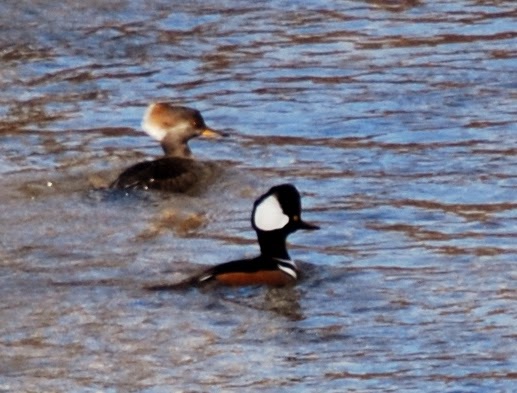
Towhees, red-winged blackbirds, and eastern bluebirds are back in abundance, and yesterday during my walk I spotted a pair of hooded mergansers swimming in our creek. They flew off upstream just out of sight so I crossed the property line and trespassed in our neighbors' hay meadow, which is still mostly brown and mucky from snowmelt, and while I carefully picked my way as quietly as possible toward the mergansers, I saw a pair of pileated woodpeckers climbing up either side of a tree trunk. Woodpeckers to the left of me, mergansers to the right--and right up the middle runs Hopeful, scaring them all away.
Good thing the dog can't scare away Spring!
Thursday, March 06, 2014
I shouldn't have to say this again, but someone wasn't listening!
1. "Works Cited" means what it says: a list of works that you have actually cited within your paper. There's a reason it's not called "Works Assigned" or "Works Vaguely Referred To" or "Works I May Have Heard My Professor Say Something about But Never Actually Opened Or Read."
2. There is another way to start a sentence aside from "there is"; in fact, there are many other ways. Learn some verbs! More than one!
3. "Similar in some ways and different in others" is just boring. Don't bore me. I'm not happy when I'm bored, and you don't want unhappy hands controlling the gradebook.
4. If I tell you a certain idea needs further development, I'm not asking you to restate the same idea three different ways without adding anything. That's not development; that's the written equivalent of a needle stuck in the same groove on a record. (I know you don't know what I'm talking about but I can't currently retrieve a more effective metaphor from my drivel-drenched brain.)
5. Plot summary is not analysis, and summarizing what I said in class is not even close to analysis, but if you're going to write an entire paper summarizing something I said in class, please get it right. Better yet, read the book! You might like it if you give it a try.
Wednesday, March 05, 2014
Zipping my lip (because I'm not Gordon Lish)
What can I say to my Creative Writing students? They're writing marvelous stuff and offering terrific suggestions during workshops, making all the points I would have made if I hadn't zipped my lip. By the time they're done, I have little left to say but "Carry on."
My writing workshop is very different from the one Carla Blumenkranz describes in "Seduce the Whole World: Gordon Lish's Workshop" (read it here). The legendary Lish "asked students to write to seduce him," explains Blumenkranz, and "if he really liked what you were doing, he might sleep with you, or he might publish your book."
That's not happening in my class, and not just because I have no power to publish anyone's books and I cherish certain moral standards that disallow sleeping with students. I want my writing students to lure reluctant readers into their essays, but any seduction that takes place is strictly metaphorical. Of course, I'm not Gordon Lish, who, according to Blumenkranz, liked to keep his students off balance:
Lish seemed to love the aura of authority conferred by the professorial role, but I'm happiest in my writing classes when I'm sitting quietly as my students carefully read each other's work and offer insightful suggestions about how to improve. If they leave me little so say, so what? I may control the gradebook, but ultimately, they're not writing for me. They're writing because they are writers.
My writing workshop is very different from the one Carla Blumenkranz describes in "Seduce the Whole World: Gordon Lish's Workshop" (read it here). The legendary Lish "asked students to write to seduce him," explains Blumenkranz, and "if he really liked what you were doing, he might sleep with you, or he might publish your book."
That's not happening in my class, and not just because I have no power to publish anyone's books and I cherish certain moral standards that disallow sleeping with students. I want my writing students to lure reluctant readers into their essays, but any seduction that takes place is strictly metaphorical. Of course, I'm not Gordon Lish, who, according to Blumenkranz, liked to keep his students off balance:
He created a situation in which each student had to approach him, like a stranger at a party or a bar, to see if she could catch his attention. Lish shot down these nervous suitors one by one, not even bothering to hear out the pickup lines they fretted over. Then he shifted in an instant to a masculine role: talking endlessly, enacting his charisma, awing his listeners into submission.Again, not happening in my class. A writing workshop is where we work on writing, so if I'm "talking endlessly," something is wrong. I like to set them loose on a task and then get out of their way and let them run with it, which doesn't leave much room for "enacting charisma" or "awing listeners into submission." If they're going to be in awe of anything, it should be the power of words.
Lish seemed to love the aura of authority conferred by the professorial role, but I'm happiest in my writing classes when I'm sitting quietly as my students carefully read each other's work and offer insightful suggestions about how to improve. If they leave me little so say, so what? I may control the gradebook, but ultimately, they're not writing for me. They're writing because they are writers.
Monday, March 03, 2014
Is that your paper or the remains of your lunch?
Would I lie to a student in writing? Of course not. That would be wrong and awful and very, very bad. Nevertheless I confess that this morning I kept inserting this comment into certain students' drafts: "I'm sure you can find more about this in your notes from class."
It could be true. Some of my students take copious notes--I've seen them! But others, sadly, never crack open a notebook or pick up a pen in class. Some don't bring the textbook to class, and I'm afraid to ask whether they've bothered to open the book or, indeed, buy it.
(You should have seen the blank looks on the faces of my students yesterday when I said that of course I expect them to do a bunch of reading over break: "You carry a book with you everywhere you go, right? So when you're stuck in a traffic jam or waiting at the dentist's office or standing in line at the bank you can read a few pages, right? Of course you do! Right?")
Some students sit through class after class with nothing on the desk in front of them except an early lunch. I suppose it's possible that a really dedicated student could gnaw some pretty good notes into the crust of a chicken finger, but I'm not betting any money on it.
So now I'm not surprised to be receiving papers that show no sign that the writer has digested anything from our class readings and discussions (except lunch). "You might find the phrase 'objective correlative' helpful here," I write. "I'm sure you can find it in your class notes."
Sure. Right. Look for it next to the chicken fingers.
It could be true. Some of my students take copious notes--I've seen them! But others, sadly, never crack open a notebook or pick up a pen in class. Some don't bring the textbook to class, and I'm afraid to ask whether they've bothered to open the book or, indeed, buy it.
(You should have seen the blank looks on the faces of my students yesterday when I said that of course I expect them to do a bunch of reading over break: "You carry a book with you everywhere you go, right? So when you're stuck in a traffic jam or waiting at the dentist's office or standing in line at the bank you can read a few pages, right? Of course you do! Right?")
Some students sit through class after class with nothing on the desk in front of them except an early lunch. I suppose it's possible that a really dedicated student could gnaw some pretty good notes into the crust of a chicken finger, but I'm not betting any money on it.
So now I'm not surprised to be receiving papers that show no sign that the writer has digested anything from our class readings and discussions (except lunch). "You might find the phrase 'objective correlative' helpful here," I write. "I'm sure you can find it in your class notes."
Sure. Right. Look for it next to the chicken fingers.
Wild weekend, with white
 |
| What's all that white stuff? |
The Great Raccoon Rumble occurred Sunday afternoon when everyone except me was taking a nap, so when my adorable grandbaby woke up and started chattering, I took her to the front window to look over a world covered with white. We were having a fascinating conversation regarding the activity around the birdfeeders ("Look, birds!" "Ta!" "Birds!" "Ah!" and so on) when I noticed just outside the front door a blur of fur that soon resolved itself into a raccoon.
It's unusual enough to see a raccoon in the daytime, but to see one right up on the porch is even stranger. I assume it was attracted by the birdseed, but soon our thrilling repartee ("Look, raccoon!" "Ta!" "Raccoon!" "Ah!") alerted the rest of the family, and then before you know it they were all out there wielding various weapons to try to scare away a raccoon that seemed set on staying. My son-in-law hit it with the slingshot a few times while my husband went scurrying around for the air-rifle, but by then the dog had discovered the intruder and had the situation well in hand. End result: dead raccoon, which we sincerely hope was not rabid.
The afternoon naps followed the Sunday Morning Sing-Along, which took place at two country churches suffering very low attendance. Only the most intrepid travelers braved the sloppy weather, which moved through various stages of rain, sleet, snow, and ice as the day wore on. I stood in the first service holding my granddaughter while my daughter held the hymnal and we all tried to sing, and soon little Lizzie joined us in her own special way ("Aaaah! Taaah!") while trying to turn the pages, close the book, climb over my shoulders, flop over backward, and otherwise infuse youthful energy into the situation.
I thought of the times when I used to attend two or three services every Sunday morning with my husband in the pulpit and me in the back pew with a two-year-old and an infant at my side and rarely any helping hand. I may have missed some important points in the sermon, but singing with babies makes my heart happy even when they don't know the words. My granddaughter is a girl on the move, much like her mother at that age, so while my daughter sang a lovely solo while I sat and held her squirming child (who added her own sound effects to the special number), it felt familiar, like coming home.
But then they left last night to go back to their own home and I watched the weather and waited for news, which arrived at 5:30 this morning: no classes before 10 a.m. and a Level II Snow Emergency, well deserved considering the ice hiding under that layer of snow all over the roads. I'm sure my American Lit Survey class appreciated the day off, but I'm struggling to adjust the syllabus so we can cover the material in a meaningful way.
I could postpone the midterm exam until after spring break--but who wants to take an exam at 9 a.m. on the day after break? Instead, I'll opt to give the midterm on Friday as scheduled but axe something from the reading list, and at this point the only options are William Faulkner's "Barn Burning" or Ernest Hemingway's "The Snows of Kilimanjaro." How can I delete either one of those from an American Lit Survey? I've only recently made peace with chopping Henry James!
Finally I figured out a way to make my Monday Morning Massacre slightly less bloody: we'll discuss Hemingway in class on Wednesday and leave Faulkner alone. I'll chop Faulkner out of the required questions on the midterm but include him in an optional question, and I'll encourage students to discuss "Barn Burning" in online reading comments (since they were supposed to have read the story for this morning's class anyway). And I'll let Faulkner and James commiserate in the Authorial Afterlife, wherever that may be.
I'll tell my students to use their snow day wisely, but I'm just enjoying a little extra time to recover from my wild weekend. Snow--aaah!
Wednesday, February 26, 2014
Put a fork in it
A colleague popped into my office to say, "I feel as if I ought to be rushing to observe someone's teaching." I know the feeling: since September we've been serving on our college's tenure and promotion committee, meeting for two hours every Friday afternoon (with only a few breaks), but this week we won't be meeting because our work is DONE.
Or mostly done. We'll probably meet one more time to clean up a few details and do some prep work for next year's committee, but we are DONE reading portfolios, observing classes, discussing the merits of our colleagues' teaching, research, and service, and making sometimes difficult decisions about whom to recommend for tenure and promotion. With an unusually large group eligible this year, we all had to visit many classes during the fall semester--over 20 hours of observations per committee member, or close to 150 hours total.
We observed a lot of great teaching and now it's gratifying to see the Trustees affirm our work by granting tenure and promotion to some very worthy colleagues, but despite the rewards of serving on this committee, I have to admit that I'm delighted that our work is done. So many committees function ad nauseam without direction or focus, always nibbling away at issues without ever accomplishing much, so it's great to serve on a committee that can look back over a busy year and see tangible outcomes of all our hard work. Our work here is done. Time to move on.
Or mostly done. We'll probably meet one more time to clean up a few details and do some prep work for next year's committee, but we are DONE reading portfolios, observing classes, discussing the merits of our colleagues' teaching, research, and service, and making sometimes difficult decisions about whom to recommend for tenure and promotion. With an unusually large group eligible this year, we all had to visit many classes during the fall semester--over 20 hours of observations per committee member, or close to 150 hours total.
We observed a lot of great teaching and now it's gratifying to see the Trustees affirm our work by granting tenure and promotion to some very worthy colleagues, but despite the rewards of serving on this committee, I have to admit that I'm delighted that our work is done. So many committees function ad nauseam without direction or focus, always nibbling away at issues without ever accomplishing much, so it's great to serve on a committee that can look back over a busy year and see tangible outcomes of all our hard work. Our work here is done. Time to move on.
Tuesday, February 25, 2014
The lunch that launched a memory
This morning I'm suddenly remembering the best bowl of soup I ever ate. It was something gumbo-esque, I think, with a tomato base and vegetables and some sort of meat. What made the soup great, though, was not inside the bowl.
I was sitting at an outdoor table at a cafe in Devonport, a brief ferry-ride from Auckland. It may have been my final day in Auckland, a day I'd spent mostly on foot, walking around the quaint seaside village and hiking around the cones of extinct volcanoes. It was July (what year? 2012 or 13?) and therefore winter, with a cold, damp breeze blasting roses into my cheeks from one direction while bright sunlight roasted me from another.
I sat outside that small cafe resting my sore feet while sipping my soup and contemplating how far I'd come, not just walking all over Auckland but traveling across the world to give a paper at a conference and spend an extra week doing research on Maori literature and culture. I didn't need extinct volcanoes to tell me I wasn't in Ohio anymore.
Today I wish I could have some of that soup, or if not the soup itself then the sense of adventure that served as a side-dish. Living too complacently at the intersection of Love-My-Job Lane and Hate-My-Office Avenue, I want to escape to a place I've never seen, walk streets my feet don't know, feel unfamiliar breezes on my face, and drink my fill of soup that warms me inside and out.
Today's lunch is as forgettable as yesterday's, but it keeps me going until the time when I can find some more of that elusive Adventure Soup. Will someone please send the recipe?
I was sitting at an outdoor table at a cafe in Devonport, a brief ferry-ride from Auckland. It may have been my final day in Auckland, a day I'd spent mostly on foot, walking around the quaint seaside village and hiking around the cones of extinct volcanoes. It was July (what year? 2012 or 13?) and therefore winter, with a cold, damp breeze blasting roses into my cheeks from one direction while bright sunlight roasted me from another.
I sat outside that small cafe resting my sore feet while sipping my soup and contemplating how far I'd come, not just walking all over Auckland but traveling across the world to give a paper at a conference and spend an extra week doing research on Maori literature and culture. I didn't need extinct volcanoes to tell me I wasn't in Ohio anymore.
Today I wish I could have some of that soup, or if not the soup itself then the sense of adventure that served as a side-dish. Living too complacently at the intersection of Love-My-Job Lane and Hate-My-Office Avenue, I want to escape to a place I've never seen, walk streets my feet don't know, feel unfamiliar breezes on my face, and drink my fill of soup that warms me inside and out.
Today's lunch is as forgettable as yesterday's, but it keeps me going until the time when I can find some more of that elusive Adventure Soup. Will someone please send the recipe?
Metaquestioning
"I really want to argue something," says a voice from the back of the room. My students are in groups writing possible essay questions for an exam, each group choosing from a list of writing tasks (argue, compare, define, explain, and so on) and one group is arguing over whether their question should ask students to argue or discuss. It's a good question about questions--a meta-question! That's the kind of test preparation I like to see.
I've done this exercise before with mixed results: some students aim for questions they consider obvious or easy, like "compare text A with text B," but I tell them such vague questions generally produce superficial and unconvincing essays. I want them to design questions that will help them dig deeper into texts and show what they know, and so far, they're doing great.
I'm reminded of my Ph.D. comprehensive exams, when I had to submit my own questions to be mixed in with the other possible questions for each topic. I agonized over those questions, hoping they wouldn't appear lightweight next to the questions written by my committee, and I was delighted to see that they stood up to the test--and maybe that was part of the test. Writing good questions proved excellent preparation for writing the exams, and as a result, here I am, all these years later, asking my honors students to write their own test.
They wrote six questions and we looked at them as a class. I've promised to use one or two of them as the basis for their exam, tweaking the wording a bit to make them more clear or challenging, but I won't have to tweak much because they've written really good questions.
"So does that mean we can skip the exam?"
Now it's time to argue.
I've done this exercise before with mixed results: some students aim for questions they consider obvious or easy, like "compare text A with text B," but I tell them such vague questions generally produce superficial and unconvincing essays. I want them to design questions that will help them dig deeper into texts and show what they know, and so far, they're doing great.
I'm reminded of my Ph.D. comprehensive exams, when I had to submit my own questions to be mixed in with the other possible questions for each topic. I agonized over those questions, hoping they wouldn't appear lightweight next to the questions written by my committee, and I was delighted to see that they stood up to the test--and maybe that was part of the test. Writing good questions proved excellent preparation for writing the exams, and as a result, here I am, all these years later, asking my honors students to write their own test.
They wrote six questions and we looked at them as a class. I've promised to use one or two of them as the basis for their exam, tweaking the wording a bit to make them more clear or challenging, but I won't have to tweak much because they've written really good questions.
"So does that mean we can skip the exam?"
Now it's time to argue.
Sunday, February 23, 2014
The thaw I saw

 The morning sun striking ice made the cliffside sparkle as if spangled with sequins, but I couldn't capture the effect on camera any more than I could capture the sound of rushing water or the chatter of a pileated woodpecker flicking from tree to tree. The forecast calls for more snow and subzero temperatures next week, but this week's thaw provided a necessary respite from cabin fever, making the bleak midwinter a little more bearable.
Friday, February 21, 2014
What poetry summaries leave out
I came out of class this morning joyful after leading a discussion of some poems by e.e. cummings, who once struck me as a lightweight but who seems to get more profound with age. (My age, not his.) Then I looked at some things students had written about cummings and recognized the stylistic hallmarks of the online summary, and I got a little annoyed. First, the very idea of summarizing a poem is ridiculous, since how a poem says is at least as important as what it says. Second, what these summaries say about what these poems say is simply insipid.
Let's look at an example. First, if you haven't seen it in a while, go look at cummings's poem "In Just--" (read it here). Got it? Okay, now here is the entire text of an online summary you can easily find via Google: "The poem In Just by EE Cummings is a poem about the season spring. It talks about how everything is fresh and new. People are happy that the weather is warmer, flowers are blooming, and kids can play outside."
Who would write a poem about that? Okay, maybe I wrote poems like that and maybe I even published one of them, but I was in the third grade at the time and I had not seen the horrors of World War I up close or spent time in a prisoner-of-war camp as cummings did. I do not teach poems written by third-graders and, thankfully, cummings did not write the kind of poem a third-grader would write. Go back to the poem and take a close look at the goat-footed balloon-man. What is he doing in the poem? What is he not doing in the summary? What else is missing from the summary? How about all those odd spaces, fused words, and uneven lines? If space mattered to cummings, shouldn't it matter to us? How is it possible to write anything about this poem without mentioning the typographical elements or the little lame balloon-man? I hear his whistle even now....
I think I helped my students hear that whistle in class today, but I fear for the ones who can't hear the difference between cummings's little lame balloon-man and the insipid online summary of the poem. Pity the busy monster studentunmindful--not!
Let's look at an example. First, if you haven't seen it in a while, go look at cummings's poem "In Just--" (read it here). Got it? Okay, now here is the entire text of an online summary you can easily find via Google: "The poem In Just by EE Cummings is a poem about the season spring. It talks about how everything is fresh and new. People are happy that the weather is warmer, flowers are blooming, and kids can play outside."
Who would write a poem about that? Okay, maybe I wrote poems like that and maybe I even published one of them, but I was in the third grade at the time and I had not seen the horrors of World War I up close or spent time in a prisoner-of-war camp as cummings did. I do not teach poems written by third-graders and, thankfully, cummings did not write the kind of poem a third-grader would write. Go back to the poem and take a close look at the goat-footed balloon-man. What is he doing in the poem? What is he not doing in the summary? What else is missing from the summary? How about all those odd spaces, fused words, and uneven lines? If space mattered to cummings, shouldn't it matter to us? How is it possible to write anything about this poem without mentioning the typographical elements or the little lame balloon-man? I hear his whistle even now....
I think I helped my students hear that whistle in class today, but I fear for the ones who can't hear the difference between cummings's little lame balloon-man and the insipid online summary of the poem. Pity the busy monster studentunmindful--not!
Thursday, February 20, 2014
The office is blowing in the wind
What season is it when you spot a member of the grounds crew using a leaf-blower in the snow?
I know what you're thinking: leaf-blower, snow-blower, same thing really. But no: he was not using the leaf-blower to blow snow but to blow leaves that have been buried under piles of snow for three weeks and are gradually being exposed as the snow melts. Perhaps you've already spotted the flaw in this plan, but if not, I'll give you a hint: when snow melts, where does the water go?
So here was this guy working really hard to try to dislodge leaves that have been squashed into sticky mulch when he could put the leaf-blower to better use warming up my office. For reasons no one has been able to explain, cold air is continually blowing from the ceiling vents in my office, making it colder than the surrounding offices and even the hallway. Someone standing on my desk with a leaf-blower could conceivably counteract the negative effect of all that cold air on my office's ambiance. I might have to wear earplugs to avoid the noise, but at least I would be a little less cold.
When the outdoor temperatures dipped below zero and then stayed there a while, my office was cozy and comfortable, but now it's actually colder in my office than outside. But hey, if I relocate my office to the great outdoors, that would be a great solution to my claustrophobia problem.
If you need me, follow the growl of distant leaf-blowers.
I know what you're thinking: leaf-blower, snow-blower, same thing really. But no: he was not using the leaf-blower to blow snow but to blow leaves that have been buried under piles of snow for three weeks and are gradually being exposed as the snow melts. Perhaps you've already spotted the flaw in this plan, but if not, I'll give you a hint: when snow melts, where does the water go?
So here was this guy working really hard to try to dislodge leaves that have been squashed into sticky mulch when he could put the leaf-blower to better use warming up my office. For reasons no one has been able to explain, cold air is continually blowing from the ceiling vents in my office, making it colder than the surrounding offices and even the hallway. Someone standing on my desk with a leaf-blower could conceivably counteract the negative effect of all that cold air on my office's ambiance. I might have to wear earplugs to avoid the noise, but at least I would be a little less cold.
When the outdoor temperatures dipped below zero and then stayed there a while, my office was cozy and comfortable, but now it's actually colder in my office than outside. But hey, if I relocate my office to the great outdoors, that would be a great solution to my claustrophobia problem.
If you need me, follow the growl of distant leaf-blowers.
Wednesday, February 19, 2014
Mega-meta-blogging-blocker
You're not writing about that, are you?
Sure I am. Why not? It's a great story.
But you're angry.
For a good reason!
You know it's a mistake to write while you're angry.
Shut up. Go away.
You'll regret it later! And what if you have to apologize?
So? I've apologized before and it didn't kill me.
But you wouldn't have had to apologize if you'd listened to me!
Now you're really making me angry.
Why do you have to complain all the time anyway? Don't you have something a little happier to write about?
What, like how I just totally smashed my students' love affair with Robert Frost? Hurray for me, turning bright-eyed optimists into bitter cynics!
What about the weather? You could write about the weather!
Warm air, sunshine, blah blah blah, but down here in my dungeon office I'm wrapped in a blanket and wishing I had a great big dog to keep my feet warm.
Such a whiner. I'm sure you could find a bright side if you tried hard enough!
Sure, but writing about the bright side would reveal the outlines of the dark side as well. Casting sunshine on the matter would only draw attention to the shadows.
Stay away from the shadows! You can't write about the shadows!
Sure I can. Just watch--!!
Stop! You might embarrass someone!
Maybe they deserve to be embarrassed.
What, now you're handing out bad-behavior tickets? What are you, the self-appointed Chief of the Collegiality Police?
Go away and leave me alone!
Keep handing out those tickets and you'll know what it means to be alone--for good.
Shut up and let me write!
But not about that!
Sure I am. Why not? It's a great story.
But you're angry.
For a good reason!
You know it's a mistake to write while you're angry.
Shut up. Go away.
You'll regret it later! And what if you have to apologize?
So? I've apologized before and it didn't kill me.
But you wouldn't have had to apologize if you'd listened to me!
Now you're really making me angry.
Why do you have to complain all the time anyway? Don't you have something a little happier to write about?
What, like how I just totally smashed my students' love affair with Robert Frost? Hurray for me, turning bright-eyed optimists into bitter cynics!
What about the weather? You could write about the weather!
Warm air, sunshine, blah blah blah, but down here in my dungeon office I'm wrapped in a blanket and wishing I had a great big dog to keep my feet warm.
Such a whiner. I'm sure you could find a bright side if you tried hard enough!
Sure, but writing about the bright side would reveal the outlines of the dark side as well. Casting sunshine on the matter would only draw attention to the shadows.
Stay away from the shadows! You can't write about the shadows!
Sure I can. Just watch--!!
Stop! You might embarrass someone!
Maybe they deserve to be embarrassed.
What, now you're handing out bad-behavior tickets? What are you, the self-appointed Chief of the Collegiality Police?
Go away and leave me alone!
Keep handing out those tickets and you'll know what it means to be alone--for good.
Shut up and let me write!
But not about that!
Monday, February 17, 2014
Bouncing baby ba-ba-ba

Friday, February 14, 2014
Going forth empty-handed
Three times this week various commitments kept me on campus for 14 or more hours but now it's Friday the 14th and I'm going forth from here (after a two-hour meeting) with not a single student paper in my bag. I've prepped Monday's classes so I'm leaving books and laptop behind and going home for the weekend utterly empty-handed.
Here's what I hope those empty hands will hold over the next two days:
my adorable granddaughter
a mug of spiced chai
some messy fish tacos
my camera equipped with its new/old lens
some dog treats during a walk with the hound
my Kindle full of books unrelated to classes
the Methodist hymnal
and did I mention my adorable granddaughter?
Empty hands--full heart!
Here's what I hope those empty hands will hold over the next two days:
my adorable granddaughter
a mug of spiced chai
some messy fish tacos
my camera equipped with its new/old lens
some dog treats during a walk with the hound
my Kindle full of books unrelated to classes
the Methodist hymnal
and did I mention my adorable granddaughter?
Empty hands--full heart!
Thursday, February 13, 2014
Just call me Prof Softie
I graded the exam promptly but didn't post the grades for three days. I wanted to think first about what why half the class bombed the exam and what, if anything, I ought to do about it.
That's three days of second-guessing myself (and third-guessing and fourth-guessing and on up to zillionth-guessing). On the one hand, the students had plenty of warning: a study of guide with sample questions, a list of essential vocabulary terms, even a repeated warning that "open book" does not mean "easy."
On the other hand, none of the students who bombed the exam have ever had classes from me before and seem to have been blind-sided by the number of questions and the amount of writing I expected from them. Many of them did well enough on the questions they answered but ran out of time to finish the exam, leaving whole pages blank.
Those blank pages included questions about concepts that will be foundational to our discussion for the rest of the semester, so I need to make sure the students understand those concepts. On the other other hand (picture me as the many-handed goddess Kali, only less ruthless and certainly less blue), I don't want to reward bad performance by offering extra credit on material they should have mastered for the exam.
But after three days of pondering I decided to give them a second chance. For each student who earned less than an A on the exam, I've created a personalized Second-Chance Quiz featuring one or two questions the student left blank on the exam. Their performance on the Second-Chance Quiz may improve their exam grade by up to 10 points, which for many of them will make the difference between failing and passing.
Is this solution fair? Probably not: students who earned an A on the exam don't get the chance to improve their scores, but on the other other other hand, they don't need it. I also fear that these students will expect similar second chances in the future, so I'll be careful to let them know that this is a one-time deal. I've already warned them that the Second-Chance Quiz is coming on Monday so they'd better spend the weekend mastering those concepts they skipped over on the exam, but those who don't bother may get nothing out of the exercise, which is fine.
I never grade on the curve and I rarely offer extra credit and I know I provided plenty of warning about what to expect on this exam, but even the students who've taken many exams from me before admitted that this one was especially daunting. On the one hand, giving them a second chance makes me feel like Professor Softie; on the other other other other hand, posting such a high percentage of horrible grades makes me feel like Kali the Avenger. Just for today, I prefer to put down the sword and let the pen prove its might. In the end, it all comes down to whether I can live with myself, and in this case, the pen wins--hands down.
That's three days of second-guessing myself (and third-guessing and fourth-guessing and on up to zillionth-guessing). On the one hand, the students had plenty of warning: a study of guide with sample questions, a list of essential vocabulary terms, even a repeated warning that "open book" does not mean "easy."
On the other hand, none of the students who bombed the exam have ever had classes from me before and seem to have been blind-sided by the number of questions and the amount of writing I expected from them. Many of them did well enough on the questions they answered but ran out of time to finish the exam, leaving whole pages blank.
Those blank pages included questions about concepts that will be foundational to our discussion for the rest of the semester, so I need to make sure the students understand those concepts. On the other other hand (picture me as the many-handed goddess Kali, only less ruthless and certainly less blue), I don't want to reward bad performance by offering extra credit on material they should have mastered for the exam.
But after three days of pondering I decided to give them a second chance. For each student who earned less than an A on the exam, I've created a personalized Second-Chance Quiz featuring one or two questions the student left blank on the exam. Their performance on the Second-Chance Quiz may improve their exam grade by up to 10 points, which for many of them will make the difference between failing and passing.
Is this solution fair? Probably not: students who earned an A on the exam don't get the chance to improve their scores, but on the other other other hand, they don't need it. I also fear that these students will expect similar second chances in the future, so I'll be careful to let them know that this is a one-time deal. I've already warned them that the Second-Chance Quiz is coming on Monday so they'd better spend the weekend mastering those concepts they skipped over on the exam, but those who don't bother may get nothing out of the exercise, which is fine.
I never grade on the curve and I rarely offer extra credit and I know I provided plenty of warning about what to expect on this exam, but even the students who've taken many exams from me before admitted that this one was especially daunting. On the one hand, giving them a second chance makes me feel like Professor Softie; on the other other other other hand, posting such a high percentage of horrible grades makes me feel like Kali the Avenger. Just for today, I prefer to put down the sword and let the pen prove its might. In the end, it all comes down to whether I can live with myself, and in this case, the pen wins--hands down.
Tuesday, February 11, 2014
Cloudy with a chance of quagmires
So much of academic life is simply unbloggable--but not, as I've just discovered, unquaggleable. Let me explain:
Yesterday I was involved in an event that a colleague described as quagmiresque, and while it had its entertaining and even instructive moments, I don't dare write a single word about it publicly. So instead let's think about quagmires--which, according to our friend the Oxford English Dictionary, can serve as either noun or verb, although the verb form appears rarely and only in the passive voice, as in this example from a 1991 Vanity Fair article: "Paglia came under the gnomic spell of Bloom, a whirring mind quagmired in a pudding of flesh."
The OED traces quagmire to the obscure noun quag "a marshy or boggy spot" or the verb quag "to quake" (with its 19th-century variant quaggle, implying "to shake like a jelly"). The OED offers examples of quagmire as far back as 1566 and dates quagmirist to 1609. There's a word you don't want to see on a resume!
Quagmire can refer to a bog either literal or figurative but Shakespeare may have intended it both ways in Henry VI, Part I when Talbot threatens, "Your hearts I'll stamp out with my horse's heels / and make a Quagmire of your mingled brains." I'm more fond, however, of the elegant simplicity of a sentence written by E. Hellowes in his 1575 translation of the Familiar Epistles of Anthony of Guevara. I've never read Anthony of Guevara's Familiar Epistles and I have no idea who E. Hellowes might have been, but I'd like to tell that Hellowes fellow Hello and congratulate him on his prescient description of the current state of academe: "There be so many quagmires, wherein to bee myred."
Quagmires to the right of me, quagmires to the left--here I am, stuck in the middle with a bunch of quagmirists. No wonder I'm quaking in my boots.
Yesterday I was involved in an event that a colleague described as quagmiresque, and while it had its entertaining and even instructive moments, I don't dare write a single word about it publicly. So instead let's think about quagmires--which, according to our friend the Oxford English Dictionary, can serve as either noun or verb, although the verb form appears rarely and only in the passive voice, as in this example from a 1991 Vanity Fair article: "Paglia came under the gnomic spell of Bloom, a whirring mind quagmired in a pudding of flesh."
The OED traces quagmire to the obscure noun quag "a marshy or boggy spot" or the verb quag "to quake" (with its 19th-century variant quaggle, implying "to shake like a jelly"). The OED offers examples of quagmire as far back as 1566 and dates quagmirist to 1609. There's a word you don't want to see on a resume!
Quagmire can refer to a bog either literal or figurative but Shakespeare may have intended it both ways in Henry VI, Part I when Talbot threatens, "Your hearts I'll stamp out with my horse's heels / and make a Quagmire of your mingled brains." I'm more fond, however, of the elegant simplicity of a sentence written by E. Hellowes in his 1575 translation of the Familiar Epistles of Anthony of Guevara. I've never read Anthony of Guevara's Familiar Epistles and I have no idea who E. Hellowes might have been, but I'd like to tell that Hellowes fellow Hello and congratulate him on his prescient description of the current state of academe: "There be so many quagmires, wherein to bee myred."
Quagmires to the right of me, quagmires to the left--here I am, stuck in the middle with a bunch of quagmirists. No wonder I'm quaking in my boots.
Monday, February 10, 2014
A bouquet of midwinter birds

My daughter brought home a bouquet of flowers to fight the midwinter blues, but I'm enjoying my bouquet of birds, colorful enough to serve as an antidote to cabin fever. This time of year it's not uncommon to see thirty or forty birds twittering around our feeder stations all at once, with as many as a dozen cardinals sharply visible against the snow.


Friday, February 07, 2014
Because science!
This just in: science has shown that people can't actually reach the horizon because it just keeps getting farther and farther away. (I read it in a paper so it must be true. On the other hand, it wasn't cited. Think I should ask for a citation?)
What burning question will science tackle next? Think of it:
There must be more! Suggestions?
Bonus question: if Schrodinger's cat reached the horizon, how would we know?
What burning question will science tackle next? Think of it:
- The Neuroscience of Dreaming the Impossible Dream
- Jam Tomorrow and Jam Yesterday but Never Jam Today: a Quantum Physics Approach
- GPS Revolutionizes Over-the-Rainbow Studies
There must be more! Suggestions?
Bonus question: if Schrodinger's cat reached the horizon, how would we know?
A casualty of the Great Apostrophe War
When my grandchildren gather 'round my knee to ask "What did you do in the war, Granny?", I'll tell them I surrendered. Gave up. Waved the white flag and caved without so much as a squawk.
I'm referring, of course, to the Great Apostrophe War of 2014. I did not volunteer to fight in the GAW and neither was I recruited; I just sort of slid into it sideways, like a car on a patch of ice or flip-flops in a wet pasture studded with cow flops. (But this is February so let's stick with the ice image and forget about the cow flops. Don't even think about the cow flops. Forget I mentioned 'em.)
I was just sitting in my office minding my own business when suddenly, without warning, an e-mail message I was trying to send to faculty mailing list was returned, rejected by the moderator. Why? Because I had used an apostrophe correctly.
Of course it's not that simple. Do you wish someone a Happy Mother's Day, Mothers' Day, or Mothers Day? I would go for Mothers' Day because it's a day belonging to all mothers, but the rapid evacuation of apostrophes from pop culture seems to be moving us toward Mothers Day, which makes my brain hurt.
So I had to send this announcement out to all the faculty using a phrase like Mothers Day but I included an apostrophe, upon which my wrist was slapped by the Powers That Be, who have outlawed the apostrophe in this case. The line was drawn in the sand: remove the apostrophe or the message will not go through.
But the message must go through! Neither rain nor sleet nor dark of night nor apostrophes nor flip-flops nor cow flops (don't think about cow flops) nor the Powers That Be can prevent the message from penetrating the faculty listserv that nobody actually reads!
But "Shoot if you must this old gray head but spare my beloved apostrophe!" is exactly what I didn't say. One of my colleagues urged me to take a stand, rally the troops to my side, and refuse to bend before the ravening hordes of apostrophe-haters, but he apparently has a lot of time on his hands. My to-do list stretches from here to Saskatchewan and threatens to swallow whole my entire weekend if I don't start checking off tasks, so I caved in and rewrote the message without the apostrophe.
Soon thereafter, through the rockets' red glare and bombs bursting in air there appeared on the faculty listserv a long message full of important information but the only thing I can see is something that isn't there--where the apostrophe ought to be is a blank spot waving like a white flag of surrender. Without intending to, I have become a casualty in the Great Apostrophe War. And I shall be telling this with a sigh somewhere ages and ages hence: two roads diverged in a wood and I, I took the one less apostrophied--and that has made not a bit of difference.
I'm referring, of course, to the Great Apostrophe War of 2014. I did not volunteer to fight in the GAW and neither was I recruited; I just sort of slid into it sideways, like a car on a patch of ice or flip-flops in a wet pasture studded with cow flops. (But this is February so let's stick with the ice image and forget about the cow flops. Don't even think about the cow flops. Forget I mentioned 'em.)
I was just sitting in my office minding my own business when suddenly, without warning, an e-mail message I was trying to send to faculty mailing list was returned, rejected by the moderator. Why? Because I had used an apostrophe correctly.
Of course it's not that simple. Do you wish someone a Happy Mother's Day, Mothers' Day, or Mothers Day? I would go for Mothers' Day because it's a day belonging to all mothers, but the rapid evacuation of apostrophes from pop culture seems to be moving us toward Mothers Day, which makes my brain hurt.
So I had to send this announcement out to all the faculty using a phrase like Mothers Day but I included an apostrophe, upon which my wrist was slapped by the Powers That Be, who have outlawed the apostrophe in this case. The line was drawn in the sand: remove the apostrophe or the message will not go through.
But the message must go through! Neither rain nor sleet nor dark of night nor apostrophes nor flip-flops nor cow flops (don't think about cow flops) nor the Powers That Be can prevent the message from penetrating the faculty listserv that nobody actually reads!
But "Shoot if you must this old gray head but spare my beloved apostrophe!" is exactly what I didn't say. One of my colleagues urged me to take a stand, rally the troops to my side, and refuse to bend before the ravening hordes of apostrophe-haters, but he apparently has a lot of time on his hands. My to-do list stretches from here to Saskatchewan and threatens to swallow whole my entire weekend if I don't start checking off tasks, so I caved in and rewrote the message without the apostrophe.
Soon thereafter, through the rockets' red glare and bombs bursting in air there appeared on the faculty listserv a long message full of important information but the only thing I can see is something that isn't there--where the apostrophe ought to be is a blank spot waving like a white flag of surrender. Without intending to, I have become a casualty in the Great Apostrophe War. And I shall be telling this with a sigh somewhere ages and ages hence: two roads diverged in a wood and I, I took the one less apostrophied--and that has made not a bit of difference.
Thursday, February 06, 2014
The CSWSW kerfuffle
The Case of the Statue Wearing Skivvies at Wellesley (CSWSW) is probably not funny--not funny at all. In fact, I'm sure it's a Very Serious Matter for those who take such things very seriously, so those people should probably stop reading right now. Go ahead! Go read something more jargon-laced and leave the rest of us alone to chuckle guiltily amongst ourselves!
(Are they gone yet?)
So the situation, which has been dissected unto death elsewhere, is this: a statue called "Sleepwalker" by Tony Matelli has been erected outside a museum on Wellesley's campus to publicize an exhibit of the artist's work. The statue (go look at it!) portrays a sleepwalking man clad only in underwear. He looks kind of creepy, although not sexual-predator creepy or Zombie Apocalypse creepy--more like someone on the verge of letting a big wad of drool drip down onto your boots if you get too close. Then again, few of us look our best while sleepwalking, so maybe we should give the guy a break. He can't help how he looks! He's a statue!
"Sleepwalker" does not strike me as threatening, but I might respond differently if I suddenly spotted him over my shoulder on a dark night. More than 100 students have signed a petition protesting the statue because it makes them feel "unsafe" and it "steps over a line." (Ever try to persuade a sleepwalker to step over a line? Good luck! Not to mention that statues are not known for their mobility.)
I don't know just where I stand on the CSWSW kerfuffle--except I'm not inclined to stand too close. Wouldn't want him to drool all over my new boots. Will someone for heaven's sake give the man a blanket?!
(Are they gone yet?)
So the situation, which has been dissected unto death elsewhere, is this: a statue called "Sleepwalker" by Tony Matelli has been erected outside a museum on Wellesley's campus to publicize an exhibit of the artist's work. The statue (go look at it!) portrays a sleepwalking man clad only in underwear. He looks kind of creepy, although not sexual-predator creepy or Zombie Apocalypse creepy--more like someone on the verge of letting a big wad of drool drip down onto your boots if you get too close. Then again, few of us look our best while sleepwalking, so maybe we should give the guy a break. He can't help how he looks! He's a statue!
"Sleepwalker" does not strike me as threatening, but I might respond differently if I suddenly spotted him over my shoulder on a dark night. More than 100 students have signed a petition protesting the statue because it makes them feel "unsafe" and it "steps over a line." (Ever try to persuade a sleepwalker to step over a line? Good luck! Not to mention that statues are not known for their mobility.)
I don't know just where I stand on the CSWSW kerfuffle--except I'm not inclined to stand too close. Wouldn't want him to drool all over my new boots. Will someone for heaven's sake give the man a blanket?!
Wednesday, February 05, 2014
Reading currents, watching waves
First exam of the semester, first set of papers, first signs of cheating, first plagiarism case--yep, the honeymoon is over. The bright, hopeful faces that sparkled in classrooms on the first day have been replaced by the faces of those bleak workers shuffling to their underground caverns in Fritz Lang's Metropolis--and that's just the faculty!
Today I've been subjected to papers claiming that certain authors "utilize the use of" something or other, and all that usefulness makes me tired. Tomorrow I'll utilize the use of utilitarianism when my honors class examines Mark Twain's "Two Ways of Looking at a River," in which he explains how familiarity with the river inured him to its beauty. He concludes:
I've looked so long into the river of students passing through my classes that I see them too often as obstacles obstructing my progress toward pleasure or bright shiny surfaces hiding dangerous currents. Taking the long view, though, the plagiarists and cheaters and grade-grubbing plodders leave tiny wakes on a wide river sparkling with beauty and power and grace.
May the waves pass us by, may our crafts stay afloat, and may we never lose sight of the river.
Today I've been subjected to papers claiming that certain authors "utilize the use of" something or other, and all that usefulness makes me tired. Tomorrow I'll utilize the use of utilitarianism when my honors class examines Mark Twain's "Two Ways of Looking at a River," in which he explains how familiarity with the river inured him to its beauty. He concludes:
No, the romance and the beauty were all gone from the river. All the value any feature of it had for me now was the amount of usefulness it could furnish toward compassing the safe piloting of a steamboat. Since those days, I have pitied doctors from my heart. What does the lovely flush in a beauty's cheek mean to a doctor but a "break" that ripples above some deadly disease? Are not all her visible charms sown thick with what are to him the signs and symbols of hidden decay? Does he ever see her beauty at all, or doesn't he simply view her professionally, and comment upon her unwholesome condition all to himself? And doesn't he sometimes wonder whether he has gained most or lost most by learning his trade?Well, doesn't he?
I've looked so long into the river of students passing through my classes that I see them too often as obstacles obstructing my progress toward pleasure or bright shiny surfaces hiding dangerous currents. Taking the long view, though, the plagiarists and cheaters and grade-grubbing plodders leave tiny wakes on a wide river sparkling with beauty and power and grace.
May the waves pass us by, may our crafts stay afloat, and may we never lose sight of the river.
Tuesday, February 04, 2014
Snowed in and not sorry
Control freak, right? So naturally I had crossed every t and dotted every i to prepare the itinerary of our visiting author: meeting with class at 10, lunch with creative writing students at noon, master class at 4, dinner with faculty at 5:30, open reading at 7:30 (extra credit opportunity!), reception and book-signing to follow. I even arranged for the bookstore to have a supply of books on hand to sell at the reading.
Somehow, in the midst of all that obsessive organizing, I neglected to arrange one important element: the weather.
Flash back 20 years; I'm leading some relatives on a tour of my favorite Lake Erie island in the height of summer, but the wind is blowing and spitting a light rain into our faces and I'm fielding complaints that it's too COLD and too WET and too FAR to walk, and I'm responding, as usual, by apologizing, repeatedly and earnestly, until someone, puzzled, asks me, "Why are you apologizing for the weather?"
Yesterday I tried really hard to avoid apologizing for the weather, but it couldn't be helped: as classes were first delayed and then cancelled, as the grounds crew tried valiantly to clear snow and make the campus safe, it became apparent that the weather was going to destroy my carefully-planned event. No public reading, no books to sell or sign, no meeting with cancelled classes--all buried under a mere six inches of wet snow.
It takes a tremendous amount of hubris, really, to apologize for the weather, as if a little more effort on my part could have ensured a warm, dry, cozy visit to the island. I suppose I really wanted to apologize for being a disappointing tour guide, for failing to anticipate my relatives' needs, for lacking an understanding of their physical limitations. "I'm sorry I'm such a sorry [relative]" is probably what I wanted to say, but who can say such a thing out loud? Better to project my flaws onto the weather; better to imply that I could have eased their discomfort if I'd only worked a little bit harder. Surely controlling the weather is not far outside my impressive powers! Surely next time I'll do better!
Yesterday's snow did not have the power to stop everything, however. The author was already here, and while I could not require students to attend an event when the campus was officially closed, I could certainly invite them. We ate lunch. We attended a master class. We enjoyed a great informal visit and some terrific insight into the writing process, both the author's and our own. In the end we flew an author across the country and paid a healthy stipend for a meeting with about eight students--but oh, what a great meeting! And what great weather, which closed us in and pushed us into a place where we could warm our hands on the fire burning deep below the surface of our stories.
I'd like to go back in time and rewind the tape, take back the apologies that cried out so pathetically for approval. I'm sorry that I focus so narrowly on my well-laid plans that I often overlook whatever the wind blows my way, from deep insights to small unexpected joys. I'm sorry that I put so much energy into being sorry. But I'm not sorry about the weather--then or now.
Somehow, in the midst of all that obsessive organizing, I neglected to arrange one important element: the weather.
Flash back 20 years; I'm leading some relatives on a tour of my favorite Lake Erie island in the height of summer, but the wind is blowing and spitting a light rain into our faces and I'm fielding complaints that it's too COLD and too WET and too FAR to walk, and I'm responding, as usual, by apologizing, repeatedly and earnestly, until someone, puzzled, asks me, "Why are you apologizing for the weather?"
Yesterday I tried really hard to avoid apologizing for the weather, but it couldn't be helped: as classes were first delayed and then cancelled, as the grounds crew tried valiantly to clear snow and make the campus safe, it became apparent that the weather was going to destroy my carefully-planned event. No public reading, no books to sell or sign, no meeting with cancelled classes--all buried under a mere six inches of wet snow.
It takes a tremendous amount of hubris, really, to apologize for the weather, as if a little more effort on my part could have ensured a warm, dry, cozy visit to the island. I suppose I really wanted to apologize for being a disappointing tour guide, for failing to anticipate my relatives' needs, for lacking an understanding of their physical limitations. "I'm sorry I'm such a sorry [relative]" is probably what I wanted to say, but who can say such a thing out loud? Better to project my flaws onto the weather; better to imply that I could have eased their discomfort if I'd only worked a little bit harder. Surely controlling the weather is not far outside my impressive powers! Surely next time I'll do better!
Yesterday's snow did not have the power to stop everything, however. The author was already here, and while I could not require students to attend an event when the campus was officially closed, I could certainly invite them. We ate lunch. We attended a master class. We enjoyed a great informal visit and some terrific insight into the writing process, both the author's and our own. In the end we flew an author across the country and paid a healthy stipend for a meeting with about eight students--but oh, what a great meeting! And what great weather, which closed us in and pushed us into a place where we could warm our hands on the fire burning deep below the surface of our stories.
I'd like to go back in time and rewind the tape, take back the apologies that cried out so pathetically for approval. I'm sorry that I focus so narrowly on my well-laid plans that I often overlook whatever the wind blows my way, from deep insights to small unexpected joys. I'm sorry that I put so much energy into being sorry. But I'm not sorry about the weather--then or now.
Sunday, February 02, 2014
A timeless trail
 Sunshine and a welcome thaw sent us hiking up the hill behind our house, but instead of stopping at the fence line, we stepped across onto our neighbor's property. We know our neighbors won't mind the incursion, but we rarely cross that line because the steep wooded hillside is slippery in the spring, overgrown with brambles in the summer, and crawling with hunters in the fall.
Today, though, we tromped on up through the snow toward the curved tree that appears to mark the peak of the hill, but on arrival we found more hill rising beyond and a wide but neglected path winding through the trees along the ridge. A sign of ancient settlement, a hunter's path, or the right-of-way cleared for the gasline that runs through here somewhere? Whatever its source, we welcome the invitation to keep tromping through the snow.
A few green mossy spots push through the melting snow but aside from that, nothing seems alive or active up here. Hopeful dashes off after some tempting scent and then barks frantically up a tree, which fails, as usual, to persuade the squirrel to come down and play. We step over fresh deer tracks but can't keep silent enough to sneak up on them--but there they are, a big buck in front and three other deer following, all leaping deeper into the woods and out of sight. We walk the ridge until a dense tangle of fallen limbs blocks the path, turning us back toward home.
 We slip and slide down the last steep drop to the fence line, grabbing onto trees to steady our descent. With a little work, we could create a path from our property up to the ridge, maybe clear out some underbrush and set some logs across the path to serve as steps, and then we'd have access to that trail year-round. Will our neighbors approve? Will it be worth the effort? Or will we other projects drive the memory of that ridgeline trail right out of our memory?
This may have been our first time walking the ridge trail, but I hope it won't be the last.
Subscribe to:
Posts (Atom)