Had lunch today with a group of senior faculty who know what I mean when I say I've got Jackie on my shoulder. Jackie's been dead for a decade but she still gives us good advice, sitting on our shoulders and telling us to Just say no when we need to protect our time, or telling us to Finish things when we're torn between a ton of different projects, or telling us to Turn off the television when we need to focus on things that matter, and if she'd lived to the current day she'd be telling us to Put away the phone and get back to work.
I realize this makes Jackie sound like a particularly annoying killjoy, but trust me: she knew how to get things done without sacrificing joy. She'd been through all the kinds of grief academe can throw in a scholar's way and emerged victorious and full of insight, which she was always willing to share with younger colleagues. She had a huge impact on the cohort of faculty members who arrived when I did, but the number of people who remember her grows smaller every year.
Now those of us who were sitting around the table today talking about Jackie on our shoulder are stepping into her shoes, finding ways to encourage junior faculty to protect their time and focus their efforts and step up into leadership positions. If someday a colleague blames a good decision on that nagging voice of Bev on her shoulder, my work here will not be in vain.
Friday, February 28, 2020

Wednesday, February 26, 2020
Because I really need a break from reading drafts
"It's time to make your verbs do the heavy lifting," I wrote in the margin of a students' draft, and I showed him some options for achieving that goal. I wouldn't offer the same suggestion to every student because those who are still floundering about for a coherent argument have bigger fish to fry, but it's very satisfying to read a draft in which the biggest challenge is encouraging a student to experiment with verbs.
Students sometimes think I'm picky about things like over-reliance on weak linking verbs, but I remind them of my now-retired colleague whose rule was "no more than three weak linking verbs per page." Try it! Cutting down on weak verbs requires paying close attention to sentence structure, a helpful exercise for any serious writer--or even the non-serious kind.
Reading student drafts requires a sort of triage, first determining the level of trauma and then determining the appropriate treatment. I have a bad habit of first reaching for papers that I suspect will be really good, which sets the bar high for the remaining papers but also assures me that the writing task was actually doable. The primary drawback of this approach is that I always end up with a group of papers requiring the most exhausting sort of intensive care.
But, as I was reminded in my Colson Whitehead class today, reading student papers is not as difficult or dangerous as pounding tunnels through solid rock or trying to harpoon a whale on the open seas, and the pay is probably better too. I'm not going to complain (much) about a task that offers me the opportunity to introduce a student to interesting verbs, even at the cost of fatigued eyes and occasional boredom.
Students sometimes think I'm picky about things like over-reliance on weak linking verbs, but I remind them of my now-retired colleague whose rule was "no more than three weak linking verbs per page." Try it! Cutting down on weak verbs requires paying close attention to sentence structure, a helpful exercise for any serious writer--or even the non-serious kind.
Reading student drafts requires a sort of triage, first determining the level of trauma and then determining the appropriate treatment. I have a bad habit of first reaching for papers that I suspect will be really good, which sets the bar high for the remaining papers but also assures me that the writing task was actually doable. The primary drawback of this approach is that I always end up with a group of papers requiring the most exhausting sort of intensive care.
But, as I was reminded in my Colson Whitehead class today, reading student papers is not as difficult or dangerous as pounding tunnels through solid rock or trying to harpoon a whale on the open seas, and the pay is probably better too. I'm not going to complain (much) about a task that offers me the opportunity to introduce a student to interesting verbs, even at the cost of fatigued eyes and occasional boredom.
Tuesday, February 25, 2020
Not that anyone asked...
I drove to work this morning behind an attractive Acura sporting a license plate that said GOLFGLV, which I interpreted as "golf glove" because what else could it be? And then I had to wonder why someone would feel so enamored of a golf glove that he would feel the need to advertise that fact so publicly (and of COURSE I assumed it was a guy--wouldn't you?). Maybe he made a killing manufacturing golf gloves or somehow owes all his success in life to a certain golf glove, or maybe he considers his car a metaphorical golf glove, which makes no sense to me--but then, I'm not the one driving around with a vanity plate that says GOLFGLV. These things ought to come with interpretations, or maybe someone could create a web site where people could post the explanation for their vanity plates to satisfy the curiosity of fellow drivers. Until that happens, I'll be scratching my head over GOLFGLV.
Monday, February 24, 2020
Winged palette
I'd like to call these bird photos Arrangement in Gray and Black but apparently the title is already in use. (Should I apologize to James McNeil Whistler or to his mother?) And besides, arrangement suggest that I did some arranging, which is patently not the case: my job in these circumstances it to sit as still as possible so as to become invisible to the birds and wait for them to land where the lens can reach them. Also, while it's true that gray and black appear in each photo, they don't at all cover the range of colors appearing around my birdfeeders yesterday. Goldfinches still sport their muted winter colors, but when the feeders are full, I never fail to see brilliant flashes of red and blue. And now the red-winged blackbirds have returned! Soon they'll be perching on fenceposts all over the county, but for now I see just a few early harbingers of spring.


Friday, February 21, 2020
Prof, interrupted
So many interruptions this week and sometimes interruptions inside interruptions, so that a look back at what I've accomplished reveals only scattered fragments that fail to cohere, which is appropriate since a fragmented sense of reality is an important characteristic of modernism that we've been discussing for two weeks in my American Lit Survey class, and despite the fact that I've written the word fragmentation on the whiteboard numerous times (alongside alienation, perspectivism, collage, and others), the word appeared on only a handful of reading quizzes on modernism the other day, leaving a whole lot of students flailing about to produce empty and inane statements about how modernism refers to literature that is really, really modern, and so I have relented and created a handout listing some essential characteristics of modernist literature for the benefit of those who have not written them down all the times we've discussed them in class.
Will the handout help? I tried to help some students in my Concepts of Nature class this week but, as is usually the case when I offer any kind of extra credit opportunities, very few students took advantage of the offer, and not the ones who needed it most. Nearly half of the students in that class earned a D or F on the first exam, which I found alarming because it covered concepts that they will need to use throughout the semester, like the pastoral mode and dualism, so I created a way for students to earn up to 10 additional points on their exam grade by coming to my office--with textbooks and notes in hand--and answering some questions orally about the concepts they'd bobbled on the exam. Yesterday was the last day for students to do this, which explains some of my frequent interruptions, and on the whole I enjoyed having face-to-face discussions with students about interesting literature--but only six (of 19) students came in, and only half of those had earned a D or F on the exam; the rest wanted to move their B up to an A, and I get that, I really do, but why did the students who most need the extra points not even bother to try? This I will never understand.
But now the deadline has passed and I'll return the exams today and hand out the modernism terms and start a new book in the Colson Whitehead class and lead a lunchtime workshop for colleagues eager to learn the secret to responding to student writing without pain or struggle (spoiler: there isn't one) and in between all that I'll try to form the fragments of my week into something I'm not ashamed to leave lying on my desk, and anything that doesn't fit will have to come along for the weekend, when I intend to take refuge, as much as possible, in an interruption-free zone.
Will the handout help? I tried to help some students in my Concepts of Nature class this week but, as is usually the case when I offer any kind of extra credit opportunities, very few students took advantage of the offer, and not the ones who needed it most. Nearly half of the students in that class earned a D or F on the first exam, which I found alarming because it covered concepts that they will need to use throughout the semester, like the pastoral mode and dualism, so I created a way for students to earn up to 10 additional points on their exam grade by coming to my office--with textbooks and notes in hand--and answering some questions orally about the concepts they'd bobbled on the exam. Yesterday was the last day for students to do this, which explains some of my frequent interruptions, and on the whole I enjoyed having face-to-face discussions with students about interesting literature--but only six (of 19) students came in, and only half of those had earned a D or F on the exam; the rest wanted to move their B up to an A, and I get that, I really do, but why did the students who most need the extra points not even bother to try? This I will never understand.
But now the deadline has passed and I'll return the exams today and hand out the modernism terms and start a new book in the Colson Whitehead class and lead a lunchtime workshop for colleagues eager to learn the secret to responding to student writing without pain or struggle (spoiler: there isn't one) and in between all that I'll try to form the fragments of my week into something I'm not ashamed to leave lying on my desk, and anything that doesn't fit will have to come along for the weekend, when I intend to take refuge, as much as possible, in an interruption-free zone.
Thursday, February 20, 2020
Kaleidoscopic
Screens! Too many of 'em everywhere I look, demanding that I pay attention (to emails, essays, way too many ads) and rewarding my attention with squinty, fuzzy vision and lingering headaches. Today I've been struggling to book rooms for a trip I'm planning for students who want to learn about careers in editing and publishing so I'm taking them to New York next month to meet with editors, but if you think it's easy to find affordable hotel rooms in midtown Manhattan for seven people on a busy weekend, think again. I see a rate that looks good but then have to scroll and squint to read the small print that complicates everything--massive resort fees! Impossible parking! Only king suites available! And here's an Airbnb claiming to accommodate 8 people with only two beds. Who's sleeping in the closet? Not me!
Time to turn away from the screens and scan the world outside my office window, or unwrap the kaleidoscope and watch the shiny colors tumble and turn. Too much squinting at tiny details--I need to take the long view. Perhaps a walk down to the river would help. Sign me up! I'm on my way (and no resort fees apply).
Time to turn away from the screens and scan the world outside my office window, or unwrap the kaleidoscope and watch the shiny colors tumble and turn. Too much squinting at tiny details--I need to take the long view. Perhaps a walk down to the river would help. Sign me up! I'm on my way (and no resort fees apply).
Monday, February 17, 2020
Of sledding and sleepwalking
Sleepy Monday, 8 a.m., and what do we have on the syllabus? A discussion of "The Love Song of J. Alfred Prufrock," which seems appropriate: a sleepy poem, a character who struggles to find the strength to wake himself from a life befogged and befuddled by indecision, inaction, and despair. Do I dare to teach Prufrock on a day when all anyone wants to do is take a nap?
I have measured out my life in attempts to explain obscure allusions to students too young or inexperienced to recognize them, but today I'm not sure I dare disturb the universe of those who sleep-walk into class under the influence of mid-semester malaise. Too many projects and deadlines and social activities in their lives and now I want them to attend to a dude who thinks a "love song" begins in hell and ends with drowning? It's a tough sell.
I feel for Prufrock today because I had too much fun and too little sleep this past weekend, when I measured out my life in photos of the grandkids sliding their sleds down a snowy hill. What do children know of existential despair? They slide, they spin, they fall, they laugh, and then they climb up the hill to do it all over again. I suspect that even gloomy Prufrock would have been happier if he'd spent more time in the company of small children. If nothing else, he would have been too busy to fuss about the fog or worry about his bald spot.
I grow old, I grow old, I shall snap a photo of the kid whose sled has rolled....
Some days I feel like Prufrock, like a sleep-walker struggling to feel his way across a foggy room, and some days I feel like a hill that's had too many sleds roll down its slopes and ground it down to a mere nubbin, but at times like that the memory of my grandkids' laughter arrives like a lifeline to rescue me from the descending gloom and draw me back into the world of light and love and laughter.


I have measured out my life in attempts to explain obscure allusions to students too young or inexperienced to recognize them, but today I'm not sure I dare disturb the universe of those who sleep-walk into class under the influence of mid-semester malaise. Too many projects and deadlines and social activities in their lives and now I want them to attend to a dude who thinks a "love song" begins in hell and ends with drowning? It's a tough sell.
I feel for Prufrock today because I had too much fun and too little sleep this past weekend, when I measured out my life in photos of the grandkids sliding their sleds down a snowy hill. What do children know of existential despair? They slide, they spin, they fall, they laugh, and then they climb up the hill to do it all over again. I suspect that even gloomy Prufrock would have been happier if he'd spent more time in the company of small children. If nothing else, he would have been too busy to fuss about the fog or worry about his bald spot.
I grow old, I grow old, I shall snap a photo of the kid whose sled has rolled....
Some days I feel like Prufrock, like a sleep-walker struggling to feel his way across a foggy room, and some days I feel like a hill that's had too many sleds roll down its slopes and ground it down to a mere nubbin, but at times like that the memory of my grandkids' laughter arrives like a lifeline to rescue me from the descending gloom and draw me back into the world of light and love and laughter.


Thursday, February 13, 2020
Highs and lows of living near water
One of the advantages of living in the middle of nowhere is that nobody bats an eye if I wander down the hill in my pajamas to check on whether the creek has washed away my driveway in the night. This morning I startled a bunny as I made my careful way down the wet muddy gravel, flashlight in hand, to confirm that I would indeed be able to leave the house without swimming. Fortunately, our bridge was still standing and the driveway was intact, but who knows what might happen if the rain keeps up?
I knew the creek was getting high last night, and opening the door confirmed the danger: if I can hear our normally quiet creek from the house, it has to be pretty high. But it's impossible to tell whether water has covered the driveway without walking all the way down to the bridge, and it always makes me nervous to stand on the bridge with all that roiling water roaring underneath. Our bridge is pretty sturdy but that doesn't mean I want to be standing on it when it finally gives way.
It seems like just yesterday that the creek washed away our driveway (and garden shed and bench and tools and all kinds of other stuff), but it turns out that was way back in May of 2018. We've had a few high-water days since then but nothing quite so catastrophic, which is good because I have too much to do today to worry about finding a gravel guy and clearing debris off the bridge.
But this morning the bridge was fine and the driveway was fine and, aside from a few mud splatters on my bathrobe, I was none the worse for my early-morning walk. Now I'm on campus and I won't be home until this evening so the water has all day to recede to normal levels--or rise up higher, if that's what it wants to do. Either way, we'll find a way to cope, because that's what we do, and lately we've had plenty of practice.

I knew the creek was getting high last night, and opening the door confirmed the danger: if I can hear our normally quiet creek from the house, it has to be pretty high. But it's impossible to tell whether water has covered the driveway without walking all the way down to the bridge, and it always makes me nervous to stand on the bridge with all that roiling water roaring underneath. Our bridge is pretty sturdy but that doesn't mean I want to be standing on it when it finally gives way.
It seems like just yesterday that the creek washed away our driveway (and garden shed and bench and tools and all kinds of other stuff), but it turns out that was way back in May of 2018. We've had a few high-water days since then but nothing quite so catastrophic, which is good because I have too much to do today to worry about finding a gravel guy and clearing debris off the bridge.
But this morning the bridge was fine and the driveway was fine and, aside from a few mud splatters on my bathrobe, I was none the worse for my early-morning walk. Now I'm on campus and I won't be home until this evening so the water has all day to recede to normal levels--or rise up higher, if that's what it wants to do. Either way, we'll find a way to cope, because that's what we do, and lately we've had plenty of practice.

Wednesday, February 12, 2020
Sliding into PowerPoint
I'm showing a PowerPoint presentation in class today and I know already what will happen: the lights go down, the slides go up, and immediately all my students--even the ones who rarely take notes--pull out pen and paper and start copying down every word on every slide. It's as if the PowerPoint logo acts as a subliminal trigger compelling them to slavishly copy down every word, even though often the only thing they'll see on the slide is an image and a question--but instead of looking at the image or responding to the question, they're busy copying it into their notes.
I know I'm not the only one who struggles with this. A colleague routinely gets complaints from students who insist that he needs to put more words on his slides, but my colleague points out that if he puts more words on his slides, then his students just copy down those words instead of engaging in discussion of what they see or paying attention to what anyone else is saying, as if transcribing the words from the screen into the notebook completes some essential cycle requiring no further thought.
I've tried a number of ways to fight this tendency. I don't use PowerPoint often but I do like to use images of various types to illustrate concepts or spark discussion, and in those cases I generally minimize words on the slides or eliminate them entirely. Sometimes, though, I use PowerPoint to convey a mass of information efficiently and I want students to return to that information to study it later, so I make the slides available on our course management system. That's what I'm doing today, and I'll tell them up front that the slides will be available online, but nevertheless I know what's going to happen. When I pause to ask a question, to encourage them to apply what we're learning to something we've read, I'll see a sea of faces staring at notebooks and a flurry of hands desperately scribbling down every word. Who can think or discuss or respond when engaged in slavish copying?
I want my students to take notes and I complain when they don't, but sometimes I need them to look up and examine some wonderful bit of art or other visual aide, and they can't do that with their noses in their notebooks. Eyes up, oh slavish copyists! The words will be there later! Rise up and see the point of the power of sight!
I know I'm not the only one who struggles with this. A colleague routinely gets complaints from students who insist that he needs to put more words on his slides, but my colleague points out that if he puts more words on his slides, then his students just copy down those words instead of engaging in discussion of what they see or paying attention to what anyone else is saying, as if transcribing the words from the screen into the notebook completes some essential cycle requiring no further thought.
I've tried a number of ways to fight this tendency. I don't use PowerPoint often but I do like to use images of various types to illustrate concepts or spark discussion, and in those cases I generally minimize words on the slides or eliminate them entirely. Sometimes, though, I use PowerPoint to convey a mass of information efficiently and I want students to return to that information to study it later, so I make the slides available on our course management system. That's what I'm doing today, and I'll tell them up front that the slides will be available online, but nevertheless I know what's going to happen. When I pause to ask a question, to encourage them to apply what we're learning to something we've read, I'll see a sea of faces staring at notebooks and a flurry of hands desperately scribbling down every word. Who can think or discuss or respond when engaged in slavish copying?
I want my students to take notes and I complain when they don't, but sometimes I need them to look up and examine some wonderful bit of art or other visual aide, and they can't do that with their noses in their notebooks. Eyes up, oh slavish copyists! The words will be there later! Rise up and see the point of the power of sight!
Sunday, February 09, 2020
Same route, different journey
Lately it seems everything I do I'm doing again: I'm filling the wood-burner again and fighting off invasive mice again and trying to get students to understand concepts like dualism and pastoralism and utilitarianism again and again and again, and did I really tell that Twinkie story to an entire congregation this morning again? That story's older than my adult children and it's morphed to fill so many contexts that it barely resembles its original kernel of truth, but I think it's a truth worth telling again and again and again or I wouldn't keep telling the story. (Again.)
Today I drove home from Jackson again and watched for red-tailed hawks on the trees along the highway and again I told myself that one of these days I'll stop and take a picture of the hawks sitting in a stately manner, unperturbed by passing traffic, but I never seem to find the right spot for pulling off the road at a place where a hawk is posing and a time when I have my camera nearby, so again I kick myself for being unprepared when hawks present themselves again.
It's helpful to have a routine, I suppose, to have a good idea what I'll be doing and teaching and even wearing from one day and week and month to the next, but sometimes I need to think and drive and do something different, although I'll probably do it wearing my same old boring clothes again. Yesterday, for instance, I bundled up in my favorite flannel shirt and livened up the drive to Jackson by stopping to take photos of the snowy landscape in the gently morning light, and even though most of the photos aren't very good, I enjoyed the attempt to see my surroundings from a slightly different angle, as not just places to drive through but as lovely little nooks offering unique perspectives.
This fear of stagnation also explains why I'm tackling a whole new topic in my film class this fall instead of going back (again) to the old faithful topic that has served me so well, and it's the reason why I'm teaching the Colson Whitehead class this semester (and watching students surprise me every day with new insights) and why I've been formulating a list of texts I want to teach before I retire--or teach again, this time with new eyes (but probably the same old clothes). I can't keep driving down the same old roads again and expect to arrive at a new destination, but I can take a few detours to enliven the journey.
Today I drove home from Jackson again and watched for red-tailed hawks on the trees along the highway and again I told myself that one of these days I'll stop and take a picture of the hawks sitting in a stately manner, unperturbed by passing traffic, but I never seem to find the right spot for pulling off the road at a place where a hawk is posing and a time when I have my camera nearby, so again I kick myself for being unprepared when hawks present themselves again.
It's helpful to have a routine, I suppose, to have a good idea what I'll be doing and teaching and even wearing from one day and week and month to the next, but sometimes I need to think and drive and do something different, although I'll probably do it wearing my same old boring clothes again. Yesterday, for instance, I bundled up in my favorite flannel shirt and livened up the drive to Jackson by stopping to take photos of the snowy landscape in the gently morning light, and even though most of the photos aren't very good, I enjoyed the attempt to see my surroundings from a slightly different angle, as not just places to drive through but as lovely little nooks offering unique perspectives.
This fear of stagnation also explains why I'm tackling a whole new topic in my film class this fall instead of going back (again) to the old faithful topic that has served me so well, and it's the reason why I'm teaching the Colson Whitehead class this semester (and watching students surprise me every day with new insights) and why I've been formulating a list of texts I want to teach before I retire--or teach again, this time with new eyes (but probably the same old clothes). I can't keep driving down the same old roads again and expect to arrive at a new destination, but I can take a few detours to enliven the journey.
 |
| An unexpected view of winter beauty. |
Friday, February 07, 2020
First (real) snow
There's no denying that it's pretty outside, all that fresh white snow frosting trees and buildings, and there's no denying that I've been begging for snow all winter long, but driving to work this morning was a bit of an adventure, with more fresh snow falling even as plows were failing to keep up with the snow that had already fallen. But fortunately it was wet snow with no ice underneath, and everyone was driving very slowly and carefully on the highway hidden underneath the snow, except for that one guy who kept creeping up as if to push my car from behind, even though it would have done him no good to get ahead of me since cars in front were keeping to the same slow pace. But I got to campus and had class and now I can sit back, look out the window, and simply enjoy the beauty, hoping all the while that the roads will be cleaned up by the time I drive home.


Wednesday, February 05, 2020
Just when I thought I'd heard everything....
So my students were doing peer responses to drafts the other day and later one of my English majors astutely observed, "I can always tell right away which of my classmates wrote their papers on their phones," and my mind cycled through a range of horrified responses:
On their phones?!!! When we provide labs and libraries full of laptops for their use? I mean, how can they possibly fit any big ideas onto those tiny screens? I know I couldn't do it! My rapidly aging eyes have enough trouble trying to read the small print on my phone, and it's a struggle making my big klutzy fingers formulate coherent prose. But then again, that might explain why so much of the prose I'm reading is not as coherent as I'd like it to be, and it certainly explains the reluctance to capitalize or format titles correctly or bother with quotation marks or, really, any punctuation marks more complicated than the pedestrian period. Next thing you know they'll be begging to respond to my paper prompts via text message. How does a writer develop a sense of the overall structure of the paper or of the relative importance of concepts when all he or she can see is what fits into that tiny glowing box? And if they're trying to read my marginal comments on their phones--well, it's really just hopeless. How can they possibly write whole papers on their phones?!
But of course I am a dinosaur. Students are free to employ whatever technology they need to write the paper, and I am free to evaluate it according to the standards set out on the grading rubric without regard for how the paper was produced. When they start expecting me to read their papers on my phone--well, that's when these old eyes will have to call it quits.
On their phones?!!! When we provide labs and libraries full of laptops for their use? I mean, how can they possibly fit any big ideas onto those tiny screens? I know I couldn't do it! My rapidly aging eyes have enough trouble trying to read the small print on my phone, and it's a struggle making my big klutzy fingers formulate coherent prose. But then again, that might explain why so much of the prose I'm reading is not as coherent as I'd like it to be, and it certainly explains the reluctance to capitalize or format titles correctly or bother with quotation marks or, really, any punctuation marks more complicated than the pedestrian period. Next thing you know they'll be begging to respond to my paper prompts via text message. How does a writer develop a sense of the overall structure of the paper or of the relative importance of concepts when all he or she can see is what fits into that tiny glowing box? And if they're trying to read my marginal comments on their phones--well, it's really just hopeless. How can they possibly write whole papers on their phones?!
But of course I am a dinosaur. Students are free to employ whatever technology they need to write the paper, and I am free to evaluate it according to the standards set out on the grading rubric without regard for how the paper was produced. When they start expecting me to read their papers on my phone--well, that's when these old eyes will have to call it quits.
Monday, February 03, 2020
Closing the book on an open text
"Tell us your theory," my students demanded, but I wouldn't do it--not until they told me their own. We've been reading Colson Whitehead's John Henry Days and they, like many readers, were frustrated by the ambiguity of the ending: Does J. Sutter live or die, stay at the festival and get shot or go back to New York with Pamela and start writing a different type of story? Is he supposed to be a twenty-first century John Henry or is all that historical stuff a big red herring? And why doesn't Whitehead offer any easy answers?
My students had to come up with answers for an essay due today, drawing their own conclusions about J. Sutter's fate based upon evidence from within the text. Last Friday they asked me to tell them my own interpretation but I refused, promising instead that I would reveal my conclusions after they'd written their papers and shared their ideas with the class.
So that's what we did today: each student explained the conclusions they had drawn about J. Sutter's fate, and, unsurprisingly, no two students agreed entirely. The remarkable thing was that each of these competing interpretations was entirely defensible based on the evidence provided within the novel. We chewed on that for a while before they asked me to give them my theory.
I read them a piece of the article I published about the novel eight years ago, an extremely obscure publication that I knew they wouldn't be able to locate locally without breaking into my office, and we talked a little bit about how Whitehead invites readers to fill the gaps in the narrative by adding their own verses to the John Henry legend. But then I suggested an alternative explanation: maybe J. Sutter is just a human version of Schrodinger's cat. As long as he's trapped inside the box--the book--he exists simultaneously in all possible states, both alive and dead and every other possibility. When we open the box and try to take him out of his context, we either doom him to instant death or breathe new life into his body. Why not leave him in the box and let him experience pure possibility?
Here's what impresses me about this class: They can read a book that offers no obvious resolution, write an essay that requires them to draw their own conclusions, and then engage in discussion that challenges all their expectations about literature, life, and the possibility of interpretation, and then they can come back and do it all over again on Wednesday and Friday and again next Monday. And if that doesn't make my job worth doing, nothing else will.
My students had to come up with answers for an essay due today, drawing their own conclusions about J. Sutter's fate based upon evidence from within the text. Last Friday they asked me to tell them my own interpretation but I refused, promising instead that I would reveal my conclusions after they'd written their papers and shared their ideas with the class.
So that's what we did today: each student explained the conclusions they had drawn about J. Sutter's fate, and, unsurprisingly, no two students agreed entirely. The remarkable thing was that each of these competing interpretations was entirely defensible based on the evidence provided within the novel. We chewed on that for a while before they asked me to give them my theory.
I read them a piece of the article I published about the novel eight years ago, an extremely obscure publication that I knew they wouldn't be able to locate locally without breaking into my office, and we talked a little bit about how Whitehead invites readers to fill the gaps in the narrative by adding their own verses to the John Henry legend. But then I suggested an alternative explanation: maybe J. Sutter is just a human version of Schrodinger's cat. As long as he's trapped inside the box--the book--he exists simultaneously in all possible states, both alive and dead and every other possibility. When we open the box and try to take him out of his context, we either doom him to instant death or breathe new life into his body. Why not leave him in the box and let him experience pure possibility?
Here's what impresses me about this class: They can read a book that offers no obvious resolution, write an essay that requires them to draw their own conclusions, and then engage in discussion that challenges all their expectations about literature, life, and the possibility of interpretation, and then they can come back and do it all over again on Wednesday and Friday and again next Monday. And if that doesn't make my job worth doing, nothing else will.
Sunday, February 02, 2020
Sunshine and shadows


Finally, a perfect day for a walk along the creek, where you might catch a glimpse of a chattering kingfisher while shadows play on the limbs of sycamores and the water sparkles in the sunshine.
Thursday, January 30, 2020
Snowless but skunkful
Where are the snows of yesteryear? Here we are at the end of January with nothing to show for our winter except a series of dark, wet, rainy, gray days with only the barest occasional dusting of snow that doesn't last. We've had more sleet than snow this month, and we face more danger of slipping on mud than ice.
We took a walk around Hogue Wild today and found a few birds and buds, lots of mud to slip on, and plenty of signs of wildlife. Deer trails and scat dot the hillside, and our back yard is pockmarked with little muddy holes dug by skunks searching for grubs, which makes me miss my old Hopeful hound even more.
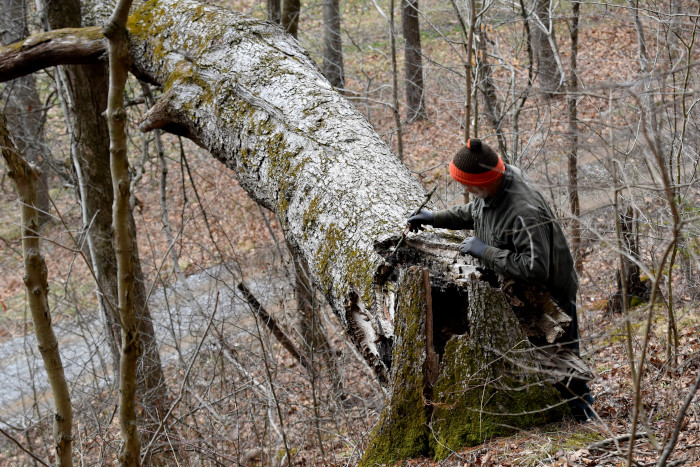
The resident lumberjack took some time to examine the next big chopping job: a tree dangling precariously in the woods alongside the driveway. It's an awkward spot to reach with a chain saw but at least there's nothing nearby that it will destroy when it finally falls. This mild winter means we haven't used as much firewood as we have in previous years, but it's good to be prepared. After all, winter isn't over yet, and that big snow may be coming just around the bend.


We took a walk around Hogue Wild today and found a few birds and buds, lots of mud to slip on, and plenty of signs of wildlife. Deer trails and scat dot the hillside, and our back yard is pockmarked with little muddy holes dug by skunks searching for grubs, which makes me miss my old Hopeful hound even more.
The resident lumberjack took some time to examine the next big chopping job: a tree dangling precariously in the woods alongside the driveway. It's an awkward spot to reach with a chain saw but at least there's nothing nearby that it will destroy when it finally falls. This mild winter means we haven't used as much firewood as we have in previous years, but it's good to be prepared. After all, winter isn't over yet, and that big snow may be coming just around the bend.


Tuesday, January 28, 2020
Feasts of words
It's probably a mistake to tell students that Stephen Crane didn't care much for college and so spent more time playing baseball than going to classes and never got a diploma but still managed to write two remarkable novels and a bunch of short stories considered among the greatest of all time and experienced adventures on Skid Row and in Cuba and Greece and in shipwreck and storm, and just think of what he would have accomplished if he hadn't died so young! It might give my students the idea that college is a waste of time when such adventures await, so I have to remind them that they're not Stephen Crane and unless they can write like Stephen Crane they'd better stay in their seats and keep learning.
And I probably shouldn't explain to my students how Colson Whitehead's John Henry Days echoes James Joyce's Ulysses in certain chapters, and I definitely shouldn't describe Joyce's prose so deliciously that the students are tempted to go find Ulysses in the library, and I shouldn't tempt them further by saying "nobody reads Ulysses these days because it's so long and complicated and demanding," because these students adore a challenge and my warnings may push them deeper into desire to open Ulysses and say yes I said yes I will yes.
And reciting lines from W.S. Merwin in front of students susceptible to the lures of alliteration is probably the wrong thing to do, because they might be tempted to follow that little warden of where the river went to its foxy lair when they ought to be focusing on the writing for tomorrow's class, and how can a student construct a competent thesis statement when that little vixen is running on the breathless night on the bridge with one end and scampering down the road that leads to places in the silence after the animals.
Frankly, I don't know how anyone gets any work down around here when we're so surrounded by prose that promises adventure and a feast for the senses--but while it's all laid before us, we may as well indulge.
And I probably shouldn't explain to my students how Colson Whitehead's John Henry Days echoes James Joyce's Ulysses in certain chapters, and I definitely shouldn't describe Joyce's prose so deliciously that the students are tempted to go find Ulysses in the library, and I shouldn't tempt them further by saying "nobody reads Ulysses these days because it's so long and complicated and demanding," because these students adore a challenge and my warnings may push them deeper into desire to open Ulysses and say yes I said yes I will yes.
And reciting lines from W.S. Merwin in front of students susceptible to the lures of alliteration is probably the wrong thing to do, because they might be tempted to follow that little warden of where the river went to its foxy lair when they ought to be focusing on the writing for tomorrow's class, and how can a student construct a competent thesis statement when that little vixen is running on the breathless night on the bridge with one end and scampering down the road that leads to places in the silence after the animals.
Frankly, I don't know how anyone gets any work down around here when we're so surrounded by prose that promises adventure and a feast for the senses--but while it's all laid before us, we may as well indulge.
Friday, January 24, 2020
So apparently it's not the end of the world as we know it
The best thing I've heard all week was a student--and not even an English major but a future petroleum engineer--telling his classmate, "I've already started accumulating my library."
Accumulating my library! The dream of my youth, but a dream shared by too few students these days. I'm still accumulating my library, but I'm also doing some weeding out because I'm running out of space to store my accumulations and the Kindle leaves me cold.
This week I've also heard the ping that tells me my home internet connection has been restored better than ever. No internet service at home for a whole week, no idea why despite running several tests, and then last night just as I was getting ready to do one final test, I hooked the wi-fi hotspot up again and suddenly had the strongest, fastest internet connection I've ever had at home. Who can explain it? Well, maybe Verizon could explain it if I got through to the right person, but I'm not terribly interested in dealing with their customer service again, especially when things are suddenly going so well.
I'm even seeing a little more clearly today after struggling with an eye irritation that kept causing my left eye to suddenly start weeping copiously for no apparent reason at the most inopportune times, like when I was observing a colleague's teaching. I had to go up afterward and explain that it wasn't his teaching that drove me to tears, but today I'm hardly teary-eyed at all and the world is far less blurry than it has been recently.
It's been a busy week and far less productive than I would have wished, but I can march into the weekend with eyes less prone to weeping, home wi-fi more responsive, and students inspiring me with their accumulation of libraries. As crazy and distressing as the world is today, I have to take my comforts where I find them and hope to avoid excessive weeping.
Accumulating my library! The dream of my youth, but a dream shared by too few students these days. I'm still accumulating my library, but I'm also doing some weeding out because I'm running out of space to store my accumulations and the Kindle leaves me cold.
This week I've also heard the ping that tells me my home internet connection has been restored better than ever. No internet service at home for a whole week, no idea why despite running several tests, and then last night just as I was getting ready to do one final test, I hooked the wi-fi hotspot up again and suddenly had the strongest, fastest internet connection I've ever had at home. Who can explain it? Well, maybe Verizon could explain it if I got through to the right person, but I'm not terribly interested in dealing with their customer service again, especially when things are suddenly going so well.
I'm even seeing a little more clearly today after struggling with an eye irritation that kept causing my left eye to suddenly start weeping copiously for no apparent reason at the most inopportune times, like when I was observing a colleague's teaching. I had to go up afterward and explain that it wasn't his teaching that drove me to tears, but today I'm hardly teary-eyed at all and the world is far less blurry than it has been recently.
It's been a busy week and far less productive than I would have wished, but I can march into the weekend with eyes less prone to weeping, home wi-fi more responsive, and students inspiring me with their accumulation of libraries. As crazy and distressing as the world is today, I have to take my comforts where I find them and hope to avoid excessive weeping.
Wednesday, January 22, 2020
When it's time to waive invisibility
My helpful colleague suggested that I wear a hoodie and dark glasses and slump down in a seat at the back of the room, so I said "Sure, and I'll wear a big name tag saying 'Not the Unabomber,'" but my colleague said, "Don't bother--they don't know who the Unabomber is anyway."
He has a point.
The larger point, though, is how I'm supposed to be inconspicuous when I observe teaching in a class with only two students enrolled. The question comes up periodically on the tenure and promotion committee, which sends multiple members to observe different classes on different levels and sometimes has no choice but to include low-enrollment classes.
In large classes, I generally sit in the back trying to be invisible so that the students forget I'm there, and I know it works because sometimes students in front of me do things they probably would not do if they remembered I was watching, like visit web sites one would not normally share with a professor. Once (this is true) I watched a videotape of a classroom that knew it was being videotaped and saw, right there on the videotape, a student watching porn on his laptop in the middle of class.
But those instances are rare. I've seen students check email and shop for shoes online, but mostly they just take notes, inspiring me to take note of the fact that they're taking notes. All we need is for someone to observe my observations and we'd have note-taking on my note-taking concerning students' note-taking, which seems a bit superfluous.
But I digress.
The point is that soon I'm scheduled to observe a class with only two students in it and I don't know how to hide in that kind of crowd. How does one escape notice in a room containing only four people, one of whom clearly does not belong? I suppose I could sit next to a ficus and try to look leafy, but alas, so few classrooms come equipped with potted plants.
Should I slip into the back of the room when students aren't looking--and scare the bejeebers out of them the first time I sneeze? Hide above the ceiling tiles--and evoke the climactic ceiling-collapse scene of Richard Russo's superb academic novel Straight Man? Or follow my colleague's suggestion and go full Unabomber?
It looks like I have little choice in this situation but to waive my right to invisibility and park myself boldly in the classroom without attempt at obfuscation. (But I'll slip those fake glasses with the big nose and moustache in my pocket just in case.)
He has a point.
The larger point, though, is how I'm supposed to be inconspicuous when I observe teaching in a class with only two students enrolled. The question comes up periodically on the tenure and promotion committee, which sends multiple members to observe different classes on different levels and sometimes has no choice but to include low-enrollment classes.
In large classes, I generally sit in the back trying to be invisible so that the students forget I'm there, and I know it works because sometimes students in front of me do things they probably would not do if they remembered I was watching, like visit web sites one would not normally share with a professor. Once (this is true) I watched a videotape of a classroom that knew it was being videotaped and saw, right there on the videotape, a student watching porn on his laptop in the middle of class.
But those instances are rare. I've seen students check email and shop for shoes online, but mostly they just take notes, inspiring me to take note of the fact that they're taking notes. All we need is for someone to observe my observations and we'd have note-taking on my note-taking concerning students' note-taking, which seems a bit superfluous.
But I digress.
The point is that soon I'm scheduled to observe a class with only two students in it and I don't know how to hide in that kind of crowd. How does one escape notice in a room containing only four people, one of whom clearly does not belong? I suppose I could sit next to a ficus and try to look leafy, but alas, so few classrooms come equipped with potted plants.
Should I slip into the back of the room when students aren't looking--and scare the bejeebers out of them the first time I sneeze? Hide above the ceiling tiles--and evoke the climactic ceiling-collapse scene of Richard Russo's superb academic novel Straight Man? Or follow my colleague's suggestion and go full Unabomber?
It looks like I have little choice in this situation but to waive my right to invisibility and park myself boldly in the classroom without attempt at obfuscation. (But I'll slip those fake glasses with the big nose and moustache in my pocket just in case.)
Tuesday, January 21, 2020
Blinded to the obvious answer
It's the easiest kind of reading quiz: print an excerpt from the reading on the quiz and ask students to analyze what that excerpt suggests about some relevant topic--in this case, what Longfellow's poem "The Fiftieth Birthday of Agassiz" suggests about the relationship between people and nature. Other quizzes will be more challenging, but this one early in the semester is intended to set a baseline, to show what conclusions students can draw about a poem that presents a metaphor as obvious as the nose on your face: nature as an "old nurse" tenderly teaching children what is written in the "the manuscript of God."
I tell them that there are many possible right answers, but I also point out that there are even more answers that are wrong, misguided, or incomplete. "Just be sure to support your response with evidence from the text," I tell them, and they do it, most of them.
Most students pick out the "nurse" imagery immediately and assume that it's referring to a medical professional rather than a nanny, but as long as they make the point that nature is trying to nurture and guide, I can accept that. A few argue that the poem portrays people as eternal infants dependent on nature's guidance, an interesting point we'll expand upon in class. With a few exceptions, the class performs well.
Those exceptions, though--I worry about those students. Generally they scribble superficial cliches with no apparent relationship to the reading; they repeat in several different ways the fact that the relationship between people and nature is complicated and deep without attending to the most obvious images in the poem, or else they offer arguments they think I want to hear (about how people take nature for granted by polluting too much) without offering a shred of evidence from the text. These are the students who will come up in a huff after class and tell me my grading is too subjective and the poem can mean anything to anyone, an argument that is true as far as it goes but willfully ignores the "nurse" metaphor that screams from every other line.
How can anyone ignore that screaming? Fear of poetry, I suspect, is the chief culprit, causing some readers to freeze when they see lines arranged in stanzas. Searching for secret meanings, they ignore the blatantly obvious. I need to know who these students are at the beginning of the semester, before we get to the less obvious stuff. (I'm look at you, Ralph Waldo Emerson, with your blighted "Blight.")
Every semester I waffle about whether to start with a really difficult reading quiz (to signal high standards) or an easier one (to establish a baseline). This time I went with the easy choice and learned something important about my students, but I warned them: the quizzes will get more challenging as time goes on as I lead them, like Longfellow's nurse, toward more distant and difficult adventures.
I tell them that there are many possible right answers, but I also point out that there are even more answers that are wrong, misguided, or incomplete. "Just be sure to support your response with evidence from the text," I tell them, and they do it, most of them.
Most students pick out the "nurse" imagery immediately and assume that it's referring to a medical professional rather than a nanny, but as long as they make the point that nature is trying to nurture and guide, I can accept that. A few argue that the poem portrays people as eternal infants dependent on nature's guidance, an interesting point we'll expand upon in class. With a few exceptions, the class performs well.
Those exceptions, though--I worry about those students. Generally they scribble superficial cliches with no apparent relationship to the reading; they repeat in several different ways the fact that the relationship between people and nature is complicated and deep without attending to the most obvious images in the poem, or else they offer arguments they think I want to hear (about how people take nature for granted by polluting too much) without offering a shred of evidence from the text. These are the students who will come up in a huff after class and tell me my grading is too subjective and the poem can mean anything to anyone, an argument that is true as far as it goes but willfully ignores the "nurse" metaphor that screams from every other line.
How can anyone ignore that screaming? Fear of poetry, I suspect, is the chief culprit, causing some readers to freeze when they see lines arranged in stanzas. Searching for secret meanings, they ignore the blatantly obvious. I need to know who these students are at the beginning of the semester, before we get to the less obvious stuff. (I'm look at you, Ralph Waldo Emerson, with your blighted "Blight.")
Every semester I waffle about whether to start with a really difficult reading quiz (to signal high standards) or an easier one (to establish a baseline). This time I went with the easy choice and learned something important about my students, but I warned them: the quizzes will get more challenging as time goes on as I lead them, like Longfellow's nurse, toward more distant and difficult adventures.
Tuesday, January 14, 2020
Adventures in editing, plus a love song to the semicolon
How many tabs can I simultaneously keep open at the top of my browser screen? As I begin the long process of editing essays submitted for the anthology I'm assembling, I find myself needing to refer repeatedly to Merriam-Webster (which is the preferred spelling, wacky or whacky?), the MLA Style Center (when do I need a suspended hyphen in late-nineteenth- to early-twentieth-century?), and the style guide for this specific book series (subheads: boldface or not?). I think I know MLA style pretty well, but the questions that come up in editing a collection of scholarly essays are more complicated than those I generally encounter in student work.
Fortunately, I'm the kind of person who gets a kick out of reading style guides, so all this attention to picky little details suits me just fine. I'm more concerned, frankly, about how to communicate with contributors, especially when substantive changes are needed. Educated people can disagree about placement of commas, but some scholars can take stylistic suggestions very personally. I'm trying to be diplomatic. I do not intend to get into any screaming matches over the suspended hyphen.
If only I could resort to poetry! In "His Love of Semicolons," Amit Majmudar elegantly defends a punctuation mark facing increasing neglect:
If I had to write elegant verse about every stylistic issue I encounter in editing these essays, I'd never get through them all, so I'm sticking to straightforward sentences in the indicative mood. No one is going to fall in love with my editorial suggestions as Majmudar fell in love with the semicolon, but as long as contributors don't scream at me, I'll be content.
Fortunately, I'm the kind of person who gets a kick out of reading style guides, so all this attention to picky little details suits me just fine. I'm more concerned, frankly, about how to communicate with contributors, especially when substantive changes are needed. Educated people can disagree about placement of commas, but some scholars can take stylistic suggestions very personally. I'm trying to be diplomatic. I do not intend to get into any screaming matches over the suspended hyphen.
If only I could resort to poetry! In "His Love of Semicolons," Amit Majmudar elegantly defends a punctuation mark facing increasing neglect:
The comma is comely, the period, peerless,I am in love, too, with the final line of the poem, which appears in two different versions. The online version ends with a full stop, but in his poetry collection Dothead, the line ends as it ought, with a semicolon.
but stack them one atop
the other, and I am in love;...
If I had to write elegant verse about every stylistic issue I encounter in editing these essays, I'd never get through them all, so I'm sticking to straightforward sentences in the indicative mood. No one is going to fall in love with my editorial suggestions as Majmudar fell in love with the semicolon, but as long as contributors don't scream at me, I'll be content.
Subscribe to:
Posts (Atom)