Saturday, September 05, 2020

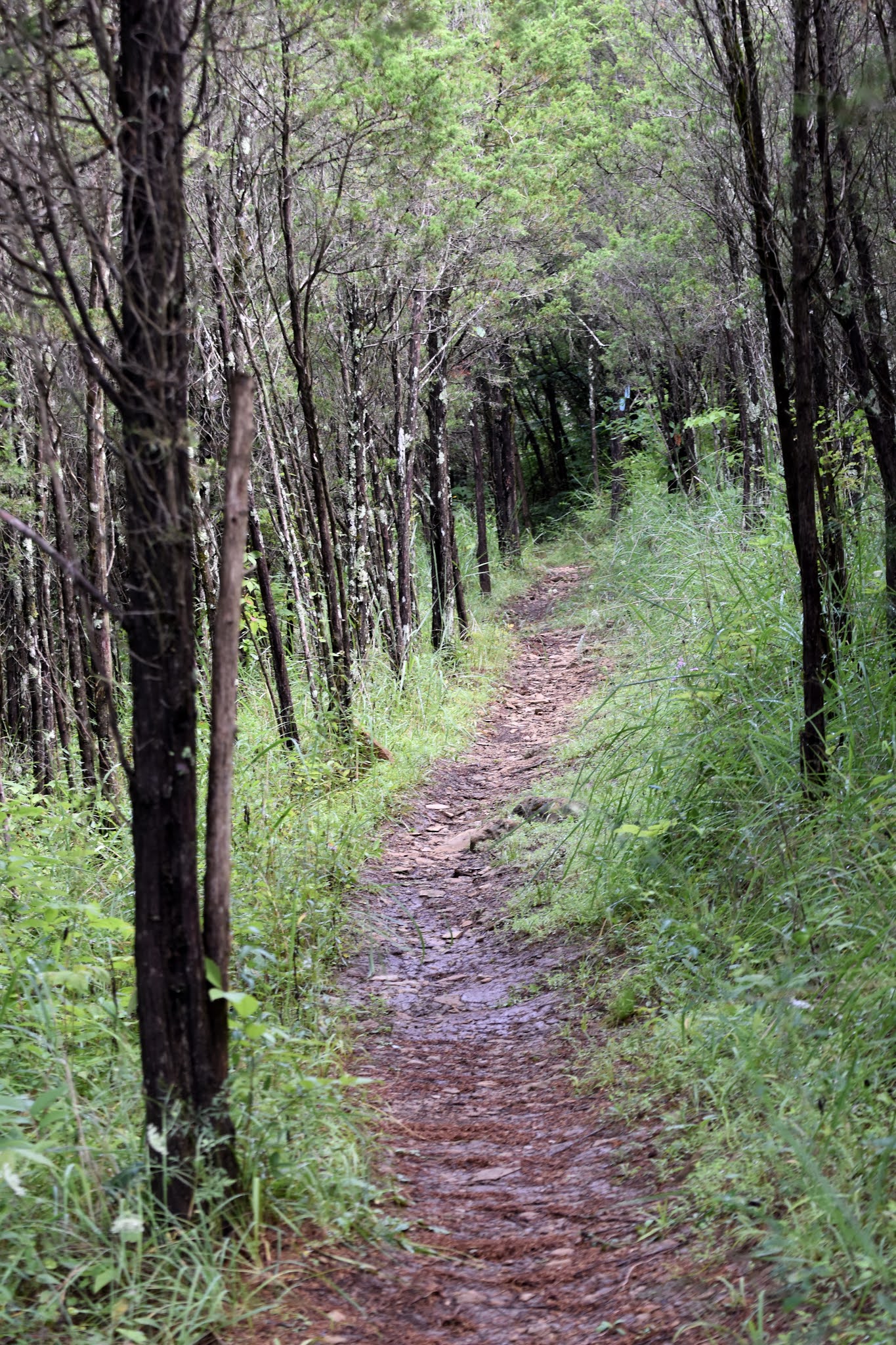
Catching the early light in sun-dappled woods

In the deep woods this time of year the only blossoms are so tiny they're easy to miss if you're not paying attention, and I must have being paying very poor attention this morning at Lake Katharine because I suddenly realized I'd passed by one of my favorite spots on the trail without even noticing.

I was a little preoccupied, trying to figure out how to persuade students that the online citation engine isn't always right because the result is only as good as the information you feed into it and if you don't know what the word "publisher" means or how to locate the name of the publisher, you're going to make a mess. But who wants to mull over such a muddle in the middle of the early-morning woods?

In the early light the woods are dark but dappled with sunshine. A hike that felt gruelling last week when the temperature was nearly 30 degrees hotter and the humidity was unbearable was much more pleasant today, and others must have agreed because I kept encountering other hikers. Recent storms had knocked a few limbs onto the trail, but nothing unsurmountable. And now, after such a refreshing hike, other obstacles seem less intransigent. Time to do some school work! 


Friday, September 04, 2020

High fives all around

This morning I asked my first-year students to give each other virtual high fives to celebrate the end of the third week. When simply being present in the classroom counts as a major victory, you know we're living through peculiar times.

And they get more peculiar by the minute. Later in the same class, the internet connection became unstable and Zoom kept disconnecting, which must have been disconcerting for the one student who was joining the class from quarantine but it was difficult for the rest of us too because every single time Zoom came back on again, that annoying computer voice would loudly announce, "This session is being recorded." I jumped every time that happened and it happened at least a dozen times.--and now I hear that I have a student in another class who has to quarantine. Just when my quarantined students are being cleared to return to one class, I'm going to have to start Zooming in another.

As it happens, I was giving my honors students some instruction in how to do their presentations that start week after next, and I reminded them that whatever technology they rely on, they should prepare a Plan B just in case. The wonky tech in the classroom provided plenty of examples to support that claim.

But things are going well enough. On the tenure and promotion committee we're figuring out how to observe and evaluate teaching in a variety of settings, so by the end of the semester we'll be experts on all the different ways our colleagues are managing pandemic pedagogy. I've been having Zoom conferences with my composition students, and as much as I miss having people in my office, we're getting the work done despite everything. And the sunflowers are blooming. Who gets the high-five for that?


Tuesday, September 01, 2020

Coming to terms with how it's not supposed to be

Two weeks into our Brave New College World, this strange hybrid method of teaching is starting to feel sort of almost normal. Yesterday morning, in fact, I had such a great 8 a.m. composition class that I thought it was a sign that all my tech troubles were over--and then I went to my 9 a.m. class, where everything went kerflooey. 

Still, after two weeks of troubleshooting, lots of troubles have been well and truly shot. I still bristle over the number of clicks I need to execute in the correct order just to get my class up and running for students both in the room and on Zoom, but I'm making it work smoothly enough most of the time. A new camera setup and new audio settings have made the Zoom recordings of my classes more useful for absent students, although the written transcripts are still problematic. (How did the Philippines sneak into our discussion of Fritz Lang's Metropolis? And what is anyone supposed to make of this random collection of words: "Which will prevent to us were spectacular for the tiger"?)

But still many times every day I suffer this sinking feeling that things are just not right. This isn't the career I signed up for! Where are the teaching joys of yesteryear?

So it's a good time to be teaching Henry Adams's "The Dynamo and the Virgin," in which the aging historian confronts the massive forces arrayed in the Machine Hall at the 1900 Paris Exposition and realizes that nothing in his prior experience has equipped him to understand this new world of force. His culture is on a conveyor-belt moving swiftly into a mechanized future while he looks on from the sidelines, clinging feebly to the tower of a crumbling cathedral. "All the steam in the world could not, like the Virgin, build Chartres," he says, but to the passing throngs propelled by dynamos into the future, the cathedral is just a blur fading hopelessly into the distance.

I hope that our new way of teaching does not become so consumed by technology that it tamps down on art and creativity and serendipity and, dare I say it, magic. These days I'm too busy clicking and troubleshooting to make room for magic, but yesterday I felt it in my 8 a.m. class when a group of relative strangers in a room experienced the alchemy that turns leaden learning into golden understanding. It won't happen every day but if we can still, despite everything, make room for magic to happen in the classroom, then I'll be content. 

Almost. Mostly. Nearly normal.

Friday, August 28, 2020

Which way is Up? No, seriously, I need to know!

At a difficult moment a student asked me how I'm doing and I calmly replied, "Well, I'm falling to pieces but I'm trying to do it with dignity and grace."

I'm not sure what provoked that response--possibly the newly altered traffic pattern in my building, where I've struggled mightily to train myself to use the correct staircase and doorway for up or down or entry or exit but now, after two weeks of classes, suddenly they've switched the directions on the staircases so that down is up and up is down. I'll have to retrain my mind and body all over again. Small thing, but the small things keep piling up and bumping into big things.

Like the virus. We have a case. A student in one of my classes tested positive so that student and everyone who sat nearby has to quarantine, which means they have to join the class discussion via Zoom, which we can manage except when they're too sick to click, and then I'm supposed to make the class recordings available to the absent students.

So I thought I'd listen to the class recordings and all I can say is: Houston, we have a problem. In some classes the Zoom recordings are clear, although they're not great at picking up comments from students beyond the front row. In other classes the recordings are all but inaudible--and the written transcripts aren't any better. Transcripts simply aren't available for some of my classes, and the ones that are available are absolutely excruciating to read; not only do they transcribe every repetition and false start and "um" and "like," but they sometimes produce gibberish, transforming "major essay" into "made your essay" and somehow producing out of thin air the phrase "and grandson a spreadsheet." (Don't ask me. No idea.)

Today I get to test out a lapel mike, which ought to solve the Zoom recording problem while also equipping me with one more piece of technology to screw up. Provided that I can find my way to class first. My next task: trying to figure out which way is Up. 

There is no way for someone on my floor to exit by this door.


Thursday, August 27, 2020

A little spider-centric self-care

 It's self-care day! No classes for me and no meetings until 4 p.m. so I decided to sleep in (until nearly 6 a.m.!), do a little housework, and then head up to the Luke Chute pollinator habitat for a morning hike, and my goodness was I glad I remembered to carry my walking stick to clear spider webs from the path. I mean, spider webs are beautiful but I prefer not to wear them on my face. Thistle, ironweed, and pokeweed were towering over the path and I saw a few butterflies and birds, but mostly I relished the placid river, green woods, and colors. 

And the spiders. Let's not forget the spiders. 


Tuesday, August 25, 2020

Next time I'll make my own sandwich

For all my griping about technology sometimes it works wonders, like this morning when a former student working on an article for a magazine asked if I knew an expert on a fairly esoteric topic and I knew just the person. The student texted me on my phone and I sent a message via Facebook to my contact, who gave me an email address to give the former student, completing a circuit that only worked because of the presence of a human being in the middle--me!

For a moment I felt like Charlie Chaplin's Little Tramp character in Modern Times, when he's moving smoothly through the gears of the machine without being ground to pieces. Sometimes, though, the machinery doesn't work quite so smoothly and someone gets crushed, as in last weekend's tech fiasco or the big Zoom outage yesterday or, on a smaller scale, today's lunch.

I've been bringing my lunch to work, see, packing a sandwich and a few cherry tomatoes in a bag so I can sit outside by the butterfly garden in the middle of the day and enjoy a few moments of peace. Today, though, I didn't bring my lunch to campus, so I thought I'd do my part to stimulate the local economy. But blood-pressure-wise, a crowded food venue is the exact opposite of the butterfly garden; I'm just not comfortable lingering in a small space with a large number of people, so I thought I'd try the campus food service's new online ordering system.

Except it doesn't work. Online ordering will be available "soon," whatever that means. So okay, I can stimulate the local economy by going off campus, and guess what--my favorite farm market offers online ordering! So I went to their website, ordered my favorite sandwich, put in my credit card number, and headed for the car. Road construction delayed me a bit so I arrived long after my sandwich should have been ready, but it wasn't. They had no record of my order--lost in the ether. They kindly invited me to order in person, which would require standing in a long line of people crammed into a small space, but I could feel my blood pressure rising so I politely declined. 

No, I did not get my money back. That's how nervous I am about crowded public spaces: I'm willing to forfeit $5.99 to avoid standing in a crowd long enough to get a refund on a lost order.

So I left, but I was still hungry. By that point every fast-food place I passed had a massive line of cars waiting for the drive-through, and wouldn't it be interesting to know the environmental impact of all those cars idling in drive-through lines all over the world? But I saw a McDonald's with a short line and zipped on in there, only to discover that the menu offers very little that I found appetizing. But after my long detour to the farm market I needed to get back to campus so I ordered food that I didn't even like just to get out of there.

Clearly the technology is not entirely at fault here. I mean, I wouldn't have had such a lousy lunch if I'd made my own sandwich or overcome my fear of crowded public places, but I've spent so much time kicking myself for my frequent technological snafus lately that I really need another target lest I become little more than a walking bruise, so I'm going to blame the online ordering system, which ground me up like a fast-food burger and spat me out in an unappetizing heap.

Monday, August 24, 2020

Time to hide all the crowbars

On the first day of class, my film students watched two brief video clips--the copier-smashing scene from Office Space and the driving-the-car-into-the-lake scene from The Office--and then wrote about how the clips portray the relationship between people and machines. I was surprised by how many of my students had never seen Office Space and by how much sheer joy I can still get out of watching those guys whaling away at a copier with a crowbar.

I've returned to that scene in my mind many times in the past week: When I stayed in my office hours after my final class on Friday to try to repair a tech problem, and when I returned to my office Saturday morning and again Sunday morning to continue wrestling with the issue, and when I learned that I'll have to accommodate the needs of another distanced learner who will be attending every class via Zoom, and then this morning when I learned that Zoom is suddenly not working at all, so that my Comedy class's first foray into Zoom teaching will have to be postponed.

But the class itself is not postponed: Zoom is down but Moodle is available, so I emailed my Comedy students to tell them I'd post an online discussion activity on Moodle to take the place of today's class. And so I sit here in my office once again scrambling to rescue what remains of today's lesson plans and trying not to cry. (Again. Tears have appeared nearly every day since classes started, mostly tears of exhaustion after I finally get home, which I'm doing a little later every day with not an ounce of energy left for whatever needs to be done at home.)

I'm not a violent person but if I routinely kept a crowbar in my office, you know what I'd be doing right now, right? 

I keep hearing that old-fogey faculty members need to get with the program and adapt to the demands of technology, and I'm trying! But sometimes the technology doesn't work, and sometimes the labels on the remote-control for the classroom projector are too small for my old eyes to read, and sometimes my students submit documents in a form my computer can't read, so I have to be nimble, flexible, agile, and resilient.

But one of these days I'm getting my hands on a crowbar, and when that day comes--look out!


Friday, August 21, 2020

With a little help from our friends

It's hard enough to be expected to believe six impossible things before breakfast, but now we're supposed to do many things daily that seem impossible: to have frequent contact with students while avoiding viral spread, to adapt to unfamiliar technology in unfamiliar classrooms where that soft-spoken student who sits in the back is so far away that there's no hope of hearing her through her mask, to conduct effective class discussion among students who aren't in the same room, and on and on, every day a new challenge. Today's minor challenge was making sure my mask was rightside-up, and just go ahead and kick me for buying a mask that requires that much attention.

I've been baffled a few times this week but never more than when a neighbor knocked on my door the other day and told me that a deer had run across the road in front of his car and leapt down the embankment to the creek, breaking its legs in the process. It was lying there suffering on the creek bank on our property, so the neighbor suggested that I put it out of its misery.

With what--an eggbeater? I could recite poetry until the young buck died of boredom, but I don't believe that's what my neighbor had in mind. Impossible! So the neighbor offered to go get a gun and pretty soon we had a whole host of neighbors I never see out along the embankment offering suggestions, and then we had a carcass on our hands. The situation provided sad evidence of the brutality inherent in everyday life, but on the other hand it was a handy reminder that tasks that seem impossible sometimes just require a little help from our friends.

Today I was teaching in an unfamiliar classroom when I encountered a tech glitch that I feared would destroy my lesson plan, but fortunately I was able to nab a passing colleague who teaches down there all the time and together we worked it out. If we're asked to do the impossible, it's good to have helpers nearby who have the right tools to solve the problems, and if they can do it without leaving behind a smelly carcass, so much the better.

If I wear it upside-down, the books will fall off the shelf.

Thursday, August 20, 2020

Small change, big impact

It's a cliche already to talk about how exhausting it is to teach classes via Zoom--to keep track of all those faces and try to lead a big group in a meaningful discussion--but yesterday when both of my first-year classes were meeting on Zoom I tried something new: instead of constantly looking down at my notes, I tucked them in my handy-dandy little gizmo that holds papers upright, so I could have my notes at eye level throughout the discussion. Not sure why it never occurred to me to do this when I was teaching for weeks and weeks on Zoom last spring, but I guess I'm just glad to find a small change that can make my work just a little bit easier.


Monday, August 17, 2020

New adventures in teaching, armed with masks and shields

At first my students couldn't hear me, which is not surprising given the way face masks muffle sound and prevent projection. So I switched to the plastic face shield so they could hear me but then I couldn't see them through my fogged-up glasses. So it was a rough start for both of my early classes today, but nevertheless it felt great to be back in the classroom.

Well, mostly great. Coronavirus-inspired anxiety about being in the presence of groups of people led to an upset stomach and a nasty taste in my mouth, and I left my travel mug of strong black tea in the car when I got to campus this morning so I approached my classes insufficiently caffeinated.  But somehow we carried on and did all the usual first-day-of-class things plus some unusual things, like reminding them of the all-college mask policy (100 percent compliance so far!) and the new traffic patterns inside the building and the procedure for attending office hours online.

And speaking of traffic patterns, I'm accustomed to teaching my two early classes back-to-back in the same room, but social distancing required moving the second, larger class to an improvised classroom space on the top floor of the library, so I'm dashing across campus between classes and hoping not to arrived covered in sweat. But I won't be doing that on Wednesday, when my two first-year writing classes will meet via Zoom. That will be the pattern this semester: two days each week face-to-face, one day on Zoom. Fortunately, all but one of my first-year students have used Zoom previously.

My two literature classes will be more complicated. I have some students with health issues that prevent them from being in class face-to-face, so they'll be participating remotely via Zoom all the time. I'm a little nervous about how well I'll manage class discussion in a class where some students are sitting right in front of me while others are on a screen, but I'm hoping that after a few weeks it will become second nature.

And then there are the clicky issues. The other day I practiced the steps I will need to share a bit of video in a class containing both face-to-face and online students, and it's just a ridiculous number of clicks: turn on the volume button on the main console, check the volume level on the computer desktop, cue up the video, click on "share screen" in Zoom, make sure to click on that tiny "share computer sound" button at the bottom of the screen, and start the video. Skip any one step or do them out of order and you're back to square one.

Every new complication means one more way things can go wrong, all stacked on top of my usual start-of-semester concerns, like learning students' names. I suggested this morning that they ought to wear masks with their names emblazoned across them, but my suggestion was met with a distinct lack of enthusiasm. But just wait until Wednesday! I'll see their smiling faces all over my computer screen with names right underneath. Provided that I can make the tech work correctly.

On Wednesday my Honors students will dive right into Homer's Odyssey, accompanying Odysseus and Telemachus on their journeys into the unknown, where they will meet various monsters and overcome unexpected obstacles, but for all of us who are back in the classroom, this entire semester will be an odyssey. Odysseus would scoff at fighting the Cyclops armed only with cloth masks and plastic shields, but if that's what we've got to fight our monsters, I guess we'd better carry on and hope for the best.

Wednesday, August 12, 2020

It's the little things I miss the most

I miss the pastries.

Gather 'round, young 'uns, while Granny tells you what life was like in the old times, before the virus banished us all to isolation inside our phones. We used to have big gatherings of people--hundreds and hundreds of people--all inside the same room, mingling promiscuously, gabbing, hugging, laughing in each others' faces--without masks.

Every year about this time the College would gather all employees--faculty, staff, administration--for Fall Convocation, where we would welcome new employees and hear presentations about the state of the College and the challenges ahead, and since you can't expect several hundred people to sit quietly for three hours of PowerPoint without some sort of incentive, we would all be given goodies (like a new College t-shirt or, one year, a branded multi-use tool that I never found a reason to use) and plied with coffee and pastries.

Coffee I can live without--and in fact I've been living quite well without it since early March--but I do miss those pastries, especially the flaky little knots filled with apricot yumminess. We would gather up our goodies and sit at tables surrounded by friends and colleagues, chatting away and catching up on how we'd spent the summer, and those of us who sat in the back could lean in and make snarky comments during the PowerPoint presentations. Given the uneven distribution of PowerPoint skills, there was always something to snark about. 

One year (this is true) they didn't give us a rest-room break. You can't put several hundred people in a room, ply them with coffee, and then subject them to three hours of PowerPoint without a rest room break. That's got to be a violation of the Geneva Conventions.

Well that won't happen this year. Fall Convocation is all online, and until someone invents an app allowing YouTube to serve coffee and pastries, we're on our own for refreshments. There will be no hugging, no chatting, no laughing in each others' faces, and while I'm free to make snarky comments to my heart's content while watching the event from my office, solitary snark is no fun.

But it's probably more fun than being hooked to a ventilator in an ICU, so we do what we have to do to carry on so that we'll survive long enough to tell the tale to our grandkids.

It's just not the same.


Tuesday, August 11, 2020

Unpixelating my eyeballs

Stare at computer screens long enough and everything starts looking pixelated, so I stepped outside my frigid office to eat lunch in the sunshine on the college mall. Once again the grounds crew has outdone itself by planting cutting gardens that attract pollinators--butterflies and bees buzzing from blossom to blossom. I didn't have my good camera and even if I did, I couldn't capture the majesty of the sunflowers stretching into the sky, but I enjoyed the buzzy quiet and the beauty of the blooms, with not a pixel in sight.


It's hard to see, but that center sunflower is at least ten feet tall.


Monday, August 10, 2020

Avoid the Day: Feeding the inner gargoyle

 Jay Kirk's new book Avoid the Day carries the subtitle A New Nonfiction in Two Movements, and if you're wondering A new nonfiction what?, join the club. Is it memoir, travel narrative, exploration of the collective unconscious through myth, or frenzied fever dream? Maybe all of the above?

If nothing else it's entertaining, except when it isn't, and here I'm referring to large chunks of the second movement when Kirk immerses us in an attempt to film a horror movie while on a ship exploring the Arctic. It's a deep dive into his personal neuroses involving visions of a muddy hole, a fire-hungry father, and a menacing dentist, and if you're giving away free tickets for that particular cruise, count me out.

The first movement is more fun, when Kirk seeks a lost manuscript of a Bartok quartet. Kirk retraces Bartok's travels through Transylvania, where the composer recorded folk music on wax cylinders and where Kirk's digital recorder breaks down when he needs it most. He draws a connection between Bartok's recordings and his own writing: "His whole method relied on this advantage: to go out into the world, collect bits of direct experience, make faithful transcriptions, then feed it to his inner gargoyle."

The problem, however, is that Kirk's inner gargoyle can be a pretty unpleasant creature, and he swiftly loses faith in his ability to gather "bits of direct experience" because everything he experiences becomes weighed down with meaning and morphed into something indirect and inauthentic and inaccessible, until he admits "an acute allergy to experience itself":

I had long suspected that my instruments for recording these experiences were little more reliable than a Xerox on the fritz. Mine maybe more than others. Memory being, of course, the defective machine spitting out its trickster distortions. The original memo--if there ever really had been one--was lost. The problem, no doubt, was that I had given myself over to thinking too much about the idea of experience.

Throughout his travels in Eastern Europe and the Arctic, he perceives experience through a scrim of myth and memory in a frantic search for meaning constantly derailed by rabbit trails splitting off and joining up again until everything seems connected in one massive labyrinth. During aforay into connections between Mary Shelley's Frankenstein, Virgil's Aeneid, and Egyptian myth, he finds "A bird-faced god sinking into the underworld in a boat. Everything entrapped by symbol, a sign to look elsewhere, to something not itself, the eternal spasmodic deferral of meaning." 

Kirk himself can't resist making such connections, multiplying clever similes as in this description of icebergs encountered on his Arctic expedition: "Slabs tilted like massive white piano lids, cracked and split, as if we'd crashed into a piano factory....Out the window the passing ice fields look like thousands of unhinged white doors. Like a torn-up suicide note shakily reglued. Like the ruins of the sun." The comparisons are playful and visual, but they also gain resonance in context, where Kirk has been obsessing over the impact of ever-present Arctic sunshine, the role of the sun in various myth systems, the presence of music in the the hum of existence, and the lure of suicide, which would allow him to escape from "the eternal horror show of connectivity. The never-ending hum of the pattern machine." 

Dead men tell no tales so I'm probably not spoiling the plot by revealing that in the end he does not kill himself, but after his bizarre and baroque explorations of myth, memory, and experience, he finds himself suspended between wheeling birds and the underworld, hovering over "The still blue hole. Like a pulsing orb at the center of this dark wheel of noise." And while parts of the book may be unpleasant, Kirk's willingness to drill beneath the surface and let us see the orb and hear the hum make Avoid the Day a trip worth taking. Just be sure to take along your seasick pills and a warm blanket.

Saturday, August 08, 2020

Some updates and a brief celebration before panicking

My birding-and-botanizing buddy has provided identifications for some wildflowers I didn't recognize last week:

Partridge-pea, or Chamaechrista fasciculata

Heal-all, or Prunella Vulgaris

Hairy Ruellia, or Ruellia Caroliniensis
 

Also, my colleague the dragonfly expert has identified this as a Tiger Spiketail, rarely seen in Ohio (only two confirmed sightings this year):


Finally, and here I demonstrate my highly developed ability to bury the lede, this morning I finally submitted the full draft manuscript of the comedy text to the editors, which gets that massive project off my back just in time to allow me to panic over how unready I am to start teaching in a week! Right now I live in this odd environment of mingled panic and pride; I don't know whether to jump for joy or tear out my hair, which would certainly solve the haircut dilemma. But for five minutes I'll allow myself to celebrate: woo-hoo it's done! There will be plenty of time to panic after that. 

Friday, August 07, 2020

Shaggy, blurry, and profoundly unrelaxed

Lately people keep telling me to just relax, which is good advice except that it's generally given at a time when relaxation is impossible, like yesterday afternoon, when I went to my optometrist's office for my every-six-months check to see how my cataracts are progressing and whether my glaucoma numbers are getting any worse, and I had to sit with my chin perched uncomfortably on a hard plastic frame while they first shot puffs of air into my eyeballs over and over again (because I kept blinking and wrecking the test) and then made me focus on a bright yellow light and push a button whenever another light flashed but I wrecked the test again because I couldn't keep staring at that yellow light without occasionally looking away and everything was going blurry and dark, and frankly, relaxation is the last thing on my mind when someone is messing with my eyeballs.

Just relax, they said. This will be over soon, they said, but all I can say is: not soon enough.

I've been told to just relax while trying to learn new technology to use in my classes this fall, even though the thought of trying to manipulate all this tech in front of a room full of students (or a Zoom full of students) just over a week from now fills me with dread, and I've also been asked repeatedly whether I'm willing to be a guinea pig to test new procedures before they get released on the full campus, most recently when I had to get a new college I.D. because I wrecked the old one (long story) and the I.D. is now essential for basic needs like getting into my building and making photocopies, so I said Fine, try out your new I.D. photo process on me, and I tried to just relax even though I hate getting my photo taken under any circumstances, and the result is a photo that makes me look squashed and desperately in need of a haircut, which is accurate but not reassuring. 

I did get a haircut, finally, in June when the salons started opening up again, but then I was a captive audience for a stylist who couldn't stop spewing ignorant conspiracy theories that destroyed my ability to just relax, so I haven't been back for a trim since then even though my bangs are now longer than they've been in at least a decade. I don't want to be a guinea pig for anyone's loony theories, and I can't just relax when the person waving scissors within an inch of my face is clearly committed to the absolute destruction of the human race, so for the moment I'm letting my hair stay shaggy while wearing colorful masks to distract people from the mess.

I used to find haircuts relaxing, a guilt-free opportunity to sit quietly and do nothing, but now, like so many other ordinary events, haircuts are fraught with danger. I can't just relax in the stylist's chair or at the grocery store where shoppers demonstrate every possible misunderstanding of how masks work or on campus where I'm constantly banging my head against various new technologies or even in my bed when I'm sound asleep until some raging doubt about the syllabus alerts me at 4 a.m. and demands immediate attention. Squashed by anxieties and blinded by blurry eyes and shaggy bangs, I bumble my way through my days just hoping not to make too big a fool of myself. Under current conditions, that may be the best any of us can hope for.


Saturday, August 01, 2020

Too many tweaks spoil the syllabus

Lately I keep repeating the same vicious cycle of syllabus-tweaking: make a change to an assignment to accommodate pandemic conditions, adjust surrounding assignments so they work well together, and then wake up suddenly in the middle of the night realizing that I need to change it all back again.

The issues are tiny individually but awkward in aggregate. Here's just one example: in a sophomore-level literature class full of (mostly) non-majors, my usual practice is to give unannounced reading quizzes about once a week to encourage students to keep up with the reading and to introduce them to the kinds of questions they'll encounter on exams. However, I also need to minimize paper-passing, so okay, let's put the quizzes online. But then I would need to either let students take the quizzes outside of class (in which case I have to get involved with online proctoring, which seems like a lot of fuss for a 10-point quiz) or else require them to bring laptop computers to take the quiz in class--while I try to monitor 18-20 computers for cheating in a classroom set up for maximum social distancing.

Just thinking about it makes me want to lie down.

So okay, we can skip the reading quizzes and come up with some other kind of reading response, which requires yet another series of tweaks to the syllabus until I figure out that my plan is once again flawed and I have to go and do the whole thing again. And that's just one class. I'm teaching four different preps starting two weeks from now. I foresee a lot of hand-wringing and sleepless nights in my immediate future, until I realize that I'm just not going to be able to produce the perfect class under current conditions. Maybe what we all need to do is stop tweaking and embrace the imperfections.

Yeah, right. You first.

Friday, July 31, 2020

Exploring the Edge of Appalachia

I think I know a thing or two about Ohio's wildflowers, but all I have to do is travel a little off the beaten track to find out how little I know.

This morning we visited the Edge of Appalachia Preserve, which, at 20,000 acres, is among the larger wild areas in Ohio. The preserve is operated as a partnership between the Cincinnati Museum Center and the Nature Conservancy, and since we are longtime supporters of the Nature Conservancy, I've often read about the preserve and wanted to visit. It's a little far to drive from our house, but from Jackson it's only an hour and a quarter southwest, so we strapped on the canoe, packed a picnic lunch, and headed out, scoffing at the rainclouds the whole way.

The preserve is nestled among tall hills on the southern edge of Ohio, and Ohio Brush Creek winds along the edges through tall grassy banks and overhanging trees. Brush Creek is a little low this time of year but heavy rains last night raised the water level enough to allow us to paddle some distance upstream from the State Route 125 bridge. We had to get out and portage at a few low rocky spots, but we enjoyed seeing multiple kingfishers criss-crossing the creek and huge swallowtail butterflies fluttering among the tall summer wildflowers on the banks.

After a few hours we squelched out of the creek in wet boat shoes and ate lunch in a shady spot where catbirds and a Carolina wren provided free entertainment, and then we decided to hike one of the many trails that weave through the preserve--even though we'd both forgotten to bring our hiking shoes.

The woods and high prairie openings were buzzing with pollinators visiting flowers I could not identify, although I'm going to spend some time trying. We'd made it most of the way up the Jane Jones Portman Trail when we were stopped by a snake stretched across the path; when my husband tried to gently urge it off the path with a stick, the snake reared up and staked out its territory. By this time our boat shoes were heavy with mud from the trail and the sun had finally come out from behind the clouds, so we were ready to turn back anyway. We left the snake in possession of the trail and went back to our van.

We spent a total of four or five hours at the preserve, but that whole time we never set eyes on another human being.  Birds, yes, and butterflies and a snake and some large animal tracks in the woods and fish jumping from the creek, but no people. We saw only a small piece of the 20,000 acres in the Edge of Appalachia Preserve, but that taste only made me want to go back and see some more. I like to think that some of my donations to the Nature Conservancy have helped to keep the preserve going, and if that's the case, it was money well spent.


What is this?

I think this is a rose pink.

No idea what this is.


Or this.


I don't know what this is but I love the red stem.

I think this is nodding onion.


Near the start of the Jane Jones Portman Trail. A little muddy.

Goldenrod is just starting to bloom.


Turkey vulture high above the creek.

Too dim early this morning to get a good pic of this great blue heron.

Ohio Brush Creek.


Monday, July 27, 2020

Not quite nimble enough

You want nimble? I'll show you nimble: when my two larger classes grew too big for socially distancing in their assigned classrooms, I adjusted my syllabi based on the assumption that I'd have only half of my students in the room at a time. And then when I learned that the Powers That Be had conducted a mass shuffling of classroom assignments to allow most classes to meet all together, I cheered and started adapting my syllabi to new conditions.

And then this morning I went to look at my two new classrooms and found that they're not my favorites but I can adapt. I mean, I know some of my colleagues really love old-fashioned chalkboards, but I don't; on the other hand, if chalk dust is the price I have to pay to fit all my students in the same room, I'll manage. And I have a firm policy against teaching in rooms with raised platforms or steps because of my proven ability to fall on my face in front of students, but again, I'll manage if it means keeping my students together.

So I thought I was all set to finish up my syllabi until I decided to take one last look at the online course schedules and found that one of my larger classes has been moved from the big chalkboard room back to the smaller room where they'd started out. And sure, okay, I can adapt to new information, but when was someone planning to inform me of the change? And how do I know the location won't be changed again? My new teaching nightmare come to life: showing up ready to teach on the first day of class but I can't find the classroom. Nobody is nimble enough for this mess.

Bev be nimble, Bev be quick,
Bev can change her classes--quick!
Move 'em here, move 'em there,
Bev can teach 'em anywhere.
Bev fall down and breathe chalk dust,
but she'll teach there if she must!
There's just one place Bev can't bear
The undisclosed location. (WHERE?!)


Saturday, July 25, 2020

Finally, blossoms (blurry)

Finally, the rattlesnake plantain orchids are blooming at Lake Katharine! Kind of a bad time to have left my camera bag sitting on a bench inside my front door 80 miles away. My phone camera just doesn't perform well under low-light conditions, so everything is a bit blurry. Maybe next weekend...


Friday, July 24, 2020

No tiara for the pristine princess--or, emerging from an emergent condition

The high point of my recent 24-hour immersion in the health care maelstrom occurred when a doctor looked at an MRI and pronounced my brain "pristine." Unfortunately, though, they don't give out tiaras for pristine brains, and I don't even want to think about how much the hospital is going to charge for all the tests required to inform me that there's probably nothing wrong.

It all started on Wednesday when I was sitting at the desk in my office and suddenly felt like I was having a heart attack--a not unreasonable assumption considering my family history of heart problems and the pain and pressure in my chest and jaw. The pain subsided after about five minutes, only to be replaced by numbness in my right arm and the right side of my face and tongue.

So I called my doctor's office, where they told me to go to the Emergency Room immediately, which I did. I drove myself there (it's only a few blocks) and walked in feeling pretty much okayish and I was immediately surrounded by a flurry of people focused on determining whether I was having a stroke. I don't know how many people were in the room but I can tell you that it's no picnic trying to comply with the resident's request that I read five sentences while a phlebotomist was jabbing a needle in my arm. (She got it on the first jab. If anyone deserves a tiara, she's the one.)

Next came a barrage of tests and the decision to keep me under observation overnight, and they weren't talking about passive observation: sleep was impossible given the constant stream of people needing to ask me the same questions and put me through the same tests over and over and over.  (Please, if you love me, don't ask me my birthdate or tell me to touch my finger to my nose any time soon). I got poked and prodded and hauled off to CT--they wouldn't let me walk anywhere even though I kept insisting that I felt fine. As test results trickled in, I kept hearing that there was probably nothing wrong but they were going to run a few more tests just to be sure.

By morning I was still in the dark about what had caused my alarming episode and I really wanted to go home, but they told me early in the morning that they needed to run just one more test and then they'd release me. Great, I thought, I can make my 11:00 meeting!

Ha!

The test got postponed again and again, and I was left to my own devices for another six hours, with nothing to do but watch home improvement shows on a TV set so high on the wall that it hurt my neck to look at it. My cell phone had long since died and I had not had the foresight to carry a book or laptop computer with me when I left my office. I was what they call emergent, but now all I wanted to do was emerge from the hospital and go back to whatever semblance of normal life I could manage after a sleepless night and an onslaught of health care.

I have to say that every single person I encountered at the hospital was helpful and competent, and I have no complaints about the care I received except to note that six hours is a long time to spend waiting for anything, much less an unpleasant medical test. I've endured dozens of CT scans over the years but the MRI scan of my brain was the worst, triggering my claustrophobia and threatening a full-blown panic attack. But I managed my breathing and remained calm by mentally taking myself outside the confined space and imagining my favorite hike at Lake Katharine, which reminded me that there's a whole big world out there outside the big noisy machine.

In the end I emerged from the hospital with a wobbly diagnosis--I may have suffered a bad case of heartburn or a migraine variant, but it may have been a TIA, the kind of mini-stroke that doesn't cause lasting damage but may portend worse strokes to come. So I'm on a couple of new medications and I'm due for a follow-up in a few weeks.

Meanwhile, I feel fine, if a little ridiculous over causing all that fuss and bother (and expense--I don't even want to think about it) over what might have been indigestion, but on the other hand, I keep reading about women who ignore heart-attack symptoms and then get suddenly struck down. So I guess I'm relieved that everything seems to be perfectly fine, and if nothing else, I can hold on to the assurance that no matter how hard I may be working my brain, it's still in pristine condition. Here's hoping that it stays that way for a long time to come. 

Wednesday, July 22, 2020

Baffled by unbaffled beasts

Can a squirrel-proof birdfeeder deter a clever raccoon? I look closely at the online description and find the words "dismantles easily for filling and cleaning," and I know it's hopeless. The raccoon family that has developed a talent for removing and dismantling my largest birdfeeder--knocking it off the pole and unscrewing the top to dump out the birdseed--is not going to be dissuaded by a squirrel-proof feeder that "dismantles easily." If I can dismantle it, so can the raccoons.

We stopped filling the smaller feeder under the sweet-gum tree about a month ago after waking to see a whole family of raccoons using as a buffet, but the big feeding station seemed impervious to raccoons, sitting high on a tall pole protected by a baffle. But somehow all summer we've seen feeders go from full to empty overnight, and the perforated metal base of the feeding tray keeps ending up on the ground. Squirrels, I thought, jumping over from the tree or the birdbath.

But we kept filling the feeders until it became apparent that something bigger than a squirrel was somehow baffling the baffle to climb up on the tray and totally take apart the biggest feeder. Twice we've found it on the ground, empty and with the screw-top lid taken off and set aside. A squirrel couldn't do that, but a raccoon could, or a whole family of raccoons.

And so today I'm looking online for raccoon-proof feeders and finding nothing that will do the job. There's a whole world of suggestions: take feeders inside at night; buy birdseed coated with hot-pepper oil (deters mammals but not birds); give raccoons their own separate feeding station. The one solution that will work best has not been mentioned--get a dog.

I would admire the raccoons' skills if I didn't have to clean up the mess caused by their marauding. And then there is the whole issue of birdseed, still not considered an essential commodity and therefore in short supply locally. But at least thinking about outwitting raccoons gives me something to focus on besides my fall-semester classes, which will be upon us in just a few weeks. How long will it take the coronavirus to dismantle my foolproof syllabi? I don't want to think about it.