What does Spring Break mean to the prof who's on sabbatical?
It means there's no point in going to campus because everyone I'd like to see is either off gallivanting somewhere interesting or, more likely, hunkering down at home with a pile of midterms to grade. I'm tempted to call them all up and sing the "I'm on sabbatical and you're not!" song, but that would be wrong.
Really wrong.
So don't even think about it.
Maybe I'll just stand outside their windows and hum it softly.
For the sabbaticaler (sabbaticalizer? sabbaticalitioner? sabbaticationist?), Spring Break resembles the rest of the semester, only lonelier because of the aforementioned absent colleagues. I could just stay home and continue working on my research project, which, frankly, has gotten a little unwieldy. It's time to close the books on reading and note-taking and start doing some serious writing.
First, though, I think I'll take a break. Tomorrow I'll drive up to my daughter and son-in-law's house to spend a few days helping my daughter celebrate her grad-school Spring Break, although I wish I'd reminded her earlier that the word "Break" is strictly metaphorical and does not mandate the breaking of limbs or the spraining of ankles. Can a musical grad student go canoeing on crutches? We're about to find out!
If nothing else, we can spend some time writing new verses to the "I'm on sabbatical and you're not!" song. One of these days I may even get the courage to sing it.
Saturday, March 10, 2012

Tuesday, March 06, 2012
Stumbling sentences, dancing prose
Quick! Who wrote this:
The second passage might be more recognizable: the lyrical language, careful control of rhythm, and love for African American folklore point clearly to Zora Neale Hurston, who wrote this description in "High John De Conquer" (1943).
But what about the first passage? Stilted dialogue, melodramatic pauses, lack of attention to rhythm and sound--just try saying out loud "This indolent atmosphere will stifle every bit of ambition that's in me." It sounds like a very bad soap opera, but no: it comes from "John Redding Goes to Sea," a short story written in 1921 by Zora Neale Hurston.
"John Redding" is a very odd short story that follows the nineteenth-century convention requiring the hero to speak in standard English even if everyone around him speaks in dialect. John's mother says, "Ah nevah wuz happy an' nevah specks tuh be," and his father says things like "we mus' let John hoe his own row. If it's travlin' twon't be foh long. He'll come back to us bettah than when he went off. What do you say, son?"
What John says is the first passage above, and it's just as ridiculous in context as out.
The remarkable thing here is not so much that Hurston was capable of writing bad sentences, but that she could so completely leave behind the stilted sentiments of John Redding's speech as she gained control over rhythm and sound. "High John De Conquer" is a minor work, loosely structured and lacking the impact of frequently anthologized short stories like "Sweat" and "The Gilded Six-Bits," but look at this sentence: "First off, he was a whisper, a will to hope, a wish to find something worthy of laughter and song." The sibilants shuffle through the sentence while the Ws carry us forward in a rhythm that feels loose but controlled. You can't pronounce that sentence quickly.
You can't say John Redding's sentences quickly either, but that's because they're constructed for the eye rather than the tongue. No one outside of melodrama ever said "Let me learn to strive and think--in short, be a man," but it's easy to imagine a front-porch storyteller leaning forward in a rocking chair to say, "High John de Conquer came to be a man, and a mighty man at that. But he was not a natural man in the beginning."
Zora Neale Hurston came to be a writer, and a mighty writer at that, but these passages suggest that she had to work really hard to develop the style that sounds so natural. But here's the question: how did she make it look so easy?
"Mamma," John began slowly, "it hurts me to see you so troubled over my going away; but I feel that I must go. I'm stagnating here. This indolent atmosphere will stifle every bit of ambition that's in me....I want to do something worthy of a strong man. I have done nothing so far but look to you and papa for everything. Let me learn to strive and think--in short, be a man."And how about this:
"High John de Conquer came to be a man, and a mighty man at that. But he was not a natural man in the beginning. First off, he was a whisper, a will to hope, a wish to find something worthy of laughter and song. Then the whisper put on flesh. His footsteps sounded across the world in a low but musical rhythm as if the world he walked on was a singing-drum."
The second passage might be more recognizable: the lyrical language, careful control of rhythm, and love for African American folklore point clearly to Zora Neale Hurston, who wrote this description in "High John De Conquer" (1943).
But what about the first passage? Stilted dialogue, melodramatic pauses, lack of attention to rhythm and sound--just try saying out loud "This indolent atmosphere will stifle every bit of ambition that's in me." It sounds like a very bad soap opera, but no: it comes from "John Redding Goes to Sea," a short story written in 1921 by Zora Neale Hurston.
"John Redding" is a very odd short story that follows the nineteenth-century convention requiring the hero to speak in standard English even if everyone around him speaks in dialect. John's mother says, "Ah nevah wuz happy an' nevah specks tuh be," and his father says things like "we mus' let John hoe his own row. If it's travlin' twon't be foh long. He'll come back to us bettah than when he went off. What do you say, son?"
What John says is the first passage above, and it's just as ridiculous in context as out.
The remarkable thing here is not so much that Hurston was capable of writing bad sentences, but that she could so completely leave behind the stilted sentiments of John Redding's speech as she gained control over rhythm and sound. "High John De Conquer" is a minor work, loosely structured and lacking the impact of frequently anthologized short stories like "Sweat" and "The Gilded Six-Bits," but look at this sentence: "First off, he was a whisper, a will to hope, a wish to find something worthy of laughter and song." The sibilants shuffle through the sentence while the Ws carry us forward in a rhythm that feels loose but controlled. You can't pronounce that sentence quickly.
You can't say John Redding's sentences quickly either, but that's because they're constructed for the eye rather than the tongue. No one outside of melodrama ever said "Let me learn to strive and think--in short, be a man," but it's easy to imagine a front-porch storyteller leaning forward in a rocking chair to say, "High John de Conquer came to be a man, and a mighty man at that. But he was not a natural man in the beginning."
Zora Neale Hurston came to be a writer, and a mighty writer at that, but these passages suggest that she had to work really hard to develop the style that sounds so natural. But here's the question: how did she make it look so easy?
When did Ohio become a verb?


If you squint, you can just about make that the red Ohio looks sort of vaguely like a lopsided angular warped heart, which makes this "I Heart Voting." But if your eyes are worn out from trying to make sense of the ballot, the sticker looks like "I Ohio Voting," which makes sense as long as Ohio is a verb, or "I Lopsided Angular Warped Heart Voting," which makes no sense at all.
Who came up with this idea? Exhaustive research (of the first Google entry that popped up) reveals that this sticker design was the result of a statewide contest, earning 38 percent of the vote--and the first runner-up received 37 percent (see all the contenders here). The Ohio Secretary of State thinks all Ohioans should wear the sticker as a "badge of honor," but you'll notice he didn't call it a badge of grammar or logic or comprehensibility.
But okay: I'll wear my sticker as a badge of honor even if today I didn't particularly heart voting. This election season has been making my heart feel squeezed and stomped on and warped into lopsided shapes, and if that's what the sticker is trying to say, I'm all for it.
Monday, March 05, 2012
The search of my nightmares
In my dream I'm serving on a search committee trying to sort through 30,000 applicant files. Thirty thousand! I've served on some difficult searches but never one that reached nightmare proportions.
Everyone complains about sorting through hundreds of applicant files, but trust me: it's better to have too many applicants than too few. I've served on both kinds of searches and there's nothing more disheartening than an applicant pool too shallow to drown a doubt.
Over the past decade, I've served on search committees almost every year, some inside my department and some outside. When I look around campus and consider the people I've had a hand in hiring, I feel pretty good: I've hired some fun and intelligent and amazing people and only one outright disaster, and Dr. Disaster has long since left the building.
What stands out from all those searches?
Worst question from an applicant: "How often do you get to Cleveland to go clubbing?" (Um, it's three hours away....are you sure you want to live in Appalachia?)
Second-worst question from an applicant: "How much did you pay for your house?" (Go ahead and ask me about housing prices in the area, but my house? Are you kidding me?)
Worst question I received while being interviewed by a member of the search committee that hired me: "Do you believe in Satan? Because [name redacted] is the spawn of Satan!"
Worst response from an applicant I was interviewing: "I don't know if you know anything about American Literature, but...."
Worst weather-related search committee disaster: the finalist arrives in town just before the blizzard strikes, but only one member of the search committee can get to campus (on foot!) for the interview because the roads are closed and the rest of us are hopelessly snowed in. By the time the roads clear, the applicant has left town.
Worst dining behavior by an applicant: while eating a meal at a very nice restaurant, the applicant picks up the linen napkin, blows her nose on it, and then smooths the napkin down in her lap, only to repeat the process multiple times throughout the meal.
Second-worst dining behavior: talking interminably about Foucault while the restaurant is emptying out because everyone wants to get home to watch the Superbowl.
Longest time served on a search committee: two and a half years--and the result was Dr. Disaster.
Which is worse, hiring the wrong person or hiring no one? I served on a search committee that resulted in no hire, which is generally referred to as a "failed" search. But honestly: would you prefer that we hired another Dr. Disaster? Sometimes the best thing to do is call it a day and go to Plan B.
And if Plan B attracts 30,000 applicants--please don't appoint me to the search committee!
Sunday, March 04, 2012
Like a rolling stone

Eagles are hard.
Moss sits there like a bump on a log, a bright patch of green in a the drab winter woods.
Eagles soar--you never know where--and they blend with the trees where they perch.
You can walk right up to patch of moss and it'll sit there and pose as long as you like.
Just try sneaking up on an eagle. They don't call 'em "eagle eyes" for nothing.
I've seen this pair of eagles perched on trees along the Muskingum not five miles from my house twice now in the past week, but I didn't have the camera with me. Today I was determined to get a good shot.
First I had to find the eagles. We found one just about where we'd seen it this morning, but we were driving on a busy state highway and the eagle was at the top of a tree on the other side of the river. Quick--make a U-turn and park sort of illegally on a side road, then dash across traffic to squeeze into the thin space between the road's edge and the guardrail to get a distant blurry photo.
How to get closer? Stumble down the slope into a field, pass a passel of "No Trespassing" signs, get right down on the muddy bank that was underwater just last week and lift the camera just as the eagle spreads its wings to soar downstream. It's a wonder to watch--but the photos show a mere speck of white above the brown river.
Back in the car. Drive downstream and find the eagle perched on another tree. Pull off on the shoulder, lean on the guardrail, and lift the camera only to see the eagle take off upstream again.

The sight of that eagle swooping above the river will feed my spirit for days to come, but the photos? Meh. Too distant for clarity, too mobile for good composition. If I could only get the eagles to sit still like a bump on a log long enough to let me walk right up and focus, I might get a good shot.
But what would you call an eagle that acted like moss? It certainly wouldn't be an eagle.
Wednesday, February 29, 2012
Singing the deluge blues
A few years ago a newly hired colleague asked, "Does it rain in Marietta all the time?"
"No," I said. "Only when you're here."
Sad but true. That poor guy--he came from out of state and taught for us during a highly unusual year year in which we endured two hundred-year floods three months apart. He lived in a lovely house that was usually located near the river and only occasionally in the river. He was here just one year, but I'm sure he tells all his friends that it always rains in southeastern Ohio.

This winter feels like a replay of that wet season. Today we're under a tornado watch and a flash flood advisory, but I took advantage of the one brief hour of sunshine between downpours to visit the Ohio River Islands National Wildlife Refuge and see what I could see.
The answer is: not much. It was the wrong time of day and the wrong season of the year to see many birds, although the chickadees were out in force and I saw a few eastern bluebirds. The walk along the river was soothing, though, and the silence helped me clear my brain. No one was out fishing or birding or hiking or boating, which was probably wise given the weather.
I drove home through a deluge that decreased visibility pretty close to zero, and now the sky is shifting among ominous shades of gray. Rain again? All the time.
"No," I said. "Only when you're here."
Sad but true. That poor guy--he came from out of state and taught for us during a highly unusual year year in which we endured two hundred-year floods three months apart. He lived in a lovely house that was usually located near the river and only occasionally in the river. He was here just one year, but I'm sure he tells all his friends that it always rains in southeastern Ohio.
This winter feels like a replay of that wet season. Today we're under a tornado watch and a flash flood advisory, but I took advantage of the one brief hour of sunshine between downpours to visit the Ohio River Islands National Wildlife Refuge and see what I could see.
The answer is: not much. It was the wrong time of day and the wrong season of the year to see many birds, although the chickadees were out in force and I saw a few eastern bluebirds. The walk along the river was soothing, though, and the silence helped me clear my brain. No one was out fishing or birding or hiking or boating, which was probably wise given the weather.
I drove home through a deluge that decreased visibility pretty close to zero, and now the sky is shifting among ominous shades of gray. Rain again? All the time.
Monday, February 27, 2012
Fumbling in memory's closet
It doesn't matter how strenuously I'm working out during my exercise class: when the CD gets to "Eye of the Tiger," I smile, and I may even laugh if my lungs aren't otherwise occupied. I used to associate the song with high school football games, but then one of the students on the California Lit trip dreamed up (literally) entirely new lyrics, and then when she reported the dream (and the lyrics) to the rest of us, we laughed.
Here's the thing: I don't even remember the lyrics or which student dreamed them up. All I remember is the flash of joy the lyrics brought to the group, and it's that joy the song recovers for me.
A similar thing happened this morning when I heard the familiar doot-doot-doot-do-DO-do-do-doot-doot rhythm coming through the speakers and suddenly I was transported back to a junior-high math class in which a friend was trying to teach me the steps to the Hustle. I couldn't do it then and wouldn't want to try now, but "The Hustle" inevitably takes me back to that moment when a cheerleader stepped outside her usual social stratum and tried to teach me to dance. (In math class. Don't even ask.)
Now that cheerleader sat in front of me in that class for most of the year, which is how we got to be good enough friends so that she would buy me a Pet Rock for my birthday, and then when she was killed in a car wreck a few months later, I skipped classes so I could go to the funeral. I still have the Pet Rock (in its original box so maybe it's worth something, but the box is a bit battered so maybe not). The rock's name is Marvin.
The cheerleader's name? No idea. "The Hustle" brings her face back to me as clearly as if we were still standing in Miss Fike's algebra class, but her name has fallen into that black hole hidden in the darkest corner of memory's closet.
Music provides a powerful key to that closet, bringing to light scenes that have been lurking in the shadows unnoticed for years, but it also reveals the existence of the black hole. Who knows what's down there? For all I know, my old cheerleader friend is in that undiscovered country singing comical new lyrics to "Eye of the Tiger."
Thursday, February 23, 2012
A strictly gnome-free vessel
A few years ago when one of my colleagues learned he would be receiving our top teaching prize, he announced the news to his friends thus: "We're gettin' a boat!"
When people ask me what I'll do with the prize, I'm generally a little more subdued, mumbling about deferred maintenance and new ceiling tiles and the crack across my front porch slab. But today I have to shout a little bit because I just made the final payment on a hospital bill I've been nibbling away at since 2009. That's right: we may not be gettin' a boat, but we're gettin' a bill paid off! A bill that has been sitting on my shoulders like a malicious gnome constantly reminding me of the pain and distress associated with surgery and chemotherapy and radiation and all the other horrors of that wretched time. But thanks to my teaching prize, I have paid the bill and banished the gnome. Woo-hoo!
How shall I celebrate? By gettin' a boat!
Not a great big speedboat for cruising the river or a clunky catamaran or a fishing boat or even a rowboat. I realized last week that what I needed to get closer to those eagles was a nice slow quiet canoe. We live a mile from a scenic river and we have a roof rack suitable for hauling a canoe--it wouldn't even have to be brand-new. I'm keeping my eyes open for a used canoe for two--woo-hoo! We're gettin' a boat!
There's only one rule: no gnomes allowed.
Wednesday, February 22, 2012
Non-complaint noncompliance
Cold wind whipped and whistled around the church this evening and the temperature inside was not much warmer--45 degrees. Apparently no one informed the programmable thermostat that we might want some warmth at the Ash Wednesday service.
Not that I am complaining. Much. I keep promising myself that I'll try to give up complaining for Lent but before you know it I'm complaining about how difficult it is to stop complaining. I'm tired of hearing myself gripe (she griped). Please, someone, make it stop!
I'll start by not complaining about how cold it was in church. Maybe shivering in a freezing sanctuary is the right way to start the season of self-denial. At least I had a warm coat! With a hood! And gloves! And a blanket! And besides, all that shivering led some interesting vibrato to the singing and extra texture to the ashes marking my forehead.
But I'm not complaining! Merely reporting the facts as I see them, objectively and without rancor. At least that's what I'm telling myself. When I cross the line from reporting to complaining, I'm sure someone will tell me.
First, though, tell me this: is it technically considered a complaint if I complain that not complaining is my cross to bear?
Tuesday, February 21, 2012
A no-brainer--for now
Okay ladies, here's a quiz:
You've put it off long enough, but it's time to schedule that mammogram! Fortunately, two excellent local medical facilities are competing for your business, both accepting your health insurance. How do you decide where to go?
Which would you prefer to hear:
A. "Who's next?"
B. "So good to see you again. Come right back here and make yourself comfortable."
You're going to have to put on one of those horrible hospital gowns, but where would you prefer to sit while wearing it:
A. In a drafty corridor where busy people dressed in professional attire keep passing by and trying not to notice that you're sitting there in a flimsy pastel garment that reveals more flesh than you normally show in public.
B. In a private room in the presence of the technician--and no one else.
It's time to step up to the big bad machine--and maybe both medical facilities use the same big bad machine, but the people who run them have different skill sets. Which technician would you rather have manhandling your tender girly parts:
A. The highly efficient technician who causes so much pain you wonder whether she trained by repeatedly slamming a garage door down on a grapefruit.
B. The slow and gentle technician who has learned the secret of squeezing grapefruits without making them burst, who somehow manages to squash your breasts without causing more than a modicum of discomfort.
I don't know about you, but I'm choosing B every time; in fact, the only people I can imagine choosing A are those who are unaware that other options exist. Yes, it is possible to get a pain-free mammogram!
For now.
The slow and gentle technician told me this morning that the B practice has been purchased by medical facility A, but it's too early to know what that will mean for the future. Will the B people teach the A people how to make mammograms less unpleasant? Or will the force of the larger A facility lead inevitably to a pervasive mediocrity of service?
Only time will tell--but as long as it makes a real difference, I'm choosing B for better breast care.
Saturday, February 18, 2012
Feathered tales
 Where I saw random scattered feathers, my colleague saw a story: "This looks like an owl's feather caught on this thorn, but down here I see dark bars, and look at these rusty-brown spots. Could be a Cooper's Hawk, but it looks like the predator became prey."
She followed the trail of feathers to a tree and then looked up and pointed. "See the feathers caught on that branch? The owl sat up there and tore the hawk to pieces."
This is the advantage of going out bird-watching with an expert: she sees what the birds are doing even when they're not actually present.
In just a few hours at two local wetlands today we saw a host of cormorants, great blue herons, mallard ducks, hooded mergansers, kingfishers, assorted gulls and little brown birds, and one fat muskrat.
And did I mention the pair of bald eagles?

I was less certain until I got home and enhanced the photo. They're eagles all right--a little blurry but eagles nevertheless.
 If I'd been bumbling about on my own, those black lumps in the trees would have remained black lumps--I wouldn't have looked twice or known what I was seeing. And later I wouldn't have understood the evidence of the battle of the owl and the Cooper's Hawk, nor would I have diagnosed the cause of the wedge missing from the trunk of a big dead tree. (Beavers!)
Through careful attention I'm learning to see what's happening in the woods and wetlands around me, but spending the afternoon with a real expert opened my eyes to how much I still have to learn. Binoculars are helpful only if you know where to point them and how to interpret what they reveal, how to translate scattered feathers and lumpy black blotches into a story, an image, and a truth.
Friday, February 17, 2012
Three cheers for shoes! (And other stuff)
YES that was me standing on the stage at Founders' Day last night, but I'm not sure what all the fuss was about. Probably my shoes. In my expert opinion as an arbiter of fashion, I maintain that it doesn't matter what you wear under all your academic regalia or what color your robe is or whether you've got blue velvet chevrons on the sleeves or brown and orange satin lining the hood or a wee gold tassel on your silly velvet hat--no, none of that matters as long as you're wearing super-cute shoes. And if your shoes are as cute as mine were last night, your colleagues just won't be able to hold back the applause.
Of course, they may have had something else to clap about, like that prize thing. You know, that little teaching award. No big deal. Well okay, maybe it's sort of a big deal. And if the college press release wants to call it the "highest honor of the evening," who am I to quibble? All I can do is express my gratitude to everyone who made this honor possible (well, not everyone or we'd be here all night): Thank you for the applause. Thank you for your confidence in me. Thank you for the $support$.
And thank you for giving me a great excuse to step out in my super-cute shoes.
Wednesday, February 15, 2012
Mostly true (unless it isn't)
In "Facts are Stupid," Dan Kois examines the ongoing debate about truth vs. fact in creative nonfiction, making a compelling case for the need for trust between author and reader. I can't tell you exactly how he twists the knife in your gut at the end; you'll just have to read it for yourself (here). But I will raise the question: are readers more likely to trust a writer who reveals his inaccuracies or one who denies them?
Of course there's an important distinction between outright untruth and exaggeration for comic effect--or at least I hope there is. (But what if that's a specious claim? What if the toaster manual I recently ridiculed was only 20 pages long instead of 40? Will revealing that inaccuracy destroy my readers' trust?) "Some inaccuracies are good for business," claims the Foundling Father in The America Play by Suzan-Lori Parks: "Take the stovepipe hat! Never really worn indoors but people dont like their Lincoln hatless."
Truth hurts--but so does falsehood. My commitment to telling the truth may have initially arisen from an innate inability to lie convincingly. I won't claim that I cannot tell a lie, but I know that any lie I tell will make my head hurt and my heart race, and I'm convinced that a lie will telegraph its falsehood as if in blinking neon lights on my forehead. (But what if I'm lying right now about my inadequacy as a liar? How would you know?)
So while I'm pretty good at telling the truth, I'm even better at not telling the whole truth. More than 20 years as a pastor's wife have trained me to bite my tongue and keep big chunks of truth to myself. I haven't mentioned publicly, for instance, the campus brouhaha that's currently making me grind my few remaining molars into dust. (Would a fact-checker challenge that statement? If I tell you that I'm missing two molars and the ones that remain are so badly cracked that my dentist keeps asking me whether I've ever fallen face-first out of a third-story window, will you believe me or assume that I'm exaggerating to win sympathy?)
Dan Kois convinces me that writing effective nonfiction requires a commitment to both truth and fact, but that commitment needn't crowd out creativity, comedy, and art. If facts alone could speak for themselves, we wouldn't need writers; we would just point out the window toward the big wide world and say, "See for yourself!" But when a nonfiction writer tosses facts out the window, that's when he ought to lose my trust.
(Unless he doesn't--and then what do I do?)
Monday, February 13, 2012
The hard work of healing
My surgeon's eyes lit up when he examined the incision left behind by my port removal. "Wow!" he said. "That really healed up nicely!"
"Thanks," I said. "Healing nicely is one of my hidden talents. I worked really hard to get it right."
Right.
If anyone ought to be thanked, it's the surgeon--he did, after all, make that incision and stitch (and glue) it back together. All I did was lie there obliviously while I was anesthetized and afterward refrain from scratching when it itched. I'm not sure my inaction contributed much to the final outcome.
But hey, compliments are hard to come by these days, so if my surgeon insists on commending me for healing up so nicely, who am I to object? And while you're at it, go ahead and congratulate me for how splendidly I manage to keep my blood flowing, my peristalsis proceeding, my joints bending, and my toenails growing. I'm just full of hidden talents!
Saturday, February 11, 2012
Welcome to Epiphany City
Yesterday morning I woke up with an epiphany, a sudden understanding about how I will frame the argument in my current writing project. This is always an exciting step in any writing project--the moment when a nebulous mass of ideas starts to crystallize around a core insight that will shape my work from this point on.
Epiphanies like that come along only after proper preparation; all the reading, thinking, talking, writing, and traveling I've been doing created the right conditions for the production of epiphanies. I'll have to work pretty hard to transform a momentary epiphany into a polished journal article, but that's what my sabbatical is for. For once, a great idea won't get shoved aside by committee work, grading, and all the petty annoyances of the academic life.
That's the magic of the sabbatical. I'm living in Epiphany City, where ideas can come out and play without fear that shopkeepers will shoo them off the sidewalk.
Thursday, February 09, 2012
Final rusting place
 If I found a rusted hulk of a classic muscle car plonked down in the middle of my sodden potato field, I believe I'd call it an art installation, charge admission, and open a gift shop offering colorful postcards, bronze reproductions, and silk-screened scarves plus occasional appearances by the reclusive artist, Mephisto Limpet, who would earnestly intone pretentious twaddle about "interrogating the scintillating liminal continuum linking the conception, as it were, of the virgin-soil-qua-final-resting/rusting-place with the exhaustion of the catalytic vision of mobility stopped, as it were, in its tracks by the feeble hedonistic vacuity demonstrated in the post-industrial pre-apocalyptic anti-pre-postmodernist whatness of the artifact returning, as it were, to its natural elements."
But it is not my art installation or my potato field or my rusting hulk of a classic muscle car, so all I can do when I walk past is to utter a silent homage to the Ford Fairlane meeting its final reward: may it rust, as it were, in peace.

Tuesday, February 07, 2012
In a jam
Yesterday I received hearty congratulations on a major milestone: the adoption of a new toaster. The thick multilingual manual greets me with "Congratulations on your purchase of an OSTER Toaster," as if buying a toaster merited a ticker-tape parade and a medal the size of a hubcap.
I'm not sure who needs a 40-page manual to learn how to operate a toaster (Conociendo Su Tostadora!), but I don't intend to read the whole thing. I have seen Groundhog Day, so I don't need to be reminded that it's a bad idea to use my new toaster in the bathtub--although maybe that would be a great place to use the old toaster. Nobody warned me not to!
Anyone who needs to be told repeatedly in writing to "Press the toast button if you are going to toast bread" probably shouldn't be permitted to own a toaster, especially considering the manual's stern warning that "Toasted food can be very hot." (Isn't this the whole POINT of a toaster? I mean, the reason we had to retire the old toaster was that it got out of the habit of producing heat, which transformed it into a clunky decorative item with little practical use. If the need arose I suppose I could toss it at an intruder, but what would stop the intruder from simply tossing it back? I can't keep a nonfunctional toaster clogging up the kitchen just on the off chance that I might someday want to play Toss the Toaster with a masked stranger!)
But I digress.
My new toaster has entered the Internet age: it comes equipped with directions for accessing the Oster Inspire Club, an online forum promising "Exclusive access to recipes, entertaining ideas, and exciting new products." Entertaining with a toaster? Sign me up!
A quick search for toaster-related recipes results in the luscious-sounding Toaster Petite Italian Hazelnut Chocolate Spread Puffs, but further exploration reveals that this recipe requires a toaster OVEN, which is a different animal entirely. If I had purchased an Oster Toaster Oven, Oster Inspire could inspire me to entertain a glittering assemblage of friends with Spa Pizza (prebaked pizza shells, one sliced tomato, and a dollop of goat cheese) or Meatloaf Enrobed in Mashed Potatoes. (Is this a bathrobe-themed party or what?)
For plain old toasters, though, Oster Inspire offers nothing except helpful hints about what the "bagel" button is for. (Toasting bagels. Who knew?) If I want to use my new toaster to entertain my friends, I'll have to come up with my own recipes. Whole-wheat toast with raspberry jelly, anyone? How about a nice bagel with cream cheese?
Be careful! Toasted foods can be very hot!
Sunday, February 05, 2012
Sirens vs. silence

I wouldn't have to walk a quarter mile to pick up my mail.
I wouldn't get stuck at home in winter weather. Instead, I would have to go to work. (Score one for living in the sticks!)
If I lived in town I wouldn't find the neighbor's cows wandering through the yard, and I wouldn't have to worry about whether my driveway might be under water after heavy rains because I wouldn't have a creek.
Right: no long walks along the water's edge to fill my ears with the sound of the creek splashing over rocks. No kingfishers swooping above the water's surface, and no great blue herons wading in the shallows where the little fishes live. No golden sunshine reflecting off the surface of the water or shining on the mottled bark of tall sycamore trees.
In town I might have many other things--convenience stores, for instance, and trick-or-treaters at Halloween--but I wouldn't have a creek. I need a creek, and I need a meadow and a piney woods and a butterfly garden and silence. In town I could listen to the sounds of sirens and passing cars, but in the sticks I hear the creek, the birds, the wind, the silence.
All things considered, I think I'll stick with the sticks.

Friday, February 03, 2012
Doing our homework
College professors of all stripes moan and groan about students' unwillingness to read, but try to organize a faculty event requiring a little reading and what happens?
Nobody shows up.
Well, usually. In the past when I've planned book discussions or teaching workshops requiring just a smidgen of advance reading, attendance has been abysmal. Apparently, faculty members don't like to do homework any more than students do.
But today was different. Since September, we've given away free copies of Arum and Roksa's Academically Adrift to close to half of the faculty on our campus, and we've talked it up at every workshop and event sponsored by the Worthington Center for Teaching Excellence. We lined up two excellent colleagues to lead the discussion and served lunch to participants--all 24 of them. That's nearly a quarter of our full-time faculty, and certainly more than we've ever attracted for a book discussion. And even more have registered to attend the discussion of the second half of the book two weeks from now.
Was it the book's controversial content that reeled in so many of my colleagues or was it the free lunch? Were they so awed by the cool bookmarks publicizing the event that they simply couldn't stay away? Who knows? But as the discussion veered today toward questions about how to motivate students to study outside of class, I wanted to ask my colleagues: what motivated you to do your homework for today's discussion? Bottle up that motivation and sell it on the open market and we'll all make a bundle.
Wednesday, February 01, 2012
On reading bad books
Life is too short to waste time reading bad books, and yet I sometimes find myself slogging through a book I'd really rather throw through a plate-glass window. Why?
Sometimes a bad book provides valuable context for a better book. Want to understand the convoluted logic of the Old Plantation Myth that enticed readers of popular American fiction from around 1890 to 1920? Then you're going to have to hold your nose and read Thomas Dixon's wretched novel The Leopard's Spots, full of abhorrent racist rhetoric that inspired a resurgence of the Ku Klux Klan. When I introduce students to the Old Plantation Myth to help them understand Charles Chesnutt's subversive short stories, I tell them, "I read Thomas Dixon so you don' t have to."
Sometimes a badly written book is a gift from a friend or colleague who is likely to ask me for a response, and I'd better read the whole thing so I can locate the bright shining moments to mention in conversation. (And if you think I'm planning to mention any titles or authors, think again.)
Sometimes a bad book is just silly enough to provide lightweight comic relief in an other wise gloomy week. Many of the self-published books sent to me by earnest strangers seeking my affirmation fall in this category, offering up mixed metaphors and sentences of such clunkiness that they make me laugh--but that doesn't mean I'll read the whole thing. If you haven't hooked me by the end of the first chapter, it goes into the recycling pile. (Sorry, self-published authors: I know there's some talent out there, but editors exist for a reason!)
Sometimes a bad book holds out the hope that it just might get a whole lot better, but by the time I realize it's a hopeless case, I'm too far in to turn back. Recently, for instance, I've received in the mail piles of unsolicited books from writers who read about my California Literature class in the Los Angeles Times and think my students would enjoy reading their work. Some of them are good and some are not half bad, but today I read a flimsy novel that is, essentially, a pale imitation of Nathanael West, and not even the mature Nathanael West who wrote The Day of the Locust but the juvenile West of The Secret Life of Balso Snell. We don't need another Nathanael West, number one, and number two, even if we needed another Nathanael West, we certainly don't need any pale imitations of Balso Snell.
But I think I'm done reading bad books for a little while at least. I would bet that the number of bad books I've read in my lifetime exceeds the total number of books most of my English majors have read. I've reached my quota; it's time for someone else to take over. Bad books, anyone? Just say the word and I'll send one on its way.
All I really want right now
...is something to drink. Water, orange juice, tea, coffee, whatever--I just really want a drink. And some breakfast. I know for a fact that there's a little leftover veggie pizza in the fridge, and that would suit me right down to my toes.
But I am under strict orders: nothing to eat or drink after midnight. How will I make it through the morning with no caffeine? I'll be a basket case by the time I get to the hospital.
Yes: it's finally port-removal day! That handy little chunk of plastic installed beneath my skin to assist in the delivery of chemotherapy drugs has got to, and good riddance!
My surgeon tells me that the port is much easier to remove than to install, but it still requires anesthesia, boo hiss. I have requested something other than propofol, which provided Michael Jackson with a dose of euphoria (and death) but only gave me vertigo so severe I couldn't turn my head without getting seasick. I have to get to the hospital two hours early (!) for a ten-minute procedure that will eat up my afternoon, and I can't eat or drink a thing until it's over.
I intend to spend my morning not thinking about all the things I'd like to eat and drink. I won't think, for instance, about orange juice, chai latte, pineapple chunks, veggie pizza, peanut butter sandwiches, or water. This is me not thinking about water. Water water water water water. Someone get me some water! It's all I really want right now!
Saturday, January 28, 2012
With Zora in Eatonville
On the porch of the Macedonia Missionary Baptist Church in Eatonville, Florida, today, a group of teens performed James Weldon Johnson's poem "The Creation" with choral recitation, drums, and dance--and it was very good. Street vendors hawked shea butter, colorful hats, African masks, and music that inspired an impromptu dance in the middle of the street, where children and youths and gray-haired grannies shook and shimmied and showed off fancy steps. It's the final weekend of the annual Zora Neale Hurston festival, a sort of homecoming for all who celebrate the author and the town she put on the map.
I lived not far from Eatonville until 1980 but I don't recall ever hearing Hurston's name until a few years later in grad school; today, though, I doubt that anyone could grow up in central Florida without being aware of the cosmic Zora. The Eatonville she described so lovingly in Their Eyes Were Watching God, Dust Tracks on a Road, and other works has been bisected by an interstate highway, but if you step down a sandy side street past tiny houses and look on Lake Sybelia, it's easy to imagine Janie and Tea Cake bringing in a stringer of catfish and sharing a feast.
I ate some fried fish with beans and rice beneath an oak tree that must have been here in Hurston's time. The woman sitting next to me claims that she danced in one of Hurston's stage shows, and who knows? She may be right. The spirit of Zora lives in the energy of the street dance, the elegance of the hats, and the memories of the residents; it shines in the eyes of teens performing James Weldon Johnson's words and sizzles in the big pots of beans and rice. I kept expecting to see her laughing and singing and dancing with the crowd--and who knows? Maybe I did.
Feathery courtship

I used to ride my bike to this park in my adolescence, but I don't recall ever seeing this kind of assemblage of gorgeous birds. Maybe I was too distracted by the hunky young men rowing sculls on the lake, an entirely different type of courting behavior. What would human beings do with the herons' amazing plumage?


Friday, January 27, 2012
Angelic archivists and other observations
Random observations on visiting college campuses:
- No how big (or small) the campus, parking is a problem--but the early bird catches the parking space.
- Cheese-stuffed olives, breaded and deep-fried: so good they're evil.
- There are wonderful students everywhere, but no students are more wonderful than my students.
- What do you call a college bookstore that stocks more T-shirts than books?
- Let's give a big shout-out to academic archivists, guardian angels of special collections and always eager to assist researchers.
- To inspire a universal groan from any assemblage of academics, just use the A-word: Assessment.
- Our popular media may prefer to portray professors as stiff and arrogant, but I don't see it. So many busy professors have taken time to talk to me about their specialties that I don't know how I'll ever thank them all. I just hope that I can be just as gracious to those who need help from me.
Wednesday, January 25, 2012
Travels with Marjory
"Look for the tower," I told myself, but the tower was shrouded in fog and so was I, wandering around the University of Florida campus looking for the library that was so easy to find yesterday. Where is Marjory when I need her?
Marjory is the name my old friend and I gave to her gps-equipped smart phone, which guided us around south Florida last week with exquisite patience even when we bluntly refused to follow her guidance. She kept telling us to make a U-turn, but we generally had other ideas. I don't remember exactly how we decided to name her Marjory, but it had something to do with our quest to explore parts of Florida that Marjorie Kinnan Rawlings might call "not pretty but beautiful" and something to do with Marjory's serendipitously sending us down Marjory Stoneman Douglas Boulevard, which took us to some beautiful places. By the end of our travels together, Marjory felt right.
But my old friend is back at work this week, so I'm finding my way around northern Florida without her help. When I finally glimpse the UF clock tower rising from the fog to guide my way to the library, my inner Marjory tells me, "Make a U-turn"--and for once, I obey.
Tuesday, January 24, 2012
In the Sink

If the Alachua Savannah is a big bathtub, the Sink is its drain--a deep hole in the bedrock where water sinks into the underground aquifer. Right now, it's the sole wet spot in the drought-stricken area and a great place to see water-loving wildlife. The Sink itself is a slimy green oval surrounded by moss-draped oaks and a boardwalk, and at first I couldn't see the turtles for the leaves. Big gators drifted across the water while three juveniles sunned on a rock and ibises dabbled in the water nearby.
I really wanted to join them to cool off after the hot hike out there, but I'm not sure the gators would have appreciated my company. Next time I visit a Sink, I'll remember to take some soap.


Monday, January 23, 2012
W&S

Just add water

Last week beauty bombarded me in the Everglades, the Keys, and Miami, but today I traveled through parts of Florida that wouldn't immediately grab a tourist's attention. When William Bartram first saw the Alachua Savannah in the 1770s, he waxed rhapsodic about the wealth of wildlife inhabiting the swampy prairie: deer, bison, alligators, snakes, and birds of all description.
Long years of development and drainage permanently altered the ecosystem, now preserved within Paynes Prairie Preserve (see it here). A narrow road winds through pine forest, palmetto scrub, and live oaks draped with Spanish moss, and then the vista suddenly opens up into broad grassland stretching to the horizon. In a normal year it's possible to see bison, wild horses, alligators, and many wading birds, but recent droughts have driven the wildlife away to swampier climes.
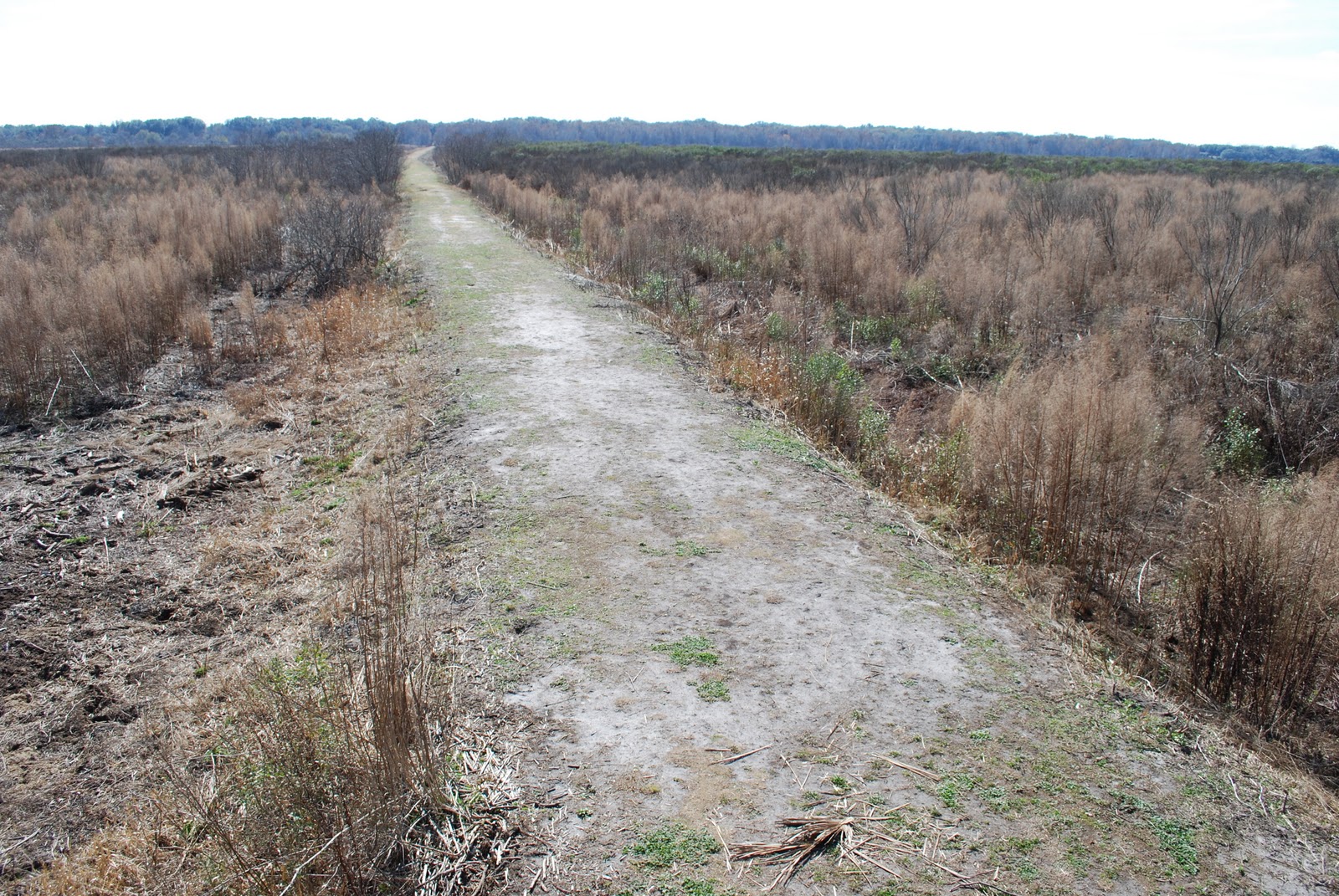
In the heat of the afternoon I hiked through woods to find a wide path leading to a viewing platform in the midst of the savannah. Signs warned me not to molest any bison, wild horses, or alligators that might block the path, and it was pretty easy to obey. I stepped over piles of manure in the path but never saw a living creature except a hawk, a few buzzards, and some nondescript little brown birds. The path was so long, flat, and featureless that the viewing platform in the distance never seemed to get any closer, but I kept plodding along anyway, wondering whether the bison, wild horses, and alligators were just waiting for me to turn my back so they could come out for a frolic.
The River Styx needs water too--I crossed it on dry ground--and I passed a swamp where cypress knees that should have been poking up out of slimy water were instead sitting high and dry. The lakes near Cross Creek are low and the swamplands parched, but Marjorie Kinnan Rawlings's house and grounds still offer a rare look into the writer's life. I took a short hike through oak and palmetto scrub where the only sounds were a woodpecker's tapping and the gentle swaying of Spanish moss.
 Most of what I saw today wasn't quite pretty, but looking at Cross Creek and the Alachua Savannah through the eyes of the authors who loved them, I can see how these places could be beautiful.
Just add water.
Friday, January 20, 2012
He-man's laptops
 Key West is the only place I've ever been where tourists applaud the sunset. Granted, it's a pretty impressive sunset: this big yellow disk touches the horizon and then slides out of sight to the sound of a thousand clicking shutters. What makes it disappear so quickly? (My theory: it's trying to get away from the horn blast from the cruise ship moored next to Mallory Square.) As soon as the sun is out of sight, everyone applauds madly, as if expecting the sun to come back up for a few quick bows and perhaps a dramatic encore.
I should have taken sunset pictures but I didn't want to get conch-fritter grease all over my nice camera.
That was before the key lime pie.
 Yes, I am doing some heavy-duty literary research on my sabbatical. For instance, yesterday I interviewed several of the cats that inhabit Ernest Hemingway's house. In Hemingway's writing studio, a cat was sitting on the table next to a Royal manual typewriter, which made me wonder: would the He-man have written any differently if he'd had laptop computers instead of laptop cats?
Computers are more portable, which is a good thing. I'll pack mine up today and start moving north toward more literary sites and academic libraries. But first, let's give the sunset one more round of applause!

Wednesday, January 18, 2012
Dispatch from a different world

(Drifting is the problem: I felt fine during the 30-minute boat ride out to the coral reef, but as soon as the boat stopped moving straight ahead and started bobbing, I was lost. Yes, I took Dramamine, and no, it didn't help.)
But forget the seasickness: what did I see?
Well, reefs, for one thing. Coral and spiny things and leafy things waving gently in the rolling swells. Fish, in schools or solitary, darting amongst the floaty stuff in sparkly silver or neon shades of yellow, indigo, and orange. There's a whole world down there!
And there's a whole different world just minutes away among the mangroves along shore, and several different worlds just up the highway in the Everglades, where a few inches' difference in elevation or water level can allow two adjacent areas to support entirely different flora and fauna.
I can't hope to understand all these different worlds in just a two-week trip, but that won't stop me from immersing myself in the environment--sometimes literally. It's a tough job, but somebody has to do it.
Birds, eyes, views
 |
| Anhinga, front view |
I've never seen a gumbo-limbo tree before (that I am aware of) but now that I've seen one, I'll never forget it: the rubbery red-orange bark would be at home in a forest of animatronic talking trees, with the sharp-angled branches serving as arms. They're not very tall--few trees are in the Everglades--but a few gumbo-limbo trees would really liven up our Ohio landscape.
 |
| Anhinga, rear view |
I don't need to take any anhingas home with me because it makes me happy just to say the word: anhinga anhinga anhinga. Their blue-gray plumage looks like a ball gown from the back and their long, sinuous necks are the essence of elegance.
Many Florida birds are a mystery to me. I know I saw cormorants, storks, ibises, and herons, and we saw both vultures and a sign warning that vulture may damage vehicles (!), but I can't put a name to many of the birds whose beady eyes ended up in my photos. I wish I could take them all home with me, but someone would squawk if I tried to smuggle them through airport security.
Maybe I could hide them in the branches of my gumbo-limbo tree. It followed me home--can I keep it?


 |
| Even in the dry season, it's easy to see why Marjorie Stoneman Douglas called the Everglades a Sea of Grass. |
 |
| We kept trying to canoe out to this mangrove tree in Florida Bay, but we never quite got there, thanks to (1) wind; (2) sand bars; and (3) mad canoeing skills. |

Monday, January 16, 2012
A sabbatical state of mind
My flight was smooth. I had an empty seat to my right, so no crowding. The plane touched down 40 minutes early (!) and my suitcase was the first one off the luggage carousel. There were no hassles at the rental-car counter, and the weather in Orlando is pretty close to perfect.
Something is seriously wrong here.
Or else something is seriously wrong with me. Why can't I just accept my good fortune instead of skulking around waiting for an anvil to fall on my head?
Time to get in a sabbatical state of mind. My son wrote this morning that a Sabbatical "sounds like it should be some sort of monk's meditation period, wandering in the forest and living with families of bears and kangaroo" and then continued thus:
If my son is to be believed, anything can happen on Sabbatical--planes can land early, luggage can avoid the usual side-trip to limbo, and rental cars can appear as promised. The Sabbatical State of Mind is a great place to be and I intend to stay there a while.
Now where's Matt with that hovercraft? Better get moving before the chickens come home to roost.
Something is seriously wrong here.
Or else something is seriously wrong with me. Why can't I just accept my good fortune instead of skulking around waiting for an anvil to fall on my head?
Time to get in a sabbatical state of mind. My son wrote this morning that a Sabbatical "sounds like it should be some sort of monk's meditation period, wandering in the forest and living with families of bears and kangaroo" and then continued thus:
The Sabbatical is a metaphysical experience that transcends all environments and states of being at the same time. Scuba-diving with porpoises on a coral reef in Fiji. Having a conversation about Hungarian politics with Matt Damon on his private hovercraft on a hot day in Antarctica. Chopping down bamboo stalks in a remote forest near Shanghai. Eating a raw chicken-head whilst watching the mating habits of the platypus in Australia. Making a working hybrid car out of parchment paper on a small island on Lake Winnipeg. This is the essence of the Sabbatical, understood only by those who have experienced it.
If my son is to be believed, anything can happen on Sabbatical--planes can land early, luggage can avoid the usual side-trip to limbo, and rental cars can appear as promised. The Sabbatical State of Mind is a great place to be and I intend to stay there a while.
Now where's Matt with that hovercraft? Better get moving before the chickens come home to roost.
Saturday, January 14, 2012
Ampersandicicles?
 Earth and sky mirror each other today, both painted in flat shades of gray and white. Yesterday's sharp wind that whipped my face and sucked the breath right out of me has gone to wherever the wind goes, leaving behind just enough snow and ice to make a walk interesting.
Rows of pointy icicles hanging from the rocks make the bluff across the road look like a giant mouth getting ready to chomp down on something juicy, while the drips refreeze below in impossibly fragile curving shapes--fountains or cascades or ampersands. Below the cliff, fungi inhabit a tree stump, while up above a red-tailed hawk circles and then perches not far from its treetop nest. After a vigorous tromp through the snow, I'm ready to find my perch--but not in the treetops. Time to go inside and warm up by chomping down on some hot spicy chili.

Friday, January 13, 2012
Eyes (and windows) wide open
The low point of my week arrived on Wednesday when I got stuck in my car and had to beg a passing student for help. The seatbelt got jammed in the door so that it wouldn't close all the way or open at all, and I had to wonder which would be worse: to open the window and call out for help (inspiring a whole new series of "How many PhDs does it take to open a car door?" jokes) or hunker down so no one could see me and then slowly starve to death, hoping that someday someone would discover my desiccated skeleton so it could be properly interred.
(Which for some reason reminds me of the wonderful opening of Jo Ann Beard's novel In Zanesville: "We can't believe the house is on fire. It's so embarrassing first of all, and so dangerous second of all. Also, we're supposed to be in charge here, so there's a sense of somebody not doing their job.")
Now where was I?
Oh yes: the low point of my week arrived when I had to open the window and call out to a passing student to help me open my car door, a moment I won't mention in my annual review. The student's willingness to rescue me, however, did reinforce the lesson provided by the high point of my week: "We're a residential campus for a reason. The campus is group work."
That line was part of a session at our annual all-day teaching workshop, which happened yesterday but required my full attention for most of the week (when I wasn't trying to maintain my dignity while helplessly stuck in my car). Colleagues from many disciplines led sessions on various methods of getting students to work effectively in groups, but my favorite moment arrived between sessions, when I was busy attending to some petty details while participants sat around chatting with each other and informally sharing their experiences using group work. I love the sound of colleagues getting together to make each other better teachers.
The opening session included a hands-on component, and I wish you could have seen a whole bunch of highly dignified college professors trying to build tents out of newspapers while blindfolded. Even with our eyes wide open we don't always realize how much we rely on each other, a lesson I'll surely remember next time I'm stuck in my car.
Tuesday, January 10, 2012
The doubtful Dart
Photos from the Detroit Auto Show reveal a sleek, shiny red compact car masquerading under the name Dodge Dart (see it here), but the new Dart has all the earmarks of an elaborate hoax:
1. The person who officially introduced the new model is purportedly named Reid Bigland, an obviously invented name.
2. This alleged Bigland calls the new Dart is "a revolutionary car," which is preposterous. The Dodge Dart of my youth looked like the car the vicar came to tea in, the car in the gray flannel suit. You'd take a battalion of Dodge Darts into a revolution only if you wanted to bore your enemy to death.
3.Similarly preposterous is the claim that the new Dart will sell for $15,995. We sold our last Dart to a pimply young Kentuckian for $650, an appropriately Dartly price. (He paid $500 in cash and promised to bring the rest the next week--and he did, miracle number one. Miracle number two was what he had done with our stodgy old Dart: scraped off the bumper stickers, installed a new sound system, and jacked up the back end. "I'm planning to race some cops," he told us, and we would have said "TMI" if the acronym had existed back then.)
4. The alleged Reid Bigland also claims that the new Dart will get 40 miles per gallon on the highway, which is patently absurd. Our Dart got 12 miles to the gallon on a good day--when it started up at all. The most efficient way to run it was to simply leave it parked.
5. The new Dodge Dart looks nothing like a Dart. This is a Dart:

In fact, it's a pretty good stand-in for the Dart I married: a sturdy 1970 two-door in a shade that testifies to the power of true love. This is a car you can trust: it raises no expectations and is therefore unlikely to disappoint.
The new so-called Dart sparkles and glimmers and seems to promise adventure, but a car like that could break your heart without batting a windshield wiper. I don't deny that it could be a great car, but a Dart? I doubt it.
Monday, January 09, 2012
Gone fishing?
Yesterday a woman at church asked me when classes start up again and I told her I'm not teaching this semester.
She got a horrified look on her face. She thought I'd been fired.
I quickly cleared up that misconception only to replace it with another: the belief among the uninitiated that going on sabbatical means being paid to sit around doing nothing. How do I get people outside academe to understand that I'm still working when what I'm doing doesn't look much like work?
I'm not standing in front of a classroom or grading papers or attending committee meetings, and until August I don't have any good reason to drive to campus every day. But I'm not sitting around twiddling my thumbs either: I'm just letting my brain cells do the heavy lifting as I absorb ideas and try to turn them into sparkling prose.
In my youth my folks used to warn me that I'd never get ahead in life if I spent so much time reading. "Nobody's ever going to pay you to sit around reading books" was how they put it, but they didn't know about sabbaticals--and neither do many others outside academe. I suppose I'll have to find a good answer to the question about what I'm doing this semester.
"Research" sounds great when it refers to scientists seeking to cure the common cold, but my literary research trip to Florida sounds like a junket: "Um, yeah, I hate to run away to Florida in the middle of winter, but someone has to study these musty old manuscripts, so I guess I'll have to make the supreme sacrifice...."
"Exploration" sounds bold and adventurous, as if I'm beating my way through uncharted territory in search of unknown treasure. Maybe I'll post a sign on my office door: "Gone Exploring." Nobody really needs to know that most of my explorations will take place between the covers of a book.
Sunday, January 08, 2012
Winter woods


Friday, January 06, 2012
A forgotten sojourner
The last novel Marjorie Kinnan Rawlings published in her lifetime, The Sojourner (1953), differs from Arthur Miller's Death of a Salesman (1949) in almost every respect: Rawlings's novel follows the long, dull life of a character who clings to the slow pace of farm life, loves soil and people more than money, and never ventures beyond his county seat until his 80th year, while Miller's Pulitzer-Prize-winner play focuses on the frenetic last days of Willie Loman, the success-seeking traveling salesman who is most himself when he's on the move.
However, the two works are similar in one important way: both feature a wandering character named Ben who lights out for the territories to make his fortune and then, in his absence, takes on undue importance among those he has left behind. Willie Loman's dead Uncle Ben appears only to scoff at Willie's insignificance, holding out the promise of glittering success beyond the far horizon. The absent Ben plays a similar role in the Rawlings novel, heading west to seek success in gold, timber, or gambling and by his absence serving as a reproach to his brother Asahel, who stays home to tend the farm he can never own because it belongs to his absent brother.
Ben, then, seems to be the sojourner for whom the novel was named, but in the end Rawlings makes it clear that the more rooted brother, Asahel, has sojourned farther into understanding of the human spirit than has his rootless brother. Ase remains on the land initially not because he loves the farm but because he loves Ben and always expects him to return home to claim his rightful ownership. Ase sees himself as a mere steward of his brother's riches:
The Sojourner follows the seasons of farm life and proceeds with the slow pace of the meager events the punctuate those seasons: the birth of a calf, the hailstorm that destroys a crop of wheat, the birth of a child and then another and then, sometimes, a death. His closest friend calls Ase "the most wordless man ever," but he proves a loyal and valuable friend, both to a rag-tag group of social outcasts and to the reader. He joys are subtle, his sorrows deep, and his final flight well worth the 300 pages it takes to get there.
Yes, it's a long novel and not without its flaws, but Rawlings writes with tremendous tenderness toward the man whose life appears narrow but whose inner landscape stretches deep into unknown territory that rewards exploration. When he finally manages to travel west, Ase discovers that a man's travels are not defined by his movements but by his mind; when the porter comments that "You could ride the train a hundred years and you'd always think it was the earth moving and not you," Ase replies, "I expect we're all moving all the time, all together, only we don't know where or which way."
Wherever we're going, Asahel Linden makes an excellent traveling companion.
However, the two works are similar in one important way: both feature a wandering character named Ben who lights out for the territories to make his fortune and then, in his absence, takes on undue importance among those he has left behind. Willie Loman's dead Uncle Ben appears only to scoff at Willie's insignificance, holding out the promise of glittering success beyond the far horizon. The absent Ben plays a similar role in the Rawlings novel, heading west to seek success in gold, timber, or gambling and by his absence serving as a reproach to his brother Asahel, who stays home to tend the farm he can never own because it belongs to his absent brother.
Ben, then, seems to be the sojourner for whom the novel was named, but in the end Rawlings makes it clear that the more rooted brother, Asahel, has sojourned farther into understanding of the human spirit than has his rootless brother. Ase remains on the land initially not because he loves the farm but because he loves Ben and always expects him to return home to claim his rightful ownership. Ase sees himself as a mere steward of his brother's riches:
Why, any man had only temporary rights to the earth. His mother's talk of control, of ownership. Tim's talk of legal rights and papers, these were nonsense. No man owned the land....He asked himself now what he expected of the land....It was not what he expected of it, but what it required of him. He felt himself on firm ground. The land asked to be worked, to be taken care of properly, and in return it would nourish all men, as long as they were indeed its brothers.
The Sojourner follows the seasons of farm life and proceeds with the slow pace of the meager events the punctuate those seasons: the birth of a calf, the hailstorm that destroys a crop of wheat, the birth of a child and then another and then, sometimes, a death. His closest friend calls Ase "the most wordless man ever," but he proves a loyal and valuable friend, both to a rag-tag group of social outcasts and to the reader. He joys are subtle, his sorrows deep, and his final flight well worth the 300 pages it takes to get there.
Yes, it's a long novel and not without its flaws, but Rawlings writes with tremendous tenderness toward the man whose life appears narrow but whose inner landscape stretches deep into unknown territory that rewards exploration. When he finally manages to travel west, Ase discovers that a man's travels are not defined by his movements but by his mind; when the porter comments that "You could ride the train a hundred years and you'd always think it was the earth moving and not you," Ase replies, "I expect we're all moving all the time, all together, only we don't know where or which way."
Wherever we're going, Asahel Linden makes an excellent traveling companion.
Thursday, January 05, 2012
Land beyond time
It's a strange paradox: the less time I have available for writing, the more urgently I seize and use that time, but when I have plenty of time to write and no pressing commitments, I'm more likely to shrug my shoulders and say, "I'll do it later."
Already I can see that being on sabbatical will require a whole new way of thinking about time. With no classes to teach and no regular meetings, the days blend together and I have trouble remembering whether this is Wednesday or Thursday. In the summer months my days are structured around working in the garden in the cool of the morning and in the house in the afternoon, but when it's 20 degrees and blustery, I'm staying inside unless someone comes up with a really compelling reason to make me bundle up and step out.
Compelling reasons are what I need. Next week I'll be on campus preparing for a pedagogy workshop and the following week I'll be in Florida, but after I return, I'll need to develop a way to structure my time so it doesn't feel so shapeless and empty. Maybe I'll set up a standing lunch date on campus once or twice a week to give me a good reason to leave the house and use the library and rec center. Maybe I'll find a way to bundle up enough to make long walks possible in this weather. Maybe I'll set daily writing goals, so many hundreds or thousands of words, with rewards for reaching certain levels.Will it work? Who knows?
I only know that I feel more idle than I have in decades and I'm disgusted at how little I'm managing to write.
Monday, January 02, 2012
The call of the mild
Before I opened my eyes this morning I could feel the presence of snow, that muffled silence suggesting that the world has been packed in soft cotton. It's just a light coating of white, but snow is a tremendous relief from the recent incessant cold rains.
And now a ray of sunshine beams into my inbox all the way from California. Some time ago--September?--a Los Angeles Times reporter called to interview me and some of my students about my California Literature class. The tone of his questions made me fear a headline like "Hicks from the Sticks Seek Gold in California," but the article has finally been published and I'm pleased to report that it's pretty good (read it here). I wish he had included more comments from my students, but the article puts my class in some pretty good company and also offers a pretty interesting reading list.
My reading list this week focuses on another sunny state. I leave for Florida two weeks from today but I've been living there in literature for quite some time, following William Bartram through the Alachua Savannah, Karen Russell through the Everglades, and Zora Neale Hurston through Eatonville. Do students in Florida and California take classes on Ohio Literature? Do they make pilgrimages to Clyde and Lorain and Columbus and Martin's Ferry during Spring Break? Do they even know why Clyde and Lorain and Columbus and Martin's Ferry are suitable destinations for literary pilgrimage?
Probably not. I'll be sure to tell them while I'm there.
Subscribe to:
Posts (Atom)