Saturday, October 30, 2021

A walk in the wet fall woods

I keep waiting for one of those crisp fall days when the brightly colored leaves stand out against a vivid blue sky, but alas, the good weather comes only on days when I'm tied up in meetings. I drive to work in the dark every morning and no matter how clear the skies may be while I'm inside teaching classes, the clouds start to gather the minute I leave the building. Soon the leaves will fall and we'll be black to bare brown woods, so if I'm going to enjoy the fall colors, I'd better do it now regardless of the weather. 

And so we went out for a hike at Lake Katharine this morning, walking through constant drizzle over paths covered by slick wet leaves. Occasionally the dim woods would open up onto vistas of yellow and red leaves alongside the lake shrouded in mist. I walked through shooting pains in my hip and hobbled back to the car both refreshed and exhausted. Conditions were lousy and I wondered if we'd ever see the sun again even as the lovely fall colors pulled me onward. Light at the end of the tunnel! I just wish the tunnel weren't so wet, dark, and cold.


Friday, October 29, 2021

Getting comfortable with discomfort

Another day, another news story about an attempt to remove from schools or libraries any book that might make a student "uncomfortable."

You know what makes me uncomfortable? Reading news stories about people trying to remove books that might make other hypothetical people uncomfortable.

Also peach skin--the fuzziness makes me uncomfortable. Big trucks barrelling down the highway right on my tail make me uncomfortable. Overuse of boldface in a document makes me uncomfortable, and a document that combines underlining and italics makes me deeply uncomfortable.

Learning the new software we're using for student advising makes me uncomfortable. Students who think anything that happened before the year 2000 is prehistoric make me uncomfortable, as do those who refer to prose written in 1921 as "Old English." 

This is just the tip of the iceberg of things that make me uncomfortable, but you know what? I'm still gonna eat that peach and drive on that highway and read that document and use that software and teach those students, because sometimes the rewards are worth a little discomfort.  

Thursday, October 28, 2021

A little monkey business

I just found myself writing a comment I don't recall ever before applying to a student project: Effective use of monkeys. It's a relief, really, to see such adorable monkeys cavorting all over an assignment, and it's a relief to be able to write something more interesting than italicize titles of books or the period comes after the parentheses.

I've been reading drafts of annotated bibliographies, the most loathsome type of assignment to grade because so many elements require attention beyond the clarity of the annotations themselves: alphabetical order, title formats, hanging indent, punctuation, and a host of other niggling details. So then it was a pleasure to shift to the interpretive maps produced by my Postcolonial Lit students, whose use of monkeys was, as mentioned, highly effective. How can I encourage the use of colorful cavorting monkeys on other assignments?


Tuesday, October 26, 2021

A lot of brouhaha about vagueness

Autumn leaves lack subtlety, but while the colors screams for attention outside, I'm stuck in my office writing "vague" on recent literature exams. I appreciate subtlety in word use and argumentation, but these responses are not subtle or understated or oblique; they're just plain vague. There's no there there.

Many questions on my literature exams don't require a specific right answer, but that doesn't mean there's no such thing as a wrong answer. Writing that the Odyssey portrays the Cyclops as an example of good hospitality demonstrates a lack of understanding of the text, as does the assertion that Inman is a war hero in Cold Mountain. But I'd rather see a student draw an inaccurate conclusion about a text than avoid drawing any conclusions at all.

My guiding rule is simple: Could the student's statement be applied indiscriminately to every work of literature ever written? If so, it's too vague. Literature means different things to different people: vague. Poets use different methods to get their point across: vague. These works are similar in some ways and different in others: vague. Music is used for many purposes in the text: vague.

These statements are salvageable; all the student has to do is provide specific examples from the texts to support broad generalizations. In fact, almost every question is accompanied by a request to support claims with specific examples from the text. What's so difficult about mentioning, for instance, the scene where Stobrod plays his violin for the dying girl and discovers that there's more to music than just hitting the right notes? 

Unless, of course, the student hasn't read the text. I would guess that 99 percent of vagueness in exam responses is a result of simple ignorance: the student hasn't read the text and so throws down a tangle of verbiage in hopes that I won't notice the absence of substance. But if I have one superpower, it's the ability to spot an absence of substance on an essay exam. I can see what's not even there, and its absence will result in a Very Bad Grade.

Fortunately, this semester I have very few students suffering from the vagueness disease. I try to nip the vagueness virus in the bud on low-stakes reading quizzes; once students see how much disaster the word vague can wreak on a 10-point quiz, they tend to work a little harder on specific examples. But a few are immune to the reading quiz vaccine--or maybe they're just immune to reading. Whatever the reason, I could definitely find use for a rubber stamp with the word vague in a big bold font.

I used to have a rubber stamp that said brouhaha (thanks to a friend who worked in a print shop), but I never found much use for it before it disappeared during one of my moves. I would get plenty of use out of a vague rubber stamp, but I would get depressed every time I saw it in my desk drawer. But imagine getting through a whole pile of exams without saying vague! That would be cause for some brouhaha. 

Thursday, October 21, 2021

Just a brief midweek happy dance

I had the strangest feeling while driving home yesterday afternoon, an overwhelming lightness as of my whole being trying to smile. Could this be--happiness? For no good reason? In the middle of a ridiculously busy week?

Let me count the reasons I ought to be unhappy right now: student intransigence, campus shenanigans, financial stagnation, personal frustration over the zillion ways it's impossible to live in two counties at once. And yet I feel happier than I have in months, maybe years. 

It's true that yesterday a colleague shared with me something a student told her about my class that made me feel like Super Professor, but a solitary student comment shouldn't be enough to offset the gloom that has characterized the past year and a half of pandemic teaching. Last year at this time we were all dutifully putting one foot in front of the other to get through the day and the week and the semester, spending so much time wrangling technology for Zoom classes that we had no time to hope for happiness. This week I'll need to turn on Zoom to accommodate one student in quarantine, but the relative absence of Zoom from my daily life has lifted a curtain and let in some light.

And this semester I've also spent more time interacting with colleagues face-to-face, most meaningfully as chair of a task force charged with producing a bit of verbiage for the College's strategic plan. Sounds deadly, right? But here's the thing: this group worked really well together crafting a statement that bears none of the hallmarks of committee-produced prose. It's succinct, elegant, profound, and perhaps even inspiring. I was delighted to lead a mixed group of colleagues through the process and especially pleased to see the rookies step up to make significant contributions, suggesting hope for future campus leadership.

And I've also finally found an avenue for my own future research and writing. No one has been doing much professional development during the pandemic--I mean, who has time to write conference papers or journal articles? I've been shepherding the comedy volume through the editing process and I finally submitted the Natasha Trethewey essay to a journal, but for a long time I haven't been able to visualize any future research or writing beyond these projects. I've been wondering whether I might be reaching the end of the road as a productive scholar, but then this week I started sensing a pathway opening in a new direction, an area adjacent to my previous work but different enough to arouse my curiosity. I'm not ready to go public yet but it's exciting to see that what looks like a dead end might instead be a sharp turn into really interesting territory. 

It came to me in the middle of a long walk up the Big Horrible Hill, a hill I haven't been able to climb in months. I could blame the weather, my ridiculous schedule, or my aging joints, but the result is that I've fallen so far off my usual exercise routine that I couldn't make it all the way up the hill the first time I tried this fall. But I've been working at it--one foot in front of another, a little farther each time--and this morning I made it clear to the top and back home again without too much trouble. I'll be living on Aleve today, but there's no doubt that getting out for a challenging walk through woods suffused with autumn gold nourishes my body, mind, and soul. 

And so I feel happy--still!--despite joint pain and piles of grading and more committee work. I'm going to hold on to this feeling as long as I can because if nothing else, pandemic teaching has taught me how ephemeral happiness can be, how easy it can be to lose hope. I know it's not over and there are more challenges ahead, but just for today, let's raise a glass to happiness.


Wednesday, October 20, 2021

All the ways I'm being horrible today (or most of them, anyway)

First, I'm making my first-year composition students find books--actual books!--to use as sources for their problem papers, and I'm even requiring that they find at least one book published by a University Press, and when they asked why, I told them about previous students who used children's books written on a third-grade level as sources in a college research paper, and when my current students pointed out that they would never do such a thing and it's not fair to make them suffer because of bad acts by past students, I said I know it's not fair--but you'll have to do it anyway.

And if that's not bad enough, I'm making them find--and read!--articles from peer-reviewed academic journals, and I even devoted time in class to showing them how to use our library research databases to find articles, and then I gave them 20 minutes of class time  to find academic journal articles, during which time I walked around the room answering questions and offering guidance--even to the student who had kept her hood pulled up earlier in class to hide the fact that she had earbuds in and therefore didn't have the first clue what she was supposed to be doing--and before the end of the hour I made each student show me a peer-reviewed academic journal article relevant to their topic, so that when their annotation and citation are due on Friday, they can't claim that they couldn't find any articles. 

And then when I received an email from a student wanting to schedule time to make up a midterm from two weeks ago, I agreed to do so provided that the student could provide some documentation excusing the absence, because the class attendance policy clearly states that while I do not take roll in that class or penalize students for absences, I also do not permit make-ups without an acceptable excuse, and I forgot that there was a midterm is not an acceptable excuse even in the current environment when we are being encouraged to cut students some slack because life is so darned difficult right now, and every time I hear that I have to bite my tongue to prevent myself from growling You want to talk about difficult? I taught a full semester while undergoing chemotherapy and radiation! If I could do that, you can remember to check the syllabus once in a while.

And the day isn't even half over! Who knows how horrible I'll manage to be by the end of the afternoon? 

Monday, October 18, 2021

Advising the advisor

I asked my students this morning what they like about autumn and they mentioned the cooler weather, colorful leaves, and decorated pumpkins, but I notice that none of them brought up the joys of scheduling courses for next semester. Good thing this time of year offers us so many lovely rewards because pre-registration season is upon us and it's terrifying.

For years I taught the first-year seminar every fall, which brings with it the task of serving as advisor to a whole class of brand-new college students, and then I've generally picked up a few English major advisees along the way as well. But I haven't taught the first-year seminar for a few years now and all our English majors seem to be finding help elsewhere. Last year I had exactly one advisee, who how now moved on to an advisor in her major. This year I have thirteen.

Which is nothing, really, compared to the huge advising load some of my colleagues carry, but here's the complication: last year we moved to a brand-new online program for advising students, but I didn't go to any of the training sessions because I didn't have advisees. I was quite adept with the previous setup, even able to troubleshoot problems that arose while students tried to register. This new program is better in every way, offering a more user-friendly experience, more helpful options, more ways for students to take charge of their registration experience, but the problem is that I don't know how to make it work. I haven't used it enough to know where the potholes are hiding, and I'm still fumbling to figure it out well enough so that I can help my students.

Fortunately, all my advisees this semester are honors students, so some of them have already mastered all the intricacies of the new program. Maybe I'll ask them to show me how it works. As an advisor, I'm supposed to have all the answers (or know where to find them), but at this point I'm full of questions, and maybe the best place to find answers is among my students.   

Friday, October 15, 2021

Friday poetry challenge: Apostrophizing apostrophes

"The apostrophe is your friend," I told my freshpersons, but they seemed skeptical, preferring to eschew apostrophes altogether or use them incorrectly to form plural nouns. "That's called the grocer's apostrophe," I told them, just in case the question ever comes up on Jeopardy or something. They don't need to know how to identify a grocer's apostrophe, or even grocers' apostrophes; they need to know how to use apostrophes to form possessives, a topic that has no doubt been troubling students since the invention of the apostrophe--but not enough to motivate them to finally learn the rules of apostrophe placement. And so I gave them the whole song and dance, all the while wondering when the Apostrophe Dance will be featured on Dancing with the Stars. (Not Star's.)

Apostrophes dance across the page;
in plural nouns they're all the rage.
They do-si-do and stick their feet
in "it's" when "its" is needed. Beat

the big bass drum for proper nouns:
"Charle's" keeps on swinging round,
racing to keep up with "Jone's."
Prancing into forbidden zones,

these marks dance on with steps so errant
I fear I'll never cure their tarrant-
ism or constrain their gams
to Arthur Murray diagrams.

Step one: write the plural noun.
If at the end an s is found,
add an apostrophe. If not,
add 's. Apostrophes gavotte

in graceful, orderly progression
when used to indicate possession.

Wednesday, October 13, 2021

My next pet peeve?

What makes a word repellant? Novelty, sound quality, redundancy, or some other factor?

While grading midterm essays over the weekend, I saw some really good papers but also the usual pile of mediocre writing demonstrating the usual problems: comma splices, spelling errors, difficulty in forming possessives. One of the essays my first-year students analyzed was written by a fellow named Kohls, and when it came to making the name possessive, I saw every possible variation: Kohl's, Kohls', Kohls's, Kohlses', and just plain Kohls. None of this provoked any response other than the usual bland marginal comments.

Only one word in the whole pile of papers made me feel as if I'd been kicked in the gut. I've seen my share of awkward constructions over the years, but few cause the kind of visceral response I felt when I encountered Nextly.

What an ugly word! Next is such a neat little bundle of meaning, entirely inoffensive and useful in indicating progression, but add that little -ly and suddenly it grates on the ear. Was my reaction to the word based on its redundancy, its novelty, or something else? 

I recall when I first started seeing relatable oh so many years ago and found it vague, unnecessary, and lazy. I fought it at first, but it was a lost cause: relatable filled a need so neatly that its general adoption became irresistible. I still bristle when students use it to say something about themselves when they ought to be saying something about the text they're analyzing, but no amount of bristling is going to send relatable back where it came from.

But I can't help bristling at nextly. Is this one instance just a harbinger of change to come? Will nextly be the next relatable? What niche does nextly fill that can't be filled by next? And why does the simply addition of -ly make the word so stinking ugly? 

I hope this was just an isolated error and not the lone cockroach you see in the night kitchen--a visual manifestation of a much larger infestation. Stomping on the cockroach may solve the immediate problem, but it has no effect on the vermin still hiding under the cabinets.

Friday, October 08, 2021

Who says there's no rhyme for "midterms"?

I'm tired and the weather is lousy and I've been up to my eyeballs in committee work all week but I still feel like writing a poem. Problem is, nothing rhymes with midterms. Interns? Infirm? Lid perms? I'm just not feeling it.

In fact I haven't been feeling particularly poetic all semester. I'm well aware that the verse I write barely qualifies as poetry, but playing with words in a rhymey way feeds a particular part of my psyche. As a child I somehow came into possession of a decrepit rhyming dictionary with the front cover missing, and I used to pore over that bedraggled volume by the hour trying to put together words to make them sing. My first publication, in fact, was a set of rhyming quatrains called "Love," published in Wee Wisdom magazine when I was in fourth grade. Everyone has to start somewhere!

Then in my turgid teen years I tried to give up rhyme and write Serious Poetry, but alas, lugubrious best describes my swerve toward free verse. Nobody encouraged my efforts, and I missed the way that comfy old rhyming dictionary fit into my hands. Did it finally fall to pieces or did someone donate it to the Goodwill? If I had it in my hands right now, would I find a rhyme for midterms?

Well I've got some time to kill while my students write their midterm exams so nothing's going to stop me from trying.

When I handed my students their midterms,
they all squirmed in their seats (like a squid squirms).
Students wriggled and writhed
like fresh bait--It's alive!--
or a bucket in which you have hid worms.

But they soon settled in, fingers flying
over keyboards, their minds clearly trying
to respond to the prompt
with aplomb. They all chomped
up the question and wrote without crying. 

Now I'm the one crying and squirmin'
(like a squid) over piles of midterms in
my inbox for grading,
so there's no more evading
the task: it's my turn for midterming!

Wednesday, October 06, 2021

Let 'em eat pawpaws

I'm sitting in my office scarfing down chunks of fresh pawpaw, thanks to my finicky Honors students. Our pawpaw harvest was not great this year but I had just enough to peel and slice and divide into little cups for my Honors Lit students, so they could get a taste of the sort of thing Inman might have eaten in the wild during his long trek to Cold Mountain. 

They were underwhelmed, to put it mildly. The pawpaws were ripe, fresh off the tree, soft and delicious, but two students didn't have the guts to try it, and many others took one bite and then dumped the rest in the trash. Did they at least have the courtesy to say thank you? No they did not. So I took the two untouched portions back to my office and ate them myself--yum!

Earlier, a student in my composition class told me that I'm the nicest professor she has, which inspired the response, "Great--now I'll have to do something mean just to prove that I'm not a pushover." Maybe I'll make them eat pawpaws.

In another class, students stare silently at their desks when I ask a question, avoiding eye contact as if it were lethal. That's the class where I have the most trouble remembering names, primarily because I never see their faces and they all appear to be variations on the same person--skinny athletes with long straight hair. Funny: overall, we have pretty good gender balance this year, but I have one class that's 75 percent male and another that's 90 percent female, and the women speak up so rarely in class that in my mind they've all merged into the same person. 

It occurs to me that I've broken one of the primary rules of pandemic teaching: masks required at all times inside buildings, and no food or drink in the classrooms. My students would have been happier if I hadn't brought them fresh pawpaws this morning, but chalk it up to a learning experience. At least they know what pawpaws smell like--and by the end of the day, so will everyone else in the building. 

Monday, October 04, 2021

Making mistakes into opportunities

A first-year student asked me the other day whether I'd actually used a typewriter back when I was in college, and I admitted that yes, back when dinosaurs roamed the earth I did indeed use a typewriter, and in fact I made enough money typing papers for classmates to pay for the 800-mile drive home for winter break, but then the student asked, "But what did you do when you made a mistake?"

Well of course there was Wite-Out if you didn't mind big blobs of glop smearing all over the place, or I could slide some correction tape in and try to make the error disappear, or I could pull the page out and start over to create a pristine page, or I could challenge myself to edit the sentence on the fly so that the error was no longer an error but simply a new pathway for the sentence to follow. And there's a joy my students may never experience--adapting a sentence in response to a hard-to-correct typing error.

And now they've made me feel old again, these energetic young people who can't imagine hauling a bulky electric typewriter down to the lobby of the dorm to type late into the night without disturbing roommates--but hey, at least that was better than the manual typewriters I'd learned on back in junior high, those clickety-clackety masses of metal with keys that required the strength of seven men to press and here I was one wimpy little woman, or not even a woman yet but a wimpy girl pounding painfully on those reluctant keys because typing would surely be a useful skill in whatever career I could conceivably pursue.

I recall sitting in a room full of these manual typewriters--because yes, back when dinosaurs roamed the earth, a junior high could justify devoting an entire classroom to typing instruction--trying desperately to hit the right keys called forth by my teacher's dictation. I don't remember his name, but I recall how he would stroll slowly up and down the room calling out, at an ever-faster tempo, "a, s, d, f, j, k, l, sem," and he said it just like that, "sem," because life is too short to waste time on all the syllables of "semicolon." His voice is seared into my memory but I can't picture him doing anything other than dictating text, so maybe that was his entire life, pacing the room and calling out letters and words and, eventually, sentences, but you know what? He taught me to type quickly and accurately, and if I could do 40 words per minute on a manual typewriter, just imagine how my fingers could fly across the keys of an electric typewriter!

Too fast and I'd make more mistakes, which is why I developed the ability to transform error into serendipity. It didn't always work, of course; there's nothing anyone can do with hte or brng or Tmmy. But if I caught an error while it could still be turned into a real word, and if I could adapt the sentence to the presence of that word, I'd do it just to avoid the annoyance of grabbing the Wite-Out or pulling out the whole sheet and starting over.

I was a good typist but mistakes were made, and if occasionally I could turn a mistake into coherent prose, that felt like a triumph. Typing introduced many rewards into my life but also many small miseries, and sometimes--when I was working toward a deadline and the error was far down on the page and the thought of starting over filled me with gloom--what I really needed to keep my fingers moving was a small triumph, a little mistake that could suddenly be transformed into an opportunity.    


Tuesday, September 28, 2021

Hot under the collard

I was reading a student essay that referred to "blue collard workers" and I suddenly recalled the fabulous collard greens served alongside equally fabulous smoked brisket in North Carolina last week, but sadly, my student wasn't writing about greens but about collars. Spelling errors aren't as nutritious as collards and brisket, but they're my bread and butter.

Ah, academe! With your annoying notices about late-afternoon Zoom meetings, your advisees reluctant to heed good advice, your bottomless pit of bad excuses! Yesterday afternoon I overheard a tutor trying to explain the function of the semicolon to another student and I thought there's no place like home! Sure, it's fun to be whisked away on a colorful adventure that tastes like brisket, but there's nothing more comforting than the gentle drone of professors' voices emanating from rooms full of sleepy students.

As of this moment I am finally caught up on the grading that piled up while I was away, so now I can look toward the future--classes to prep, essays to edit, meetings to schedule, and on it goes. I've been back two days and already I'm wondering when I can get away again. Last year at this time I was contemplating a semester with no breaks, no opportunities for travel, no enticing prospect outside my home and office and piles of work; this year we get a brief break two weeks from now and a longer one at Thanksgiving. Covid transmission is dropping in the area and campus case numbers remain very low, so things are starting to feel more normal.

Last year all I wanted was a return to normal, but now that I've tasted the brisket and seen the sights, I'm bored by normality and I want to get away. Unfortunately, the only way to break away is to work really hard to earn that break, so off I go once again to stamp out ignorance, one blue collard at a time.   

Sunday, September 26, 2021

A full and colorful life (but now I need a nap)

In just five days we managed to drive seven hours (twice!), stuff eight people into an AirBnb, eat way too much junk food, attend my nephew's wedding, watch my adorable granddaughter dance with Daddy and Grampa, eat a slice of the world's best wedding cake (apple spice!), sing Happy Birthday to my dad, hang out with both of my brothers for the first time in years, watch the grandkids splash in a pool that set their teeth chattering, and even teach an online class--and then come home to a new concrete front-porch slab! I'm having a full life over here, so full that I don't have time to write about it, and now I need to try to catch up on all my course work so you'll have to make do with photos.


With my brothers.

I guess we clean up well.

Cousins!


Great-Grampa had lots of help with his birthday gifts.


Taking Grampa out for a spin.

Dancing with Daddy

A feat of cheese engineering.


Some handsome dudes.

Beautiful wedding venue.


Monday, September 20, 2021

Mapping the imaginary

I showed my Honors Lit students a map of North Carolina this morning, but it was a singularly uninspiring map: here is Raleigh; here is Cold Mountain; here is a long stretch of state in between the two. The map comes alive only as we read Cold Mountain, following the footsteps of Inman as he walks across the state on his long homeward odyssey; students will follow Inman's internal map layered over William Bartram's descriptions of the state and the smaller maps other characters provide. "Island can only exist / if we have loved in them," wrote Derek Walcott, and I hope my students will love Cold Mountain enough to develop a vivid internal map, although it's just as likely that they won't.

My Postcolonial Lit students, on the other hand, showed me maps they'd made illustrating contexts of various works we've read so far this semester. Some of the maps are rudimentary, and I grade them on the quality of the information presented rather than on artistic merit, but a few stood above and beyond the rest. How, for instance, do you draw a map of a book of poems Chris Abani wrote about his time confined in a Nigerian prison? A talented student drew the outline of Nigeria, marked the places where Abani was born and imprisoned, and filled in the rest with important words from the poems. In the center is a small barred window filled with a work of art by Viktor Ekpuk, and together the art, map, and words evoke the freedom of creativity within captivity. Lovely.

Another student mapped Paule Marshall's short story "To Da-Duh, In Memoriam," in which a small girl travels to Barbados to visit her grandmother, who cannot believe the child's stories about life in New York City. The student juxtaposed maps of Barbados and New York, with the island map showing what the grandma loves the most--her house, her garden, the tall hill nearby. From the New York map, though, the Empire State Building throws its long shadow across the sea to hover over the island, a visual reminder of the way progressive urban values overshadow and ultimately overwhelm Da-Duh's agrarian island life.

When we shared these maps in class last Friday, students commented on how vastly the maps differed, even though some were mapping the same literary work. I reminded them that every map is an interpretation, pointing us toward the map-maker's values as well as the real world; these maps, though, are especially subjective because they focus on works of the imagination. A good map leads us to a destination, which is difficult enough when that destination is a point on the globe but infinitely more difficult when the destination exists outside the realm of gps. Who can map a poet's mind? Who can map the outline of abstract concepts? 

And how do we map the places that exist only because we have loved in them?

Wednesday, September 15, 2021

The Inland Island and the illusion of escape

I went for a walk to help me think last evening but found my ruminations interrupted by mosquitoes. Pesky critters--how am I supposed to think deep thoughts when I'm being dive-bombed by blood-thirsty vermin?

On the other hand, blood-thirsty vermin of a different sort play a part in the book that inspired my deep thoughts, The Inland Island by Josephine Johnson. The book had been recommended as something I might want to assign in the place-based class I'm teaching next semester, and while every description of the book makes it sound ideal, I found it deeply frustrating.

The Inland Island, published in 1969, recounts a year in the life of a plot of ground outside Cincinnati, Ohio, and given my longtime interest in nature writing and the Midwest region, it's surprising that I'd never read the book before. It earns high praise for its lyrical descriptions of nature, but Johnson occasionally interrupts those pastoral passages with sharp criticism of events taking place outside of her rural refuge: the Vietnam War.

The contrast is jarring--peaceful description of spring wildflowers followed by sudden images of children burning--and it reminds me of nothing so much as a poem by James Wright, "Lying in a Hammock at William Duffy's Farm in Pine Island, Minnesota" (click here), which transports us to a lyrical pastoral moment until the final line: "I have wasted my life." An interesting insight, but it's so unearned and abrupt that it feels like someone has flipped the hammock and dumped us unceremoniously on the ground.

As I was walking and swatting mosquitoes last night, I thought of other works that combine lyrical descriptions of nature with deep thoughts about philosophy, theology, or the human condition. Take Walden, for instance, or if you want something more recent take Annie Dillard's Pilgrim at Tinker Creek or Amy Irvine's Desert Cabal: the descriptive and ruminative passages are so intimately intertwined that you can't separate the strands; pull on one thread and it's all knotted up with everything else.

The Inland Island is different, and that difference is apparent in the title: the author's rural refuge is so separated from the outside world that the occasional dispatches from that world feel intrusive, disconnected, unearned. She could have found more effective ways to link the two worlds, but maybe the separation is the point: we need to retreat to a pastoral refuge to escape the horrors of everyday life. But when those horrors keep intruding despite our attempts to escape, it's hard to know where to turn.

I'm thinking of assigning one or two chapters of the book in my class next semester but I'm not sure what my students will make of those sudden irruptions of violence. Et in Arcadia ego, I'll tell them, and they'll look at me as if I'm nuts, which maybe I am. I don't particularly like the book, but sometimes we need to be reminded that even the loveliest setting might include mosquitoes.

Monday, September 13, 2021

Someone wake me when the fun starts

It's hard enough trying to teach classes when I'm wide awake--teaching in my sleep is darned near impossible. Nevertheless I keep trying to do it, tossing and turning in bed at night while my mind races to resolve all the issues arising over the next couple of weeks.

It's a tough part of the semester anyway, with all four classes turning in drafts or papers this week, one class preparing for an exam, all of this week's drafts being revised for resubmission next week, and the usual daily class preps. But then everything got way more complicated when my nephew scheduled his wedding for next Thursday and my family decided that it would be nice to celebrate my Dad's 88th birthday next Friday since we'll all be together anyway, and now I have a long drive to North Carolina and a whole lot of fun activities interrupting my already busy week.

So this week I need to respond to a pile of papers and prep next week's classes, including online activities for the two days I'll miss, but then I also need to prep classes for the Monday after I return from North Carolina since I won't want to do all that class prep on the road regardless of who's driving. It feels like three weeks of work being compressed into a few days--days already busy with papers demanding responses--and all that compressed work keeps contorting in my brain all night long.

This morning I took steps, trying to do all the things that can possibly be done before the papers start flooding in. I set up online activities for two classes. I wrote a study guide, wrote most of an exam, got all my ducks in a row for classes for the rest of this week. And now I need to start responding to student drafts, because I've scheduled one-on-one conferences with my first-year writing students for the next four days. 

And what about outside of class? I need to buy a dress for the wedding (but all the local stores I usually rely on have closed!), find wedding and birthday gifts, catch up on some mowing--and oh yeah, the guy who's replacing our front porch slab is slated to demolish the old one next Monday and pour the new one on Tuesday. If I do any sleep-walking that night, I'd better not wander out to the front porch.

All this fuss is leading up to what ought to be a delightful series of events, the whole family together for the first time in years, but I won't get to enjoy the fun until I move all the obstacles out of the way first--and if I can't find a way to do it while I'm awake, my subconscious is happy to take over at night.

Good thing I don't need to be mentally alert to read student drafts. (As if!)


Wednesday, September 08, 2021

Overheard in the hallway

Prof 1: Yeah, my students are a little needy, but I'm just trying to listen and be even nicer than usual.

Prof 2: I'm tired of nice. I just don't have the energy for nice.

Prof 1: But you've got tenure--you don't have to be nice! 

If only it were true....

Tuesday, September 07, 2021

My dream semester

I confess that my mind wandered during our department meeting yesterday as we were trying to assemble a schedule of English course offerings for the next two years, a task just as scintillating you might imagine. While the discussion hovered over issues outside my bailiwick, I asked myself a question: What courses would I teach if I could put together my dream schedule?

Course scheduling is like a jigsaw puzzle in which everyone holds tightly to certain beloved pieces while others lie neglected in a heap, and the complete picture won't come together without compromise and cooperation. We need enough composition classes, enough intro-level literature classes, enough upper-level classes, enough writing courses, enough service courses to make everyone at least partially happy. No one gets to be entirely happy all the time, but we're all willing to trade in a little happiness for the good of the order: I'll move my class to a different time so it doesn't compete for English majors with yours, and you'll move that upper-level class to spring semester so it doesn't compete with mine, and we're both moderately content.

But what would I teach if I didn't have to think about anyone else's needs, if I only had to please myself? What would my dream schedule look like?

It would start small: Only three classes instead of four. The four/four load becomes more exhausting every year, leaving little energy for writing, research, service commitments, or out-of-class activities like field trips. My dream semester will include only three classes, which means I'll have to sacrifice first-year composition. I don't mind teaching composition every semester and I think I'm pretty good at it after all these years, but if offered the opportunity to drop one course without repercussions, I would drop composition without a moment's regret.

Instead I would teach the upper-level writing course I haven't been able to offer for years: Nature Writing. Imagine spending a semester reading and writing about nature with advanced writing students! If I could bump a colleague's writing course to make room for Nature Writing without risking any hard feelings, I'd do it--but again, we're just dreaming here. 

So dream on: How about a Representative American Writers course focusing on Natasha Trethewey and Amit Majmudar? My upper-level courses generally focus on fiction, but spending a semester with these two very interesting contemporary poets would be a nice change. Both poets plunge deeply into the American experience for people of color, and both engage in formal experimentation to produce poems ranging from playful to somber. I would gladly spend a semester in such good company, if enough students would sign up for an upper-level poetry course.

And for my third course, I would love to reproduce my favorite teaching experience ever: the California Lit class that included a spring break trip to California. I wouldn't have to go to California; I could teach Florida Lit or Chicago Lit or literature focusing on some other area where I'd love to take students. Since we're dreaming, let's locate this dream semester at a time when Covid no longer makes travel so unpleasant, and let's imagine that I can find sufficient grant funding to make the trip affordable. It's hard to believe, but in 2011 my California Lit students each had to pay only $850 to cover their share of the cost of six days in San Francisco and Monterey, which covered airfare, lodging, admission to attractions, and some meals. The rest of the cost was covered by grants, and it's a good thing my dream semester includes only three classes, because a trip like that takes a lot of time to plan and finance.

So there's my dream schedule: Nature Writing, Trethewey/Majmudar, and a Concepts of Place class including a trip to somewhere interesting. What would have to change to make such a schedule possible? 

Well, I would. I would have to stop caring about what my colleagues want and what my department needs, and I would have to think only about what makes me happy. So maybe I'll save up this schedule until I'm ready to retire and then go out with a bang. By then the four/four load may have reduced me to nothing more than a composition-teaching robot, but a girl can dream, can't she?

Friday, September 03, 2021

At one with wonders

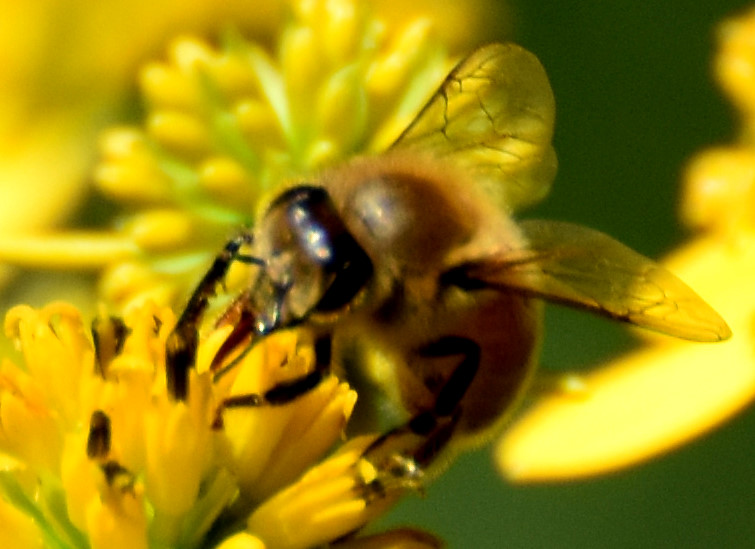
If you want to see wonders, stand still in the middle of a summer meadow and wait for a flash of movement and then follow the movement with your eye wherever it goes, turning as the bright flash of butterfly or bee flits hither and yon until it finally alights on a sunflower or ironweed blossom or tall scraggly weed, and if it never lights but keeps flying you'll still see wonders--the play of light and shadow on a milkweed pod or the deep purple berries hanging like strings of jewels from pokeweed stalks--and the fluttering of butterfly wings and buzzing of bees make you merge with the meadow to become an extension of the sunshine itself.


Photos from the Luke Chute Pollinator Habitat yesterday afternoon.