Wednesday, May 11, 2022

You are now entering the Timeless Zone

Only Wednesday? How can this be?!

The end of classes means the end of time, or the end of my constant awareness of time. I spent an hour in the cool of the morning wrasslin' with the weed-whacker and came inside feeling like I'd done a day's work, but here I have the whole rest of a Wednesday to fill up however I like. Think of the possibilities! I could buy paint for the living room, clean the hall closets, read a good book--or, more likely, catch up on email and read a bunch of files to prepare for tomorrow's assessment meeting.

The weed-whacking was a pain, literally--I had to work around flood debris and lingering muddy spots and ended up with a massive blister that burst as I was carrying the weed-whacker back up the hill. Another sign of the end of time: a yard-work-related injury. It'll heal. So will the lawn, eventually. A little flood damage is not the end of the world.

Yesterday I applauded another kind of ending: celebrating some retirements. One long-time colleague spoke of her delight in seeking new adventures, and she's just the type to keep adventuring until there are no more adventures left. This, I think, is the reason I have trouble seeing beyond retirement: I can't envision what new adventures might be out there beyond the classroom. I realize that this is a failure of imagination, so I'd better get the imagination cranked up before it gets too decrepit to do the work.

But first, I'll start by imagining my summer break. Surely I'll do something more significant than weed-whacking and wildflower walks and forgetting that it's Wednesday, but at the moment, that's about all I can manage.

Here are some pictures from yesterday's walk.


Eight or ten turkey vultures were hovering overhead along the creek.


Brand-new oak leaves emerging.

Buckeye blossoms!

Our creek looks so harmless when it's not in flood stage.

Blue-eyed Mary.

Green valerian, maybe?


Stonecrop.

Perfoliate bellwort.

My first rhododendron blossom!


Monday, May 09, 2022

Doused with a dose of perspective

There's nothing like a little minor disaster to distract attention from major disasters, and it's helpful to occasionally be doused with a dose of perspective. Which is why I'm not complaining (much) about the flash flood that washed away part of my driveway Friday night. Sure, I've been mightily inconvenienced, but nobody died, right? I had to use some creativity to get around obstacles that washed across my path, but I thrive on creativity, so it's all good. Or it's all mud. Or something like that.

Friday felt like a disaster long before the flood hit. I spent the morning hours first having all kinds of uncomfortable eye tests at the cataract surgeon's office, then balked at the cost estimate and wondered whether my eyesight was really valuable enough to merit wiping out my entire health savings account, then spent some time squinting blurrily at final exam and papers, and then attended a campus meeting that left me feeling reamed out and hopeless, and then I finally got to go home--but I didn't take my laptop with me because I was sure I'd be back on campus Saturday morning to finish the final set of student papers before attending Commencement.

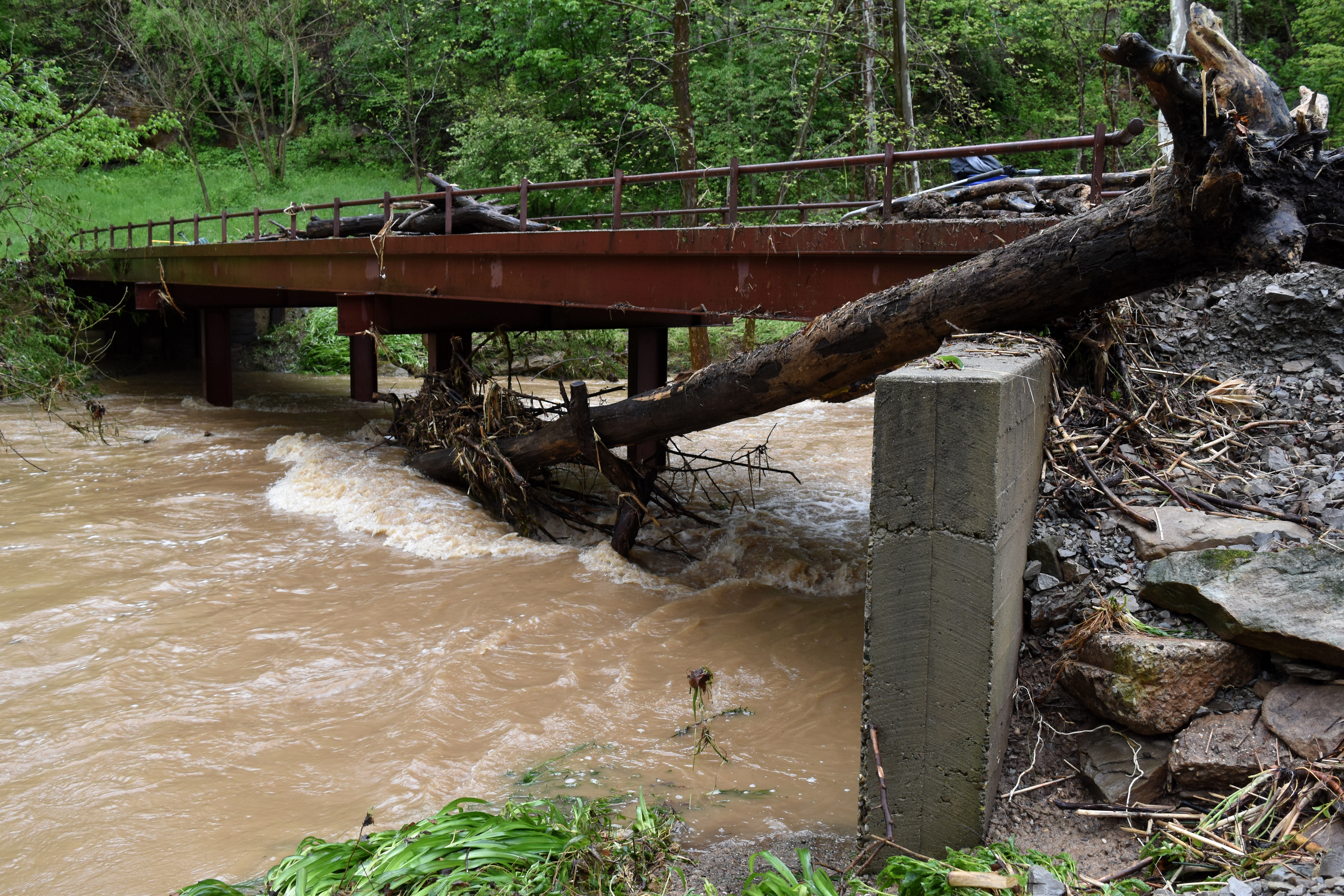
And sure, rain was in the forecast, but we've had plenty of rain this spring without problems, so when the sky started falling in earnest, I was totally unprepared. Frankly, I'm not sure how anyone could have prepared for that kind of deluge--when the normally placid creek suddenly starts thundering like Niagara Falls, it doesn't do any good to stand on the bridge declaring "Thus far and no further!" A chunk of wet sky fell into our area and transformed our tiny creek into a solid wall of water that overtopped its banks, inundated our lower meadow, tossed entire trees against our bridge, and wiped out part of the ramp that connects the bridge to the lowest part of the driveway.

What to do? No way to drive across all that water and no possibility of a gravel delivery over the weekend, so we mostly stayed put. No Commencement for me! (Good thing I wasn't slated to serve as Marshal this year.) But I needed to finish grading that last pile of papers, so I used my husband's laptop to sign into our course management system so I could access the papers and issue a grade. I didn't have access to my usual grading rubrics and I couldn't insert comments into the papers, but who reads comments on a final paper anyway? I decided to just wing it, and if the students want to quibble over the grade, I can deal with that later. 

But now the grading is done and the driveway is fixed and I'm getting caught up on all the things I couldn't do over the weekend without access to my laptop, which turns out to be quite a lot. But again, nobody died, and the inability to get to campus reminded me how very much I love my job and want to be able to see well enough to keep doing it, so I'll soon be scheduling that cataract surgery regardless of the cost. See? Perspective: sometimes it comes in little doses, and sometimes it falls like Niagara from the sky, but either way it can wash away the pervading gloom and make me feel a little less hopeless.

You really wouldn't want to drive on that mess.

Free delivery of firewood.


Debris shows that the bridge was under water overnight.

That's gravel from our driveway washed into the neighbor's field.

That tree usually stretches far above the water level.


Wednesday, May 04, 2022

Fueling final exams

My American Lit classroom was bubbling with energy at noon when students gathered to take their final exam. Where was all that energy last week when we were discussing poetry? No matter: a few of these students are graduating on Saturday and they're delighted to finally be done; the rest are just full of beans. Cocoa beans, to be exact. Yes, I brought chocolate to the final exam. Final exams are long and grueling--I don't want anyone to faint dead away. I want their brain cells to be alert and well lubricated, and chocolate can help. I suspect that some of these students will find other ways to lubricate their brains later on.

My Learning in Retirement class was also bubbling yesterday but for different reasons. No final exams in the Comedy in Theory and Practice class; just a final wrap-up of concepts and an opportunity for my retirees to put what they've learned into practice: each class member could take the microphone for up to five minutes to share a joke or funny story or whatever. If someone could find a way to transform Dad Jokes into fuel, that class could keep the world turning on its axis for a few millennia. 

I was strong-armed into teaching that class but I came to look forward to it every Tuesday afternoon. I mean, who doesn't appreciate a weekly excuse to laugh with a bunch of interesting people? We read some great stuff and watched some silly videos but mostly it was all about the laughter. Now I'm looking at the vast expanse of summer break stretching before me and wondering where I'll find my Tuesday afternoon laughs. Shall I go out back and tell jokes to the birds?

That's the drawback of summer break: no good reason to spend time regularly yammering with a room full of people. Of course I'll have Writing Wednesdays, and Faculty Council will continue to meet occasionally over the summer to hash out details of the College's survival plan--oops, Strategic Plan, sorry!--but laughter is rarely at the top of the agenda for those meetings. Still, it's better than spending the entire summer talking to the birds.

They've been pretty bubbly lately, the birds. For a week I've been hearing wood thrushes in the woods below the woodpile, and this morning there were orioles at the end of my road. Mornings are raucous with birdsong, suggesting that the local avian population is getting plenty of the bird equivalent of chocolates. 

Have my students had enough? I've run out of things to teach them this semester so it's time for them to show me what they've learned, and then it's time for me to read it all and assign a grade. So many things to grade! I need some fuel. Good thing they didn't eat up all the chocolates.


Sunday, May 01, 2022

Wishing upon a shooting star

I thought I saw shooting stars, those delicate white or purple blossoms that appear to be ready for blast-off, and I was so surprised I even said the words shooting stars out loud although no one was around to hear. 

Soon, though, I was assailed by doubt. I'd never seen shooting stars in that stretch of woods before and couldn't be sure they would bloom so early there; I couldn't get close enough to examine them carefully and the photos I took showed an ambiguous mass of blurred blossoms. So I lost confidence in my shooting stars, didn't tell anyone that I'd seen such a thing and couldn't be certain that I had.

And then I saw a newspaper photo showing shooting stars blooming in the same area of the state where I'd been hiking, and I knew that I was both right and wrong--right in believing I was seeing shooting stars, wrong to doubt my perceptions. 

I try to approach the natural world with humility, knowing that what I don't know far exceeds what I do, and yet when I encountered another hiker in those same woods who was all excited about what he thought was "some weird kind of pitcher-plant back there," I looked at the photo on his phone and confidently identified it as Jack-in-the-pulpit. I even pointed out a few more places where he could be sure to find more. Most of the time I know what I know and I'm willing to learn about what I don't know, but I'm reluctant to take a risk on an identification if I'm not entirely certain--because what if I'm wrong?

Well, what if I am? Will the world end if I misidentify a wildflower? Will the botanists of the world line up to heap contempt on my head? I've known some botanists and I don't see them carrying around buckets of contempt to throw at rank amateurs.

The word amateur, let's recall, derives from the French for lover, and love is a risky pursuit. I love wildflowers enough to venture into unknown territory and try out paths that might prove to be dead ends, and sometimes I have to stop in my tracks and confront an unexpected wonder. Shooting stars, I say out loud, and next time I'll believe it. 


Friday, April 29, 2022

Mid-week recharge among the wildflowers

This morning a student hopped up in the middle of class to carry his laptop closer to a power outlet. "I'm about out of power--I need to plug in," he said, and I thought, aren't we all. All out of power--need to plug in.

So that's what I did yesterday when I discovered I had a rare afternoon with no responsibilities. I came to campus for an 8 a.m. meeting and then high-tailed it out of town for a quick trip to Jackson.

Now I know I've told a million people what a relief it is not to have to make that drive to Jackson every weekend. It's only 90 minutes, but for a few years it was 90 minutes in the car every Friday afternoon and then 90 minutes in the car every Sunday afternoon and then all kinds of stuff to catch up on in Jackson over the weekend, which felt exhausting.

So it's been a real treat to not make that drive every weekend, but yesterday I didn't mind the drive so much because it allowed me to have lunch with a friend and then take my favorite hike at Lake Katharine, which hosts the widest variety of spring wildflowers I've ever seen in a two-mile span. I was pleased to see some improvements in the steep trail, but mostly I was delighted to see so many spring flowers blooming in profusion. 

Halfway through the hike I sat on a bench while the creek burbled nearby and a hairy woodpecker hopped along a tree limb and I felt plugged in, as if that bench contained a power outlet that plugged right into my soul. I'm a little out of practice so I walked more slowly than I used to, but I still took the long loop on the off chance that I might find the rare showy orchis still blooming. Sure enough there they were, the blossoms fading and ready to fall but still making a stand for beauty and growth.

Today I'm that showy orchis, battered by the elements and exhausted by the demands of this train-wreck semester but still standing in front of my classes and pointing toward beauty and growth. Final exams are next week, followed by grading and assessment activities and one long meeting after another, but after that maybe we can all move a little closer to the outlet and recharge our batteries, whatever it takes.

Violets popping out from the cliff face

Bloodroot, past blooming

Foamflower

Wild geraniums

Ferns

Trilliums

Bluebells in many colors


One of four types of violets I saw

Jack in the pulpit

Solomon's seal

Magnolias just leafing out

Path through the bluebell woods


Pawpaw blossoms

More trilliums

Showy orchis

Spurred violets


Monday, April 25, 2022

Today's hot teaching topic

I just printed out eleven copies of a handout for my composition class, something I've been doing all semester--even though I haven't had more than seven students in the room on any day since Spring Break. Most days just five or six show up. Why do I keep printing eleven copies when I haven't seen eleven students in the room since early March? That's the triumph of hope over experience.

This morning we met outside, where we could discuss the reading assignment without melting into a massive puddle of sweat. Cold temperatures last week followed by a very hot weekend moved the entire building into Meltdown Mode. I opened every window but we were too hot to think straight so we moved the class outdoors. I could not do that with my American Lit class because I needed to use the projector, which only made the room feel hotter. 

An hour from now that same room will be crammed full of sweaty students, five of whom will be extra-sweaty because they're giving presentations.  I wouldn't want to be in their shoes in a building this hot. Frankly, I don't really want to be in my shoes either. I already feel like a sweat-bomb after teaching one class in that room, and I've got two more classes to come, both of which feature student presentations that can't be done outside. 

And so we will suffer together, sharing a vivid reminder that the life of the mind cannot be conducted without the cooperation of the body. (Just don't sit too close because we're all gonna stink.)  

Saturday, April 23, 2022

Wildflower walk, blurred but beautiful

The camera and the eye see the world differently, I keep telling myself, but it's never been more apparent than it is right now. Cataracts are clouding my vision to the point that I've lost my confidence in what I'm seeing. I sit down to edit photos and I can't tell whether the fuzziness I'm seeing is in the photo or in my eyes, and the colors look washed out but I can't trust myself to enhance them because I fear I'll go overboard. The good news, though, is that I have an appointment with the cataract doctors in two weeks, when I'll undergo extensive testing to find out whether my cataracts have reached the level where our insurance will pay to remove them. If not, I'll keep seeing a washed-out world, keep second-guessing all my photos. But that doesn't mean I'll stop venturing out into the woods to see what I can see--and wonder what I can't.


Monday, April 18, 2022

Partly sunny with chance of train wreck

Yesterday I saw the signs that we were finally emerging from this cold, wintry spring when I got out the mower and mowed the front lawn. Granted, it was still chilly enough for long sleeves and layers, but the ground had dried enough so the mower wouldn't sink in, and the unruly grass was desperately calling out for a trim. The smell of wild onions, the cheery grape hyacinths nodding their heads in the breeze--our long extended winter might finally be coming to a close.

And this morning I saw the signs that we might eventually emerge from this long, taxing semester when I collected the last set of student drafts. I'll have plenty of grading yet ahead--papers and presentations and final exams--but this is the last time this spring that I'll have to read drafts and make suggestions for revisions.

Back in January I thought this semester would be pretty much like Fall semester except with fewer masks. In fact, for a while it seemed that the biggest problem we'd face this spring was whether--and when--to go to a "mask optional" policy. After a great deal of fuss, we pulled off the masks in late February and suffered no apparent repercussions, but by Spring Break no one was talking about masking anymore. We'd been blindsided by a different kind of problem and we're still not sure what repercussions we will face or for how long.

Sure, everyone knew that some budget-tightening would be needed in the next couple of years, but what we didn't expect--and by we, I mean everyone below the VP level, from students to staff to faculty--what we didn't expect was that the budget train was about to drive right off a cliff. The budget crisis hit hard and fast and repeatedly, causing an epidemic of insomnia and angry meetings. Kind of a bad time to be on Faculty Council! It's easy to say that we're not going to let campus controversies affect the students' learning experiences, but it's hard to accomplish that when cuts are affecting academic offerings and when the people charged with fixing the problems aren't getting any sleep. 

And then fall course scheduling season dealt another blow. Changes to our general education curriculum have been causing steady declines in enrollments in my department for a few years, but now the English train has driven off a cliff and I find myself dangling out a broken window, holding on for dear life. Suddenly I see a whole new vista opening up ahead of me: a few final years of teaching freshman comp and the sophomore seminar and other service courses before I fade away into insignificance. 

Sure, the changes that were made to my fall teaching schedule will affect only a small number of students, but I feel the difference every day. Today, for instance, as I was introducing my American Lit Survey students to Allen Ginsberg's poem "A Supermarket in California," with its "What peaches and what penumbras! Whole families shopping at night!", I told them they could see how Don DeLillo made use of this image in White Noise, which I'll be teaching in my American Novel class this fall, except I had to stop myself before the sentence was over because of course the American Novel class got cancelled and, depending on how the next few years go and when I decide to retire, I may never get a chance to teach it again.

Those two unexpected blows would have been enough to make this semester difficult--and I'm working really hard to make sure my anger and disappointment don't affect my teaching but I'm not superhuman, especially when I can't sleep, so it's a struggle. But then we've seen a host of smaller disturbances, the most horrible of which can't be written about or discussed openly, to protect the guilty as well as the innocent. 

Last week before the Faculty Council meeting we were delicately skirting the perimeter of one of these difficult issues when I was reminded of what happened at the end of my first semester at Marietta College. I was a newbie still feeling her way around campus, and suddenly the place was swarming with cops and the FBI was confiscating equipment and a colleague I'd never even met was being led away in cuffs, soon to be tried and convicted for setting up a secret email server to distribute child pornography. 

So last week when a few of us old folks on Council were reminiscing about that long-ago scandal, a fresh-faced junior faculty member asked, "After all that, why didn't you just walk away?"

"Some of us needed the job," I pointed out, but it was more than that. Even at the end of one semester, I knew that Marietta was a place where I could do good work that would be appreciated and occasionally rewarded, and I'd seen enough to suspect that the College could weather this storm and come out the other side stronger.

Is that still true? Possibly. Probably, even. But will I still be here to enjoy the recovery? And if my fingers lose their grip on that bloody broken window, will anyone even notice that I'm gone?

Friday, April 15, 2022

Explaining the obvious, one draft at a time

I can't read it if I can't see it.
I can't see it if you didn't submit it.
A full draft is better than a partial draft, but a partial draft is better than no draft at all.

Reading the abstract is not the same as reading the article.
Reading the article is not the same as understanding the article.
Quoting the article is not the same as synthesizing the information into your argument, but it's a good start, especially if you cite it properly.

The words "Works Cited" indicate that the works on the list have actually been cited within the accompanying document.
"Cited" means the document refers to the source specifically, by author's name or title and, when available, page number.
Vaguely gesturing toward "some experts" is not the same as citing a source.

It may be accurate, in a metaphorical sense, to refer to an institution of higher education as a Collage, but students who want to be taken seriously spell it College.

Using only commas is better than using no punctuation at all, but just barely.
Consider the colon: a pause that promises more to come.
Or the dash--that dashing shift to something different.
Or if you can't manage those, how about the occasional question mark at the end of a question?
Really, at this point, any punctuation at all would be a nice thing. And would it kill you to capitalize proper nouns?

Kidding! We are all improper now. We should be happy simply to receive a pile of words, in whatever form they arrive--provided that they actually arrive. Because let's face it: the easiest paper to grade is the one that does not, in the strictest sense of the word, exist.

Monday, April 11, 2022

Where are the academic cheerleaders when we need them?

We're getting ready to celebrate All Scholars Day, when students present the results of their research and creativity, so this morning a first-year student asked me what ASD is all about. "It's kind of like a pep rally for academics," I lied, "with bands playing and cheerleaders leading a massive crowd in chants celebrating all our hard-working students: Give me an A! Give me another A! Give us all A's!"

If only. All Scholars Day is back to being a face-to-face event this year, so I'll spend time Thursday walking around the poster session and asking students to explain their work. There will be no bands or cheerleaders, but students will hear encouragement and occasional gentle applause, and maybe someone will give them the A's they're after.

First, though, I need to tackle the big ol' pile o' papers in my inbox, some needing feedback and revision and others begging for a grade. Would the work go any more smoothly if I had an academic cheer squad urging me on? They wouldn't have room to turn around if I tried to cram them into my office so they'd have to do their jumps and tumbling runs out in the hallway, which might disturb my colleagues trying to teach in the nearby classrooms. Then again, they could adapt their cheer routines to encourage all kinds of learning experiences: 

Two bits! Four bits! Six bits! A dollar!
If you did your homework, stand up and holler!

We've got spirit, yes we do!
We submitted our files into the Moodle dropbox--how 'bout you?

Give me an A! Give me another A! Give me another A! What's that spell?
Wait, what are you doing in college if you don't know what AAA spells?!

And then they'd form a pyramid in the hallway while the pep band marches past playing "We Will Rock You," and everyone in the building would stop what they're doing and stomp their feet to indicate their eagerness to teach teach teach and learn learn learn!

I don't know if that kind of motivation would inspire me to get my students' papers graded more quickly, but I'll tell you one thing I'm sure of: I won't get them graded at all if I keep indulging in ridiculous fantasies. Time to send the academic cheerleaders home and get back to work.

Wait--who left this pom-pom in my office?  


Friday, April 08, 2022

Even the cruelest month has its bright moments

April is the cruelest month, breeding student papers that must be read and graded, computer bugs that shut down our ability to function, wide-spread panic attacks and existential despair even among students who've never read The Waste Land--and now the weather forecast tells me April is bringing snow? Like, tomorrow? While tulips and daffodils and forsythia are blooming all over the place? That's just gratuitous suffering.

A student explained that he had to miss class today in observation of Good Friday--which is next week.

The flag in the center of campus is flying at half-staff again today, as it has every day this week, and no one can tell me why.

Five e-mails in a row came from students looking for extensions on a project, and I went ahead and granted the extensions because it's really hard to expect students to do research in our online databases when the campus internet connection has been taking frequent unplanned mini-vacations for hours at a time.

Cruel, I tell you. April is pouring on the cruelty relentlessly, luring us outdoors with sudden bursts of sunshine and then dumping dark rainclouds on our heads, and now snow? It may not be Good Friday yet, but this so-called spring sure feels apocalyptic.

And yet we carry on. Each time a new disaster drops--and I can't even talk about the most interesting ones--we just grit our teeth and carry on, because what else can we do? 

This afternoon I'm filling in to teach a colleague's religion class, leading a discussion of the book of Job. Students have been talking about the problem of pain, but I'm going to direct the to the problem of genre: how do we know how to approach a text like Job if we don't know if it's supposed to be read as tragedy, comedy, courtroom drama, or something else entirely? And yes, I'm going to make them learn some characteristics of certain genres and think about how the frame influences how we view the picture.

Right now April is framed in alternating gloom and glee, with massive black clouds hanging over a campus where daffodils bloom, robins sing, pandemic masks get flung to the ground, and the flag remains at half-staff. How do we react when gratuitous grace mingles with gratuitous suffering? Right now, all we can do is carry on.


Monday, April 04, 2022

With Prufrock in the art gallery


One panel of the Prufrock project

At an art exhibit on campus last Friday I encountered an old friend: the ghostly presence (or absence?) of J. Alfred Prufrock in a collage of torn paper and string. Leaning closer, I saw lines from T.S. Eliot's "The Love Song of J. Alfred Prufrock" adhering to each panel. Here were the words "I have measure out my life with coffee spoons" near an image of a steaming cup of coffee, and alongside a swirling black hole was the eternal question, "Do I dare disturb the universe?"

It's no surprise that this work of art was created by a student with dual majors in Art and English. She encountered the poem some time ago in my American Lit Survey class, where Prufrock pops up every spring like clockwork just before midterm. I was touched to see that a hundred-year-old poem could inspire such creativity and insight, especially since Prufrock often evokes very different responses from students--confusion, boredom, anger. "Why can't he just say what he means," they ask me, and I say, "That, in a nutshell, is the problem." They are not amused.

But amusing students is not my primary purpose here. Lately I've been thinking more deeply about that purpose, not because I'm at a loss for things to think about but because I'm fighting off the perception that I'm an old stick-in-the-mud resistant to change--or, as a colleague told me succinctly last week, "Maybe your courses would attract more students if they had more interesting titles." Would more students be attracted to American Lit Survey if it were called Love Songs with T.S. Eliot? I don't think so!

And this persistent accusation that I am resistant to change does not hold up under scrutiny. When I was hired here 22 years ago, the department had no African American Lit class, so I created one. There was no Postcolonial Lit class, so I created one. It's interesting to look through the course listings and see the number of courses that are now a permanent part of our curriculum that I've designed, proposed, and taught: Concepts of Nature, Concepts of Comedy, Concepts of Place (taught as Cal Lit and Florida Lit), Creative Nonfiction, Life Writing--and in addition I've designed special topics courses on Flannery O'Connor, Stephen Crane and Kate Chopin, Colson Whitehead, animals in film, machines in film, Nature Writing, Comedy Writing, plus capstone classes on postmodernism, Garbage Theory, and 9/11 Literature. To fill a need in the curriculum, I developed and taught an experimental Sports Lit class that was linked with a developmental writing class. And I'm not done doing new things: next spring I'm slated to teach a special topics class on the ambiguous zone between fact and fiction, if anyone registers for it. That's a pretty wide variety of classes to develop and teach over a 22-year span.

But one class remains constant: every year, usually in the spring, I teach a sophomore-level Survey of American Lit since 1865. Sure, I tweak the syllabus to introduce more recent authors (because the Norton Anthology only goes so far) and I've changed the assignment structure significantly over the years, but if you look at the syllabus for any one semester, you'll get a pretty good idea of what the course covers and what it's trying to do. Somewhere near midterm during the unit on modernism we'll spend a whole class period discussing Prufrock, and that's not going to change, no matter how many students complain.

Why? Because Prufrock still has something to offer today's student--and so do I.


The full project. It's more impressive in person.


Friday, April 01, 2022

Not a peep

I have complaints! Many, many complaints! But every time I try to articulate them, I sound just like a former colleague who frequently inspired me to pray, "Lord, help me never to be like her!"

I'm trying not to be evil, but it's an effort. All this tongue-biting is painful, and I don't always have something soft nearby to kick. The disconnect between how I expected my career to be going and where it's actually going is keeping me awake way too many nights, and all that sleeplessness makes it even harder to maintain self-control during the day. So I grit my teeth and bite my tongue and vent only when it's safe, but here we are at the end of an exhausting week and all I want to do is scream. 

I need a diversion. Fortunately, there are some options. The sky is gray and spitting rain (and snow--in April?) so I won't be able to walk up the hill to look for wildflowers as I did yesterday afternoon, and tomorrow I need to do some house-cleaning to prepare for visiting grandkids. (Because when we moved my husband back home from the Jackson house, we dumped a bunch of things in the guest rooms and said we'd deal with them later. Well, later has arrived!) 

Today, though, I think I'll distract myself with a Peep Show. 

Relax--it's not that kind of Peep Show. Downtown businesses are creating sculptures and scenarios out of Peeps, the marshmallow candies that taste like foam insulation.  I missed last year's event, which included gardening Peeps, tropical-fish Peeps, and a Peeps pizza (Peepza).  And it's all dedicated to raising money for worthy causes. Who can complain while in the presence of charitable Peepzas?

Now all I have to do is keep my rage contained until 5 p.m., when the Peep Show starts. (Don't be evil don't be evil don't be evil...) Provoke me all you want--you won't hear a peep out of me. 

Tuesday, March 29, 2022

Once again being asked to explain that I'm not a machine

It's hard to imagine a college without any faculty but that doesn't stop a whole lot of people from trying. 

One of my students asked me yesterday when we're going to put all our "course content" online so that they can stop coming to classes and start saving money, because online education must of course be so much less costly than face-to-face classes. He'd heard a rumor about a wholesale movement toward online learning, and all I wanted to say was, "You don't absorb ninety percent of what I tell you in class but you're willing to stake your future on some random rumor?" But that's not the point. The point is that this student thinks education would be so much cheaper and more efficient if we took contact with faculty out of the equation.

It's a tempting thought. If our job is to introduce students to a certain body of knowledge, why not just put that body of knowledge online and allow them to access it at their own pace? The problem is that this vision of education fails to distinguish between faculty members and machines or between teachers and scholars.

Certainly online teaching can be effective; I've seen it and I am in awe of those who can do it well. However, effective online teaching requires more than simply dumping a pile of content into a course management system and allowing students to access at their leisure. Online pedagogy is different from face-to-face pedagogy, but it still requires teachers to carefully design activities to help students master skills and content. What if some of our tried-and-true methods don't translate well to the online environment? Well, then we would need training to help us master online pedagogy, and we would need IT support to deal with the inevitable glitches. Those things cost money. Switching to online teaching might be a cost-saving venture in the long term, but in the short term it would require significant investment in training and technical support, which is neither free nor easy.

And then who says putting classes online will take faculty out of the picture? Someone still needs to read and grade and assess and trouble-shoot and provide the kind of hand-holding our students have come to expect, and that's more than anyone can ask of a course management system. The vending-machine model of education, in which students insert money into the slot and press the right buttons so it can spit out a diploma, fails to consider the importance of human interaction. The machine isn't going to spend office hours doing one-on-one tutoring with a student struggling with a difficult concept. That's what teachers do.

And that's not all that teachers do. Those who think that our only responsibility is to pass a big body of knowledge to the students fail to consider our role as scholars. We don't just draw on the existing body of knowledge--we add to it. We write and do research and create art and performances that add to human understanding. A vending machine knows how to dispense a can of soda but cannot engage in the process of creating new types of soda or imagining a world beyond the realm of soda. That's what scholars do, and that kind of activity can't be confined to a box.

Every time this topic comes up I feel as if I'm once again being called on to defend my right to exist, which is exhausting, but if I object, I'm accused of being stuck in the past and resistant to change. But you know what? I'm okay with that. I've tried online teaching and I did a pretty good job of it, but I know how much I had to rely on our instructional technologist and how many more of her we'd have to hire if a whole bunch of us switched to online teaching, and I also remember how much time and effort I had to devote to trying to prevent and punish online cheating. When the institution makes the kind of commitment to online teaching that would solve those problems, I'll be happy to make whatever changes are required. Meanwhile, I'll keep being the kind of teacher and scholar who can't be automated or confined to a box.

Now hand me a can of soda, because my students aren't going to teach themselves.

Saturday, March 26, 2022

Welcome to my landfill

Yesterday when I was trying to think of an appropriately festive way to celebrate an unexpected windfall, this is where I landed: 

Grabber Reacher Tool for Elderly, 32" Foldable Picker Upper Grabber, Long Handy Mobility Aids, Reaching Assist Tool for Tr...

That's a 32-inch adjustable trash picker-upper, which would make it easier to pick up the many beer cans that rude people keep tossing alongside my road. That's right: when considering how to commemorate a significant influx of dollars, I settled on a twelve-dollar tool that would make it easier for me to pick up other people's trash. And that's all you need to know about my world right now.

The windfall came from an unexpected source: myself. I learned from my taxman yesterday that we'd seriously overpaid the quarterly estimated taxes on my husband's 2021 income, thanks to a tried-and-true method we're calling ELTEFMMCA (Earning Less Than Expected and Failing to Make Mid-Course Adjustments), so not only do I not have to write a big fat check to the IRS next week, but the refund will cover the quarterly estimated taxes on his income for the entire rest of 2022, so I will not have to write a big fat check to the IRS in June, September, or next January either. Hallelujah!

But of course I had been setting aside money to cover those big fat checks that I will now not have to write (unless someone suddenly starts earning more money), and now that feels like money in the bank. Which, of course, it literally is, but it's money that I've been pretending isn't in the bank so that it will still be there when I need it to make those quarterly tax payments, which I now don't need to do, so the invisible money suddenly became visible and now I want to do something fun with it.

But buying a trash picker-upper? That hardly seems celebratory. I grumble and gripe every time I go out with a five-gallon bucket to gather the latest crop of cans full of ditch-water, and I put every ounce of frustration into stomping those nasty cans flat so I can fit more in the bucket. Today I made it less than half a mile before the bucket was full, and while bending and stooping over muddy roadside ditches to pick up trash provides an excellent whole-body workout, it does not fill me with warm feelings about the human race. 

Buying a tool that would make it easier to pick up the trash feels like accepting a situation that I find repugnant. And yet, it surely would make it easier to reach those beer cans nestling in eight inches of muddy water just beyond my reach.

So far, I have not purchased a 32-inch adjustable trash-picker-upper, but I'm leaning in that direction. Because as much as I resent living in a world in which people treat my bucolic country road like a landfill, that's the only world I've got right now, and it wouldn't hurt to spend twelve dollars to make that world just a tiny bit better.

Friday, March 25, 2022

Friday poetry challenge: aiming for mediocrity

Comparing notes with colleagues at yesterday's Faculty Council meeting, I learned that if someone had called a special meeting at 4 a.m., we would have had a quorum. Everyone is overwhelmed, no one is sleeping, and yet we carry on--just barely.

Which is why today my primary goal is simply to be an adequate teacher. I aim for mediocrity! Excellence will have to wait for another day.

Just for today
I'll be okay.

Mediocrity
is the thing for me.

My teachy stuff
is just enough.

No home-run hit--
just adequate.

But that's okay.
(Just for today.)

Tuesday, March 22, 2022

Not exactly hair-raising

People keep commenting on my hair. Why? I haven't done anything special with it--in fact, I long ago decided to pretty much give up and let it do what it wants, which is mostly to hang in my eyes or stick out in random directions. And yet in the past couple of weeks random people have been making random comments about my random hair(s), all complimentary. Whatever it's doing, I guess it ought to go ahead and keep doing it.

Thinking about hair is more pleasant than thinking about other things, like war or refugees or gas prices or the campus budget crisis, but it makes me feel frivolous. I mean, don't I have something more important to write about than hair? Sure, but I'd rather not.

Yesterday someone complimented my hair (out of the blue!) while I was sitting on a bench out on the campus mall soaking in some sunshine after a very busy morning of teaching and preps. After the between-classes rush of students cleared up, it was just me and the birds overhead and the bulbs sending up greenery from bare brown patches--oh, and the groundskeeper across the way driving around a big loud messy piece of equipment poking holes in the turf. What was he doing to that scraggly-looking lawn? Aerating? I have no idea, but it was loud and annoying until he drove loudly away.

I was reminded of a class activity last week, when lovely weather inspired me to send my Place students outside in the middle of class. We'd been reading about urban nature, so I sent them out in pairs to examine specific spots where nature impinges on campus and report on how people interact with those places and what it takes to keep those natural spots healthy. They looked at trees and ornamental garden plots and a field and an unexpected patch of early spring flowers, and they concluded that all it takes to keep natural places healthy is a little work by the groundskeepers. Well yes, but those groundskeepers have to be hired and trained and paid, and someone has to order the right equipment and keep it running, and someone has to establish budget priorities so all those things can be paid for, which suggests a whole network of people and institutions have a hand in keeping that little patch of flowers blooming or that field mowed or that tree standing.

Last week at another awful meeting someone asked whether the budget crisis will prevent the kinds of plantings we're accustomed to seeing on campus in spring and summer, when our campus blooms from end to end. A person in the know said the planting budget can't be cut because campus beautification is a tool for attracting new students, which is a valid point. I would not want to minimize the importance of keeping campus beautiful, but I wish some people understood that excellent teaching is also a tool for attracting and retaining students and should therefore be protected.

I mean, if the students aren't coming here for the teaching, what are they here for? It's certainly not my hair.


Friday, March 18, 2022

Words fail. Daffodils don't.

I keep starting to write about this week's craziness but my sentences tend to end in helpless sputtering. The student who wrote---!! The administrator who said---!!! The colleague who claimed---!!!!!

I mean, I can't even with these people. And when we have people in positions of authority feeling empowered to say out loud in public that anyone who criticizes the current administration ought to be immediately fired, I just don't have the words.

But I have the daffodils. They're blooming beautifully. Yesterday I took a chair down to the thickest part of the daffodil patch and sat there trying not to think for a while. Consider the daffodils of the field! They toil not, neither do they spout senseless garbage in meetings!

I wandered lonely as a cloud that doesn't have to attend three hours of meetings on its sole non-teaching day. There was no wind so the daffodils weren't dancing, but at least they were quiet and nondemanding and unlikely to point a finger of blame at me--or at anyone, really. We've got way too much random blame floating around campus right now. Some of us need to take a lesson from the daffodils and spend some time in the sun simply being there.

So I have no words. I have no wisdom. I have no poetry. But I have daffodils, and that's not a small thing.


Tuesday, March 15, 2022

Some funny business

Some requests are easy to resist. A student wants to meet with me via Zoom at 10 p.m. on a weeknight during Spring Break? Um, no, and I'm not even going to offer an excuse.

But I did feel the need to offer excuses the past ten times I refused the annual request to teach a course in our local Learning in Retirement program. I taught for the program once before and found it rewarding, exhausting, and exhilarating, but I've resisted their requests ever since for various good reasons: Too busy or tired to teach a two-hour class once a week for eight weeks; too distracted by other projects (writing and editing essays on teaching comedy); unwilling to put in that much work for a stipend that's significant but not life-changing. 

But the leaders of the program persisted and finally I agreed to teach a course on comedy in spring of 2020. Then came Covid. Then the whole program moved online and they asked me to teach the class via Zoom, and I said that I couldn't spend one additional millisecond on Zoom than was absolutely necessary or my head would explode. 

Then this spring they went back to in-person classes and I ran out of excuses, so here I am getting ready to lead a weekly discussion of comedy with a bunch of retired people, and I couldn't be more pleased. For one thing, I need that stipend to pay for my new cell phone so I can continue to enjoy funny pictures of my grandkids, and for another, I need to immerse myself in comic material to distract myself from the current misery on campus, including the fear that I'll never get another raise. 

So today's the big day: an introduction to the history of comedy, illustrated with film clips and some short readings. I can count on these students to read the homework assignments, so I know they'll be prepared to discuss theories of comedy next week. Among other topics, we'll have sessions about comedy and the human condition, comedy as uniter or divider, and what makes British comedy so very British (with an expert guest speaker). I have one class session set aside to view a film, but I'm going to ask them for suggestions before deciding which one. And during the final class session, I've set aside time for anyone who wants to perform up to five minutes of comedy in front of the group. I hope some of them will want to put comedy theories into practice, and by that time we'll be so comfortable with each other that we'll laugh even if it isn't funny.

So I guess it's a good thing that I finally ran out of excuses. Eight weeks from now I may be exhausted from the extra work, but at least I will have had a few laughs along the way.


Saturday, March 12, 2022

Frosting my mood on a snowy morning

Yesterday I stood out in the sunshine admiring daffodils that were just about to bloom, and today they are buried under a blanket of wet snow. About six inches, I would guess, and still falling. 

All week I've been hearing towhees calling and I thought the juncos had left us, but snow brings back the snow-birds so this morning they're all over the place, along with a herd of cowbirds desperate for some seeds from our feeder. When everything they rely on for food is suddenly covered with snow, the birds have to find sustenance where they can.

No sign of a plow on our road so it's a good thing I don't need to go anywhere. Tomorrow I need to drive to Columbus to pick up our son from the airport, so I sincerely hope the roads are clear by then. Shoveling snow during spring break? That's just not right!

I've been thinking of the Robert Frost poem--not "Stopping By Woods on a Snowy Evening," lovely as that might be, but the more bleak and hopeless "Desert Places," with its "blanker whiteness of benighted snow / with no expression, nothing to express." If I sit and think too much I'll soon join Frost in "scare[ing] myself with my own desert places," so I think I'd better get up and get moving, for I have many rooms to clean and miles to go before I've seen a host of golden daffodils, or something like that.