Thursday, May 18, 2006
Signs of spring
Woke to the sounds of wild turkeys gobbling in the meadow the other day. On Tuesday my daughter saw a pileated woodpecker on the woodpile, and last weekend we spotted two indigo buntings (or maybe one indigo bunting two different times). We still hear orioles singing, so perhaps they'll stick around a little longer this year. We need to walk up the hill to see what's blooming up there, but the weather has been a bit iffy. Hummingbirds have been scarce so far, but the sun'll come out tomorrow and then you never know what spring will bring.

Wednesday, May 17, 2006
Simply syllabi
What does it take to write a syllabus? A computer, a calendar, and a stack of books on the one hand, and on the other hand a peculiar sort of magic that transforms a nebulous idea into a complexly detailed outline of an actual course. Equal parts sweat and art combine to balance practical questions (How many exams? How many pages of reading per week? Will anyone be willing to write or read over break?) with philosophical and pedagogical concerns (What kind of writing assignment will encourage ethical academic behavior? Should reading assignments challenge the gifted, pander to the mediocre, or engage the struggling student? Is there a way to do all three?).
I always seek to communicate expectations clearly and produce a syllabus that leaves no room for misunderstanding, but even my most carefully worded statements get misinterpreted. "Late papers will not be accepted," for instance, is commonly interpreted to mean "Late papers will receive a slightly lower grade but will not endanger the student's chance for an A." Similarly, "Plagiarism will result in an F on the assignment and may result in the student's failing the class" is frequently understood as "Students who plagiarize will have unlimited opportunities to revise papers to 'fix' plagiarized passages, with no negative effects on the student's grade."
The most frequently misunderstood part of my syllabus, though, occurs on the detailed schedule of assignments, which begins with a statement like this: Reading and writing assignments are due at the beginning of class on the date listed. No matter how carefully I explain what this means, every semester in every class a few students come to the first few classes unprepared. When I ask why they have not done the reading or writing assignments, they say, "I thought we were supposed to read those after class" or even "I thought we were going to read those in class." There must be a better way to get across the idea that work should be done before class on a given date, but if there is a foolproof method, I've never found it.
But there's always hope. At the beginning of the semester, a syllabus is simply a statement of hope: hope that I haven't forgotten anything important; hope that the reading and writing assignments will effectively engage students in meaningful learning; hope that students will understand my expectations and meet or even exceed them. The syllabus's clear, crisp prose and parallel bullet points suggest that everything is in under control, that the learning process will proceed in a rational, orderly fashion. As time goes on, though, hope falters and order breaks down. A syllabus might attempt to hold chaos at bay by banning cell phones in the classroom, but a sentence on a syllabus, no matter how sternly worded, will not prevent the terrorist attack, the forty-year flood, or the sudden alarming awareness that the class does not understand the distinction between poetry and prose.
A syllabus at the end of the semester is a mess, its hope deflated and its order hidden under frantic scribbles. The best moment for any syllabus occurs when the printer spits out the first copy and I hold in my hand a document promising hope and order. How do I write a syllabus that will deliver on that promise? That is the eternal challenge.
I always seek to communicate expectations clearly and produce a syllabus that leaves no room for misunderstanding, but even my most carefully worded statements get misinterpreted. "Late papers will not be accepted," for instance, is commonly interpreted to mean "Late papers will receive a slightly lower grade but will not endanger the student's chance for an A." Similarly, "Plagiarism will result in an F on the assignment and may result in the student's failing the class" is frequently understood as "Students who plagiarize will have unlimited opportunities to revise papers to 'fix' plagiarized passages, with no negative effects on the student's grade."
The most frequently misunderstood part of my syllabus, though, occurs on the detailed schedule of assignments, which begins with a statement like this: Reading and writing assignments are due at the beginning of class on the date listed. No matter how carefully I explain what this means, every semester in every class a few students come to the first few classes unprepared. When I ask why they have not done the reading or writing assignments, they say, "I thought we were supposed to read those after class" or even "I thought we were going to read those in class." There must be a better way to get across the idea that work should be done before class on a given date, but if there is a foolproof method, I've never found it.
But there's always hope. At the beginning of the semester, a syllabus is simply a statement of hope: hope that I haven't forgotten anything important; hope that the reading and writing assignments will effectively engage students in meaningful learning; hope that students will understand my expectations and meet or even exceed them. The syllabus's clear, crisp prose and parallel bullet points suggest that everything is in under control, that the learning process will proceed in a rational, orderly fashion. As time goes on, though, hope falters and order breaks down. A syllabus might attempt to hold chaos at bay by banning cell phones in the classroom, but a sentence on a syllabus, no matter how sternly worded, will not prevent the terrorist attack, the forty-year flood, or the sudden alarming awareness that the class does not understand the distinction between poetry and prose.
A syllabus at the end of the semester is a mess, its hope deflated and its order hidden under frantic scribbles. The best moment for any syllabus occurs when the printer spits out the first copy and I hold in my hand a document promising hope and order. How do I write a syllabus that will deliver on that promise? That is the eternal challenge.
Tuesday, May 16, 2006
Confessions of a recovering journalist
I see by the papers that 5 p.m. today is the deadline for potential buyers to submit bids to purchase the Philadelphia Inquirer and the Daily News. If I could dig up the $600 million asking price, those papers would be mine.
As a recovering journalist (printer's ink is an addiction, like cocaine; once it's in the blood, the hunger never completely dissipates), I've always cherished the notion of owning my own newspaper. Granted, the two Philly papers exceed the dimensions of my wildest fantasies, but a girl can dream, can't she? Owning not one but two newspapers on Ben Franklin's old stomping ground would be the journalistic equivalent of, say, piloting Air Force One or being President of Harvard.
Back in my teens, when my classmates were aching to be the next Donna Summer, I wanted nothing more than to be the next Jim Squires. At the time he was editor of the Orlando Sentinel, my hometown newspaper, but then when he moved on to edit the Chicago Tribune, I nearly swooned with envy. Years later after he'd moved from journalism to politics, I finally met Jim Squires and confessed my adolescent worship; we had a good chuckle and traded stories of the news biz. I was a small-town newspaper editor at the time but we spoke the same language, a language I rarely get a chance to speak since I left the news biz in '98.
Now here's my chance to re-enter the world of headlines and deadlines--but first I need to come up with the $600 million. How much does a soul sell for on e-bay these days?
As a recovering journalist (printer's ink is an addiction, like cocaine; once it's in the blood, the hunger never completely dissipates), I've always cherished the notion of owning my own newspaper. Granted, the two Philly papers exceed the dimensions of my wildest fantasies, but a girl can dream, can't she? Owning not one but two newspapers on Ben Franklin's old stomping ground would be the journalistic equivalent of, say, piloting Air Force One or being President of Harvard.
Back in my teens, when my classmates were aching to be the next Donna Summer, I wanted nothing more than to be the next Jim Squires. At the time he was editor of the Orlando Sentinel, my hometown newspaper, but then when he moved on to edit the Chicago Tribune, I nearly swooned with envy. Years later after he'd moved from journalism to politics, I finally met Jim Squires and confessed my adolescent worship; we had a good chuckle and traded stories of the news biz. I was a small-town newspaper editor at the time but we spoke the same language, a language I rarely get a chance to speak since I left the news biz in '98.
Now here's my chance to re-enter the world of headlines and deadlines--but first I need to come up with the $600 million. How much does a soul sell for on e-bay these days?
Monday, May 15, 2006
Grade deflation
All over campus as my colleagues complete their grade reports I hear the same sounds: first, a loud hurrah as the final click sends final grades to the Records Office; next, as the reality of diminishing deadlines rapidly sets in, a sound like air rapidly escaping a deflating balloon.
Lots of stuff on the to-do list--reports to write, messages to send, courses to plan--but without classrooms full of students eagerly awaiting our pearls of wisdom, the sense of urgency just evaporates. No rush. The to-do list will still be there tomorrow.
Meanwhile, we waft around the silent classroom building like so many wasted balloons drifting in the wind. Grade deflation: it's an occupational hazard that leads, sometimes, to drunkenness, despair, and doom. But fortunately there is a cure, and it's waiting just around the corner. It's called fall semester.
Lots of stuff on the to-do list--reports to write, messages to send, courses to plan--but without classrooms full of students eagerly awaiting our pearls of wisdom, the sense of urgency just evaporates. No rush. The to-do list will still be there tomorrow.
Meanwhile, we waft around the silent classroom building like so many wasted balloons drifting in the wind. Grade deflation: it's an occupational hazard that leads, sometimes, to drunkenness, despair, and doom. But fortunately there is a cure, and it's waiting just around the corner. It's called fall semester.
An error message for the ages
"The processing of tasks has been interrupted," says the error message on my computer screen. I've seen this message more times than I can count, but I've never appreciated just what a versatile excuse it could be:
Do you have our papers graded yet?
The processing of tasks has been interrupted.
Mom! Did my band socks get washed?
The processing of tasks has been interrupted.
What? No blog entry today?
The processing of tasks has been interrupted.
Note how cleverly this excuse avoids assigning blame, refusing to specify the type or urgency of the interruption, which could range from a trip to the ladies' room to a collision with a deer to a cataclysmic event involving weapons of mass distruction and The End of the World as we Know It; as far as the error message is concerned, they're all one.
I think I'll borrow my computer's error message just as I have adopted "Fatal Error" as a category on my research paper rubrics. Plagiarism? Fatal error. Competent paper that might be appropriate for some other class but has no discernible relationship to the actual assignment? Fatal error. Documentation so screwed up that it's impossible to tell where any given piece of information came from? Fatal error. Nobody wants to get a checkmark in the Fatal Error box, perhaps because it's not coincidental that the phrase "Fatal Error" starts with F.
My computer throws so much incomprehensible gobbledygook at me that it's reassuring to know that it can communicate when it really wants to. Of course I wish it would communicate something more helpful like "Your wish is my command," but we have to take our blessings where we can find them, and for today, I'm happy to say that the processing of tasks has been interrupted.
Do you have our papers graded yet?
The processing of tasks has been interrupted.
Mom! Did my band socks get washed?
The processing of tasks has been interrupted.
What? No blog entry today?
The processing of tasks has been interrupted.
Note how cleverly this excuse avoids assigning blame, refusing to specify the type or urgency of the interruption, which could range from a trip to the ladies' room to a collision with a deer to a cataclysmic event involving weapons of mass distruction and The End of the World as we Know It; as far as the error message is concerned, they're all one.
I think I'll borrow my computer's error message just as I have adopted "Fatal Error" as a category on my research paper rubrics. Plagiarism? Fatal error. Competent paper that might be appropriate for some other class but has no discernible relationship to the actual assignment? Fatal error. Documentation so screwed up that it's impossible to tell where any given piece of information came from? Fatal error. Nobody wants to get a checkmark in the Fatal Error box, perhaps because it's not coincidental that the phrase "Fatal Error" starts with F.
My computer throws so much incomprehensible gobbledygook at me that it's reassuring to know that it can communicate when it really wants to. Of course I wish it would communicate something more helpful like "Your wish is my command," but we have to take our blessings where we can find them, and for today, I'm happy to say that the processing of tasks has been interrupted.
Friday, May 12, 2006
Out of the pink
"Sweetheart," I said to the love of my life, fire of my loins, buyer of my groceries, "did you buy this box of Kleenex?"
"Yes," he said. "What's wrong with it?"
"It's pink."
"I can see that."
"Pastel pink with flowers all over it."
"So?"
"Look around," I said. "Do you see any room in this house that's begging for a pastel pink floral Kleenex box?"
"Well, it's not offensive," he said.
"Tell me," I said. "When you're selecting which box of Kleenex to buy, do you ever think about how the color of the box will blend with our decorating scheme?"
"Not a bit," he said.
"Ah," said I. "That explains a lot."
I married a man who bakes the world's best bread, grows the world's best tomatoes, and smokes the world's best beef brisket, so I suppose I shouldn't complain if he can't think about complementary colors while shopping for Kleenex; still, I struggle to find a place where the pink pastel Kleenex box won't stand out like an open wound.
Finally I have it. "Sweetheart," I say, "I've found the perfect place for the pink Kleenex box."
"Great," he says, "as long as it's not in my office---"
But it's too late. Hope he enjoys it there. It's a big box so it'll be around a long, long time.
"Yes," he said. "What's wrong with it?"
"It's pink."
"I can see that."
"Pastel pink with flowers all over it."
"So?"
"Look around," I said. "Do you see any room in this house that's begging for a pastel pink floral Kleenex box?"
"Well, it's not offensive," he said.
"Tell me," I said. "When you're selecting which box of Kleenex to buy, do you ever think about how the color of the box will blend with our decorating scheme?"
"Not a bit," he said.
"Ah," said I. "That explains a lot."
I married a man who bakes the world's best bread, grows the world's best tomatoes, and smokes the world's best beef brisket, so I suppose I shouldn't complain if he can't think about complementary colors while shopping for Kleenex; still, I struggle to find a place where the pink pastel Kleenex box won't stand out like an open wound.
Finally I have it. "Sweetheart," I say, "I've found the perfect place for the pink Kleenex box."
"Great," he says, "as long as it's not in my office---"
But it's too late. Hope he enjoys it there. It's a big box so it'll be around a long, long time.
Thursday, May 11, 2006
Killing time
Big mistake: I seriously miscalculated the amount of work I need to keep occupied while my Concepts of Nature students take their final exam. I finished a big stack of grading with more than an hour to spare in the exam period. What to do? Sit and watch students struggling to pull ideas out of thin air? It's not exactly a pretty sight and it makes me nervous. I don't know, maybe it makes the students nervous too. At any rate the room is buzzing with nervous energy already and I don't need to make it any worse.
Start by putting graded papers in alphabetical order so they'll be easier to return. Done--with an hour to spare.
Look around the room. Wonder who decided to cover the back wall with a mural of Don Quixote tilting at windmills. If that mural is to scale, then either the Knight of the Mournful Countenance was 14 feet tall or the windmills were manufactured by the Little Tykes corporation. What message does that mural send to students? Are we trying to warn them of the dangers of reading too many books? Judging from the number of students who ask "Who's the funny-looking guy on the horse?" I suspect that the warning is falling on deaf ears.
My ears are being tickled by the gentle clickety-clicking of fingers on laptop computer keyboards. Sounds like raindrops. The students using laptops are ranged around the room close to the wall and I notice they're sharing power outlets in a friendly fashion. I hope that's all they're sharing. Yesterday in another exam I watched a student blatantly leaning over to look at the paper of the person in front of him and I was briefly tempted to warn him that copying the answers of the stupidest student in class is not the most reliable path to academic success, but then I had to wonder: who is stupider, the stupidest student in class or the one who copies his answers?
Forty-five minutes to go. Wonder whether all this scribbling is adding up to anything interesting. Yesterday's American Lit students labelled the Roethke poem "The Waking" variously as a villente, vaninelle, villinelle, villenelle, vilanette, villonelle, and, finally, villanelle, but seven students labeled it nothing at all. Several wrote that Ginsberg's "Howl" is "really out there" or "over the top," phrases I'll need to add to my glossary of technical analytical terms. One student wrote about "The Church of Jesus Christ of Ladder-Day Saints" while another wrote about the Denise Levertov poem called "The Jacob's Latter." On Ladder Day, I believe I'll climb the latter.
Forty minutes left. Look around again. Notice that at least three-quarters of my students are wearing flip-flops. This room is cold enough to hang meat in but most of my students are essentially barefoot. Not bare-headed, though. Wonder when I stopped caring whether my students wear baseball caps in class. Students have been known to write cheat-sheets on the bills of their caps, but that wouldn't help much on an essay test. A colleague of mine has a statement on his syllabus prohibiting a long list of student behaviors, including hat-wearing and spitting. In my classes, students can spit all they want as long as they spit directly into their hats. So far, it hasn't been a problem.
Thirty minutes left and what do I hear? A rustling of papers, a gathering of books, and yes! The first finished exam hits my desk. That's one down, 22 to go. Even ifI grade this one very slowly, I'll still have at least 20 minutes to kill, and then what?
Most of these students will do well on the exam, but if I'm being graded for my time-killing abilities, I get a good solid F.
Start by putting graded papers in alphabetical order so they'll be easier to return. Done--with an hour to spare.
Look around the room. Wonder who decided to cover the back wall with a mural of Don Quixote tilting at windmills. If that mural is to scale, then either the Knight of the Mournful Countenance was 14 feet tall or the windmills were manufactured by the Little Tykes corporation. What message does that mural send to students? Are we trying to warn them of the dangers of reading too many books? Judging from the number of students who ask "Who's the funny-looking guy on the horse?" I suspect that the warning is falling on deaf ears.
My ears are being tickled by the gentle clickety-clicking of fingers on laptop computer keyboards. Sounds like raindrops. The students using laptops are ranged around the room close to the wall and I notice they're sharing power outlets in a friendly fashion. I hope that's all they're sharing. Yesterday in another exam I watched a student blatantly leaning over to look at the paper of the person in front of him and I was briefly tempted to warn him that copying the answers of the stupidest student in class is not the most reliable path to academic success, but then I had to wonder: who is stupider, the stupidest student in class or the one who copies his answers?
Forty-five minutes to go. Wonder whether all this scribbling is adding up to anything interesting. Yesterday's American Lit students labelled the Roethke poem "The Waking" variously as a villente, vaninelle, villinelle, villenelle, vilanette, villonelle, and, finally, villanelle, but seven students labeled it nothing at all. Several wrote that Ginsberg's "Howl" is "really out there" or "over the top," phrases I'll need to add to my glossary of technical analytical terms. One student wrote about "The Church of Jesus Christ of Ladder-Day Saints" while another wrote about the Denise Levertov poem called "The Jacob's Latter." On Ladder Day, I believe I'll climb the latter.
Forty minutes left. Look around again. Notice that at least three-quarters of my students are wearing flip-flops. This room is cold enough to hang meat in but most of my students are essentially barefoot. Not bare-headed, though. Wonder when I stopped caring whether my students wear baseball caps in class. Students have been known to write cheat-sheets on the bills of their caps, but that wouldn't help much on an essay test. A colleague of mine has a statement on his syllabus prohibiting a long list of student behaviors, including hat-wearing and spitting. In my classes, students can spit all they want as long as they spit directly into their hats. So far, it hasn't been a problem.
Thirty minutes left and what do I hear? A rustling of papers, a gathering of books, and yes! The first finished exam hits my desk. That's one down, 22 to go. Even ifI grade this one very slowly, I'll still have at least 20 minutes to kill, and then what?
Most of these students will do well on the exam, but if I'm being graded for my time-killing abilities, I get a good solid F.
Wednesday, May 10, 2006
The Faculty Beautification Plan
Bad news for those of us who look like English professors: an article on Inside Higher Ed reports on a new study that found a correlation between "hotness"and positive evaluations on RateMyProfessors.com:
http://www.insidehighered.com/news/2006/05/08/rateprof
This is not the first time studies have discovered a link between professorial attractiveness and positive evaluations, but instead of griping, I propose a solution: if colleges really care about student engagement in learning, it's time for every institution of higher education to institute a Faculty Beautification Plan.
Liposuction. Botox. Tanning beds. Weekly pedicures. On-site hair stylists and makeup artists. Personal wardrobe consultants. These are the educational reforms that will make a real difference in the classroom, and while the initial cost might be a bit steep, the program will pay for itself in the long term as students flock to fill the classrooms of newly attractive professors.
But what about professors who resist beautification? That's when we call in the Surrogate Professors, a crack team of attractive figureheads who stand in front of a classroom looking good and spouting words piped into a hidden earpiece while the actual professor remains comfortably out of sight. Students will be so distracted by the Surrogate Professor's physical assets that they won't notice her inability to distinguish radon from a radio, and if the Surrogate Professor causes a disaster in chem lab, at least students will find the class memorable (especially those with the acid burns on their arms).
It's time for colleges to stop hiring faculty based on academic credentials and start including a swimsuit competition in the hiring process. We need to stop counting scholarly citations in favor of applicants who have appeared on People's Most Beautiful People list, and let's toss out the "collegiality" quotient in favor of "date-ability."
Of course, the plan won't work unless reforms are instituted at every level. Graduate programs will have to dramatically increase their production of attractive Ph.D.s, and the easiest way to accomplish that will be to admit into their programs only highly attractive students. Where will they find a large pool of hot students? At the undergraduate level, of course, which means undergraduate institutions will have to step up their production of attractive students as well. So the first step in the Faculty Beautification Plan would be for all institutions of higher education to reject all applicants who fail to earn high marks on the "hotness" scale.
Let's face it: privileging the life of the mind simply enables unattractiveness. It's time for colleges to stop offering refuge to people with Einsteinian hair. The fast-food industry offers a handy solution for that problem: the hair net. What every college needs to succeed in today's market is to fill every classroom with students who look like models and place in front of them a professor who looks like Tom Cruise.
Where will all the ugly people go? Sorry, that problem is outside the scope of the grant.
http://www.insidehighered.com/news/2006/05/08/rateprof
This is not the first time studies have discovered a link between professorial attractiveness and positive evaluations, but instead of griping, I propose a solution: if colleges really care about student engagement in learning, it's time for every institution of higher education to institute a Faculty Beautification Plan.
Liposuction. Botox. Tanning beds. Weekly pedicures. On-site hair stylists and makeup artists. Personal wardrobe consultants. These are the educational reforms that will make a real difference in the classroom, and while the initial cost might be a bit steep, the program will pay for itself in the long term as students flock to fill the classrooms of newly attractive professors.
But what about professors who resist beautification? That's when we call in the Surrogate Professors, a crack team of attractive figureheads who stand in front of a classroom looking good and spouting words piped into a hidden earpiece while the actual professor remains comfortably out of sight. Students will be so distracted by the Surrogate Professor's physical assets that they won't notice her inability to distinguish radon from a radio, and if the Surrogate Professor causes a disaster in chem lab, at least students will find the class memorable (especially those with the acid burns on their arms).
It's time for colleges to stop hiring faculty based on academic credentials and start including a swimsuit competition in the hiring process. We need to stop counting scholarly citations in favor of applicants who have appeared on People's Most Beautiful People list, and let's toss out the "collegiality" quotient in favor of "date-ability."
Of course, the plan won't work unless reforms are instituted at every level. Graduate programs will have to dramatically increase their production of attractive Ph.D.s, and the easiest way to accomplish that will be to admit into their programs only highly attractive students. Where will they find a large pool of hot students? At the undergraduate level, of course, which means undergraduate institutions will have to step up their production of attractive students as well. So the first step in the Faculty Beautification Plan would be for all institutions of higher education to reject all applicants who fail to earn high marks on the "hotness" scale.
Let's face it: privileging the life of the mind simply enables unattractiveness. It's time for colleges to stop offering refuge to people with Einsteinian hair. The fast-food industry offers a handy solution for that problem: the hair net. What every college needs to succeed in today's market is to fill every classroom with students who look like models and place in front of them a professor who looks like Tom Cruise.
Where will all the ugly people go? Sorry, that problem is outside the scope of the grant.
Tuesday, May 09, 2006
A simpler way to a C-
I brought it on myself so I shouldn't complain: I collected 82 papers last week and I'm giving essay exams to 82 students this week, and I'll need to turn in final grades for 82 students by early next week. That adds up to 164 separate items to grade, and not only to grade but, in some cases, to search for uncited sources and uncover plagiarism. I'm roughly halfway through but already my eyes are giving out, not to mention the millions of brain cells committing suicide in despair after resisting my repeated attempts to decipher incoherent prose.
There must be a better way. I'm holding out for the time when we can implant electronic chips in students' brains and just run a sensor over them at the end of the semester to measure how much they've learned. We could set up an automatic system like those EZ-Pay scanners at highway tollbooths: hidden sensors will scan the chip every time the student comes through the classroom door, providing frequent detailed updates on how much students know. Of course the machinery would have to be calibrated pretty carefully because, let's face it, there are things my students know that I'd really rather not know they know, you know? But it would have to be preferable to forcing my eyes to focus on tiny illegible scribbles that try but don't quite manage to convey coherent thoughts. Kind of like this paragraph. Good thing nobody's grading my blog.
There must be a better way. I'm holding out for the time when we can implant electronic chips in students' brains and just run a sensor over them at the end of the semester to measure how much they've learned. We could set up an automatic system like those EZ-Pay scanners at highway tollbooths: hidden sensors will scan the chip every time the student comes through the classroom door, providing frequent detailed updates on how much students know. Of course the machinery would have to be calibrated pretty carefully because, let's face it, there are things my students know that I'd really rather not know they know, you know? But it would have to be preferable to forcing my eyes to focus on tiny illegible scribbles that try but don't quite manage to convey coherent thoughts. Kind of like this paragraph. Good thing nobody's grading my blog.
Monday, May 08, 2006
Closing the open-door policy
I wonder whether it's time to rethink my open-door policy. I keep my office door open when I'm in there so I won't get claustrophobic, and if I'm leaving the office for a few minutes, I leave the door open so I don't have to remember to carry my keys. But recent events make me wonder whether I ought to get in the habit of locking my door every time I leave the office.
The first event was fairly mysterious: a book I had assigned for a class disappeared at the beginning of the semester and then reappeared after the class was done. I keep that book in a fairly obvious and visible place so anyone could have walked in and lifted it, but at first I assumed that I had misplaced it, something I have been known to do. I searched high and low and then bought a new copy, keeping it just where I had kept the original. And then at some point after the class was over, I noticed that the book had multiplied: two identical copies sat side-by-side on the shelf. Did someone "borrow" the book just to get through my class and then return it when the class was over? I'll never know the answer.
Then today one of my colleagues left her office for a brief errand and came back to discover a student retrieving his graded exam from her desk. To find the exam, the student had to enter the office, root through papers on the desk to find the right pile of exams, and then rifle through the graded exams to find his. My colleague was justifiably steamed, and her department has now decreed that office doors must be locked when faculty members are not present.
I don't keep anything of great value in my office (except my books!) and I don't worry much about my own privacy; if a student should discover the location of my kaleidoscope or my secret stash of herbal tea bags, I suppose I'll survive the embarrassment. But I am concerned about my students' privacy, and considering how often I wander off to make copies and leave my grade book sitting right smack in the middle of my desk, I ought to be more concerned. But I hate not trusting students. Even after spending half the morning investigating possible cases of academic dishonesty, I cherish the fond hope that my students are, in essence, nice people.
But even nice people can be tempted. Is my open office door an attractive nuisance? Is that grade book sitting in the middle of my desk an invitation to snoop? Maybe it's time to close the door.
But first, I'd better find those keys.
The first event was fairly mysterious: a book I had assigned for a class disappeared at the beginning of the semester and then reappeared after the class was done. I keep that book in a fairly obvious and visible place so anyone could have walked in and lifted it, but at first I assumed that I had misplaced it, something I have been known to do. I searched high and low and then bought a new copy, keeping it just where I had kept the original. And then at some point after the class was over, I noticed that the book had multiplied: two identical copies sat side-by-side on the shelf. Did someone "borrow" the book just to get through my class and then return it when the class was over? I'll never know the answer.
Then today one of my colleagues left her office for a brief errand and came back to discover a student retrieving his graded exam from her desk. To find the exam, the student had to enter the office, root through papers on the desk to find the right pile of exams, and then rifle through the graded exams to find his. My colleague was justifiably steamed, and her department has now decreed that office doors must be locked when faculty members are not present.
I don't keep anything of great value in my office (except my books!) and I don't worry much about my own privacy; if a student should discover the location of my kaleidoscope or my secret stash of herbal tea bags, I suppose I'll survive the embarrassment. But I am concerned about my students' privacy, and considering how often I wander off to make copies and leave my grade book sitting right smack in the middle of my desk, I ought to be more concerned. But I hate not trusting students. Even after spending half the morning investigating possible cases of academic dishonesty, I cherish the fond hope that my students are, in essence, nice people.
But even nice people can be tempted. Is my open office door an attractive nuisance? Is that grade book sitting in the middle of my desk an invitation to snoop? Maybe it's time to close the door.
But first, I'd better find those keys.
Sunday, May 07, 2006
It doesn't have to be prosaic
I bought Paul Auster's novel Oracle Night solely because the hardback was on sale for only $5 and I can't resist that kind of price, but I enjoyed it an awful lot more than other Auster novels that cost three times as much. I've read a lot of Auster and I often admire his novels' style and structure, but I generally don't enjoy them. Oracle Night is an exception: from the moment I started, I didn't want to put it down. The main character is a writer who gets carried away by his writing until it threatens to consume his entire life, and the novel contains a series of stories nested within one another with intricacy and grace but without the artificial feeling so common to contemporary metafiction. I cared about the character, empathized with the urgency of his quest, and relished Auster's delicious sentences:
I was damaged goods now, a mass of malfunctioning parts and neurological conundrums, and all that frantic getting and spending left me cold. For comic relief, I took up smoking again and whiled away the afternoons in air-conditioned coffee shops, ordering lemonades and grilled cheese sandwiches as I listened in on conversations and worked my way through every article in three different newspapers. Time passed.
This may be a boring scene, but it is not a boring passage; the language sings with energy and precision. When time passes in an Auster novel, it passes in a playful and elegant manner.
The same cannot be said for Caitlin Flanagan, who is currently making the rounds of the talk shows to push her book, To Hell With All That. I haven't read the book but I've read Flanagan's essays in The New Yorker and The Atlantic, including the one in the current issue called "How to Treat the Help," and I'm just not impressed. Others can and will argue over Flanagan's ideas about how women should live, but I have a more basic complaint: her prose is...prosaic. It doesn't sing. It betrays little rhythm, elegance, playfulness; it just goes clunkety-clunking across the page like the Little Engine With Wax in its Ears:
It is a culture in which people with no experience of having staff in their homes are becoming the employers of small retinues of servants--the nanny, the once-a-week housecleaner, the cheap 'mow, blow, and go' gardener with his truckload of day workers. It is also a culture in which the servants oftentimes have no previous experience of a life in service (many were factory or agricultural workers in their native countries; many are educated). They are, moreover, cowed not only by their employer's power over them but also by the fact that they are quite often in this country illegally and thus loath to make waves.
Here we see Flanagan's favorite syntactic move: the long parenthetical statement, set off either by parentheses or sets of dashes. I'm fond of dashes myself, but a person who uses dashes and parentheses as frequently as Flanagan does demonstrates an unwillingness to think about how her ideas are related to one another. We also see her favorite rhetorical move: the vague generalization lacking evidence, as in "many were factory workers...many are educated." How many? It makes a difference. And we also see "oftentimes" followed, in the next sentence, by "often," once again raising the ugly question: why do we need both words? What does "times" add that "often" does not accomplish on its own?
Flanagan is a competent writer, but I resist revisiting her fraught and frenetic afternoons. Auster, on the other hand, makes even the slow passage of time sound like music.
I was damaged goods now, a mass of malfunctioning parts and neurological conundrums, and all that frantic getting and spending left me cold. For comic relief, I took up smoking again and whiled away the afternoons in air-conditioned coffee shops, ordering lemonades and grilled cheese sandwiches as I listened in on conversations and worked my way through every article in three different newspapers. Time passed.
This may be a boring scene, but it is not a boring passage; the language sings with energy and precision. When time passes in an Auster novel, it passes in a playful and elegant manner.
The same cannot be said for Caitlin Flanagan, who is currently making the rounds of the talk shows to push her book, To Hell With All That. I haven't read the book but I've read Flanagan's essays in The New Yorker and The Atlantic, including the one in the current issue called "How to Treat the Help," and I'm just not impressed. Others can and will argue over Flanagan's ideas about how women should live, but I have a more basic complaint: her prose is...prosaic. It doesn't sing. It betrays little rhythm, elegance, playfulness; it just goes clunkety-clunking across the page like the Little Engine With Wax in its Ears:
It is a culture in which people with no experience of having staff in their homes are becoming the employers of small retinues of servants--the nanny, the once-a-week housecleaner, the cheap 'mow, blow, and go' gardener with his truckload of day workers. It is also a culture in which the servants oftentimes have no previous experience of a life in service (many were factory or agricultural workers in their native countries; many are educated). They are, moreover, cowed not only by their employer's power over them but also by the fact that they are quite often in this country illegally and thus loath to make waves.
Here we see Flanagan's favorite syntactic move: the long parenthetical statement, set off either by parentheses or sets of dashes. I'm fond of dashes myself, but a person who uses dashes and parentheses as frequently as Flanagan does demonstrates an unwillingness to think about how her ideas are related to one another. We also see her favorite rhetorical move: the vague generalization lacking evidence, as in "many were factory workers...many are educated." How many? It makes a difference. And we also see "oftentimes" followed, in the next sentence, by "often," once again raising the ugly question: why do we need both words? What does "times" add that "often" does not accomplish on its own?
Flanagan is a competent writer, but I resist revisiting her fraught and frenetic afternoons. Auster, on the other hand, makes even the slow passage of time sound like music.
Burned
The outdoor temperature was 35 degrees when we got up this morning, too cold for May and too nippy for a picnic, but a picnic was on the schedule so we went to church and prayed for warmth. The sun stayed hidden behind clouds but the air warmed up enough to allow the show to go on, although everyone felt a bit chilled after the home-made strawberry ice cream.
Yesterday at the track meet the breeze was so cool that nobody thought about sunscreen, so today we're all pretty red. Tomorrow, who knows? Maybe we'll have snow. It could happen.
Yesterday at the track meet the breeze was so cool that nobody thought about sunscreen, so today we're all pretty red. Tomorrow, who knows? Maybe we'll have snow. It could happen.
Friday, May 05, 2006
The secret faculty spa
In the secret faculty spa there’s a sauna where the steam smells like eucalyptus, the towels are thick and fluffy, and no one laughs at your surgical scars.
Aromatherapy, ear-candling, and massage are available in the secret faculty spa, and cucumber facials to soothe those puffy under-eye rings. The lap pool is a popular feature, but the less buoyant might prefer free weights or yoga. Volleyball? Darts? Dressage? The secret faculty spa is equipped to satisfy any sporting need--or even provide an impromptu tango lesson led by Antonio Banderas's better-looking younger brother.
After the workout and a dip in the whirlpool, the faculty gather at the juice bar for peach/mango smoothies to strengthen them for the return to the world of chalkdust and excuses.
At the secret faculty spa there are no excuses, no meetings, no assessment reports, no students--but the only way to keep undesirable elements out is to keep the location secret. In fact, the secret faculty spa is so secret that no one knows where it is. Not even me.
Aromatherapy, ear-candling, and massage are available in the secret faculty spa, and cucumber facials to soothe those puffy under-eye rings. The lap pool is a popular feature, but the less buoyant might prefer free weights or yoga. Volleyball? Darts? Dressage? The secret faculty spa is equipped to satisfy any sporting need--or even provide an impromptu tango lesson led by Antonio Banderas's better-looking younger brother.
After the workout and a dip in the whirlpool, the faculty gather at the juice bar for peach/mango smoothies to strengthen them for the return to the world of chalkdust and excuses.
At the secret faculty spa there are no excuses, no meetings, no assessment reports, no students--but the only way to keep undesirable elements out is to keep the location secret. In fact, the secret faculty spa is so secret that no one knows where it is. Not even me.
Writing that matters
Writing, says Richard E. Miller, is "a technology to think with." In Writing at the End of the World, Miller thinks his way through some really important questions: "How--and in what limited ways--might reading and writing be made to matter in the new world that is evolving before our eyes? Is there any way to justify or explain a life spent working with--and teaching others to work with--texts?"
These are the questions that keep me awake nights, but Miller does not offer easy answers or simple steps arranged in bullet points. Instead, Miller's engaging and elegant essays model writing as a technology to think with, demonstrating that writing can create space where big ideas can be tried, tested, wrestled with in ways that matter.
I don't see this happening much in student writing or in academic writing in general--and neither does Miller, who notes that both students and professors tend to see writing as "a tool for succinctly recording the thoughts of others" or "a weapon for fending off other points of view." Miller wants something more risky, more personal, more like thinking out loud.
And so do I. I don't know exactly how I'm going to encourage this kind of writing in my own life or in the lives of my students, but I have a feeling I'll spend the rest of my life trying out all the features of this amazing technology.
These are the questions that keep me awake nights, but Miller does not offer easy answers or simple steps arranged in bullet points. Instead, Miller's engaging and elegant essays model writing as a technology to think with, demonstrating that writing can create space where big ideas can be tried, tested, wrestled with in ways that matter.
I don't see this happening much in student writing or in academic writing in general--and neither does Miller, who notes that both students and professors tend to see writing as "a tool for succinctly recording the thoughts of others" or "a weapon for fending off other points of view." Miller wants something more risky, more personal, more like thinking out loud.
And so do I. I don't know exactly how I'm going to encourage this kind of writing in my own life or in the lives of my students, but I have a feeling I'll spend the rest of my life trying out all the features of this amazing technology.
Thursday, May 04, 2006
Trout lilies
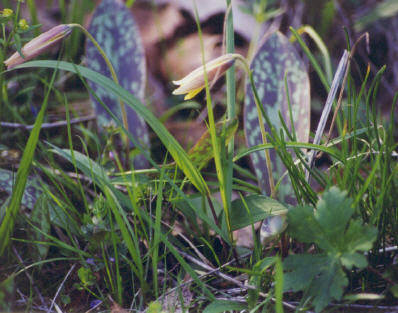
We have found trout lilies in only one small area on our entire 11 acres: on the south end of the lower meadow, where trees and creek come together. They're hard to spot even when I know where to look; they're small and delicate and they do a great job blending into the weeds. The blossoms last a very short time; by the end of the summer, that whole area will be overrun by towering ironweed and joe pye weed. But that won't stop the trout lilies from coming back next spring.
Wednesday, May 03, 2006
Enlightening
Let us review:
Recently, the Check Engine light in the Toyota went OFF at about the same time at the Check Engine light in the Neon came ON.
Late last week we took the Neon in for a few small repairs (that got unexpectedly bigger when I ran the car into a deer on the way to the shop), and now the Check Engine light in the Neon is OFF.
This would suggest that the Check Engine light in the Toyota should be ON, which is indeed the case.
This may just be the Toyota's clever method of reminding me who’s boss; after all, after a vehicle has passed the 180,000 mile mark, it is entitled to have a few crotchets. Still, it is reassuring to know that the Law of Conservation of Engine Light Illumination in the Universe remains in force.
Recently, the Check Engine light in the Toyota went OFF at about the same time at the Check Engine light in the Neon came ON.
Late last week we took the Neon in for a few small repairs (that got unexpectedly bigger when I ran the car into a deer on the way to the shop), and now the Check Engine light in the Neon is OFF.
This would suggest that the Check Engine light in the Toyota should be ON, which is indeed the case.
This may just be the Toyota's clever method of reminding me who’s boss; after all, after a vehicle has passed the 180,000 mile mark, it is entitled to have a few crotchets. Still, it is reassuring to know that the Law of Conservation of Engine Light Illumination in the Universe remains in force.
A modest proposal
I've been thinking ab0ut the similarity between the following statements:
If you don't buy me a candy bar, I'll hold my breath until I turn blue!
If you don't let me keep more than six cans of beer in my dorm room, I'll drive to the store to buy another six-pack after I'm plastered!
The main difference, of course, is that the child making the first statement is unlikely to hurt anyone by holding his breath, while the student making the second statement could do real harm to himself or others. Further, the child threatening to hold his breath is presumably able to make a rational choice whether to carry out the threat, while the student who has already consumed a six-pack may not be in any condition to rationally evaluate the advisability of driving. The student may as well put it this way: "If you don't let me keep more than six cans of beer in my room, I won't be able to stop myself from killing random strangers!"
Something important has been left out of this discussion. If the only options are being allowed to keep a 12-pack in the dorm or driving drunk, then the 12-pack seems like the right answer; but let's look at it another way: if drinking a six-pack of beer makes a student too stupid to think clearly about whether to drive to the store, maybe the solution is to drink not more than six beers but fewer. How about stopping at three?
If you don't buy me a candy bar, I'll hold my breath until I turn blue!
If you don't let me keep more than six cans of beer in my dorm room, I'll drive to the store to buy another six-pack after I'm plastered!
The main difference, of course, is that the child making the first statement is unlikely to hurt anyone by holding his breath, while the student making the second statement could do real harm to himself or others. Further, the child threatening to hold his breath is presumably able to make a rational choice whether to carry out the threat, while the student who has already consumed a six-pack may not be in any condition to rationally evaluate the advisability of driving. The student may as well put it this way: "If you don't let me keep more than six cans of beer in my room, I won't be able to stop myself from killing random strangers!"
Something important has been left out of this discussion. If the only options are being allowed to keep a 12-pack in the dorm or driving drunk, then the 12-pack seems like the right answer; but let's look at it another way: if drinking a six-pack of beer makes a student too stupid to think clearly about whether to drive to the store, maybe the solution is to drink not more than six beers but fewer. How about stopping at three?
Tuesday, May 02, 2006
Facing up to Facebook
The hostility level in my composition class was running pretty high and for a while I couldn't quite figure out why. It's true that my students have a paper due Thursday and a final exam next week, but the anger seemed to be simmering at an unprecedented level. Finally, toward the end of class, a student burst out, "It's not fair!"
"What's not fair?" I asked.
"Trying to get rid of Facebook!"
"Who's trying to get rid of Facebook?"
"You are!"
This was news to me. I have never been involved in any attempt to limit students' access to Facebook; further, the college administration has no such plans in the works either. I told the student this, but then he changed his angle of attack: "Have you ever looked at students' profiles on Facebook?"
"Yes."
"That's not fair!"
And so it went, on and on, some expressing their outrage that professors would dare trespass on what students see as their private domain. Somewhere along the way I admitted that I have a blog. "You have a blog?" asked the irate student. "Why would you want a blog?"
Clearly, the conversation was getting nowhere, so we moved on. All day I've been trying to comprehend the intensity of the anger my students expressed. Do they want to erect electronic walls around their little piece of the blogosphere and kick everyone who's not just like them out of the playroom? Do they really think that what they post on Facebook will never come back to haunt them? I hope they don't intend to run for public office.
I understand that Facebook and other such sites are intended to help students make connections, but today it was clear that what my students want most is simply to be left alone--and after a class like today's, I am happy to accomodate them.
"What's not fair?" I asked.
"Trying to get rid of Facebook!"
"Who's trying to get rid of Facebook?"
"You are!"
This was news to me. I have never been involved in any attempt to limit students' access to Facebook; further, the college administration has no such plans in the works either. I told the student this, but then he changed his angle of attack: "Have you ever looked at students' profiles on Facebook?"
"Yes."
"That's not fair!"
And so it went, on and on, some expressing their outrage that professors would dare trespass on what students see as their private domain. Somewhere along the way I admitted that I have a blog. "You have a blog?" asked the irate student. "Why would you want a blog?"
Clearly, the conversation was getting nowhere, so we moved on. All day I've been trying to comprehend the intensity of the anger my students expressed. Do they want to erect electronic walls around their little piece of the blogosphere and kick everyone who's not just like them out of the playroom? Do they really think that what they post on Facebook will never come back to haunt them? I hope they don't intend to run for public office.
I understand that Facebook and other such sites are intended to help students make connections, but today it was clear that what my students want most is simply to be left alone--and after a class like today's, I am happy to accomodate them.
Monday, May 01, 2006
Close encounters of the stinky kind
So I'm sitting here reading drafts of papers from my Concepts of Nature class while trying to ignore the ripe aroma of whatever dead woodland creature recently expired in the furnace room. I could go in there and hunt for the stinky carcass myself, but, um, in a minute I'll come up with a really good reason why one of the resident men is really more qualified for the job. Besides, I'm busy reading rhapsodies about nature from students who have just finished reading Philip K. Dick's Do Androids Dream of Electric Sheep, so I'm well aware that my unwillingness to empathize with the small creatures that occasionally wander into my house marks me as less than human. If being fully human requires sharing my living space with mice, call me an android.
Walt Whitman wrote "I Think I Could Turn and Live with the Animals," but I wonder whether he ever had to share a kitchen with a nest of hornets? I did, although I was not aware of it until our Hornet Eradication Program led to a mass die-off in the hive, which proceeded to disintegrate and soon smelled like a dead horse. There is no room in a small kitchen for the smell of a dead horse, so I diligently hunted down the source. I cleaned the sink, the disposal, and the cabinet under the sink, and then finally I realized that the stink was coming from under the cabinet. The resident Pest Eradicator pried up the board at the bottom of the cabinet and quickly slapped it back down again: the entire space under the cabinet was filled with a deteriorating hornet's nest.
That was another time and another place but I'll never forget the peculiar shock I experienced when some of the larvae tried to escape by creeping across the kitchen floor behind my back, a memory that still gives me nightmares. That was our only hornet problem, but we have had other close encounters: the snake coiled around the water heater, the infamous incident of the rats in the night-time, the chipmunks that gnawed the insulation, the dead mouse under the sofa. There's nothing quite like coming home after an exhausting car trip, collapsing on the sofa, and suddenly levitating upon encountering the distinctive smell of dead mouse.
And while we're on the topic of mice, let us not forget the live mouse that sprang out of my tenure file and would have sprung into my lap if I had not vacated that chair rather more suddenly than usual. I had no empathy at all for that mouse, although my bitterness toward it lessened after my tenure case was approved.
Ah, finally the Eradicator has arrived. He confirms the presence of a dead mouse dangling pitifully from a piece of insulation in the furance room. I wish I could work up some empathy for the mouse, but, on the other hand, I doubt that the mouse ever worked up any empathy for me; if he did, he would take his stink outside, where he could experience oneness with nature without disturbing my peace.
Walt Whitman wrote "I Think I Could Turn and Live with the Animals," but I wonder whether he ever had to share a kitchen with a nest of hornets? I did, although I was not aware of it until our Hornet Eradication Program led to a mass die-off in the hive, which proceeded to disintegrate and soon smelled like a dead horse. There is no room in a small kitchen for the smell of a dead horse, so I diligently hunted down the source. I cleaned the sink, the disposal, and the cabinet under the sink, and then finally I realized that the stink was coming from under the cabinet. The resident Pest Eradicator pried up the board at the bottom of the cabinet and quickly slapped it back down again: the entire space under the cabinet was filled with a deteriorating hornet's nest.
That was another time and another place but I'll never forget the peculiar shock I experienced when some of the larvae tried to escape by creeping across the kitchen floor behind my back, a memory that still gives me nightmares. That was our only hornet problem, but we have had other close encounters: the snake coiled around the water heater, the infamous incident of the rats in the night-time, the chipmunks that gnawed the insulation, the dead mouse under the sofa. There's nothing quite like coming home after an exhausting car trip, collapsing on the sofa, and suddenly levitating upon encountering the distinctive smell of dead mouse.
And while we're on the topic of mice, let us not forget the live mouse that sprang out of my tenure file and would have sprung into my lap if I had not vacated that chair rather more suddenly than usual. I had no empathy at all for that mouse, although my bitterness toward it lessened after my tenure case was approved.
Ah, finally the Eradicator has arrived. He confirms the presence of a dead mouse dangling pitifully from a piece of insulation in the furance room. I wish I could work up some empathy for the mouse, but, on the other hand, I doubt that the mouse ever worked up any empathy for me; if he did, he would take his stink outside, where he could experience oneness with nature without disturbing my peace.
G.M.E.C.
Last night we began our annual Garlic Mustard Eradication Campaign. In under an hour, three of us pulled enough garlic mustard to fill a 4x6 foot trailer; by the time we were done, the pungent garlicky smell had permeated my entire being, and my clothes were covered with stickers, prickers, and bits of leaf and dirt, not to mention the tick in my hair. Ticks love my hair. To a tick, my hair looks like home. I'm told a mild winter produces a bumper crop of ticks and other pests. I guess I'll have to start wearing a hat.
When I look at the amount of garlic mustard lining the area roadways, I realize that trying to eliminate the invasive weed would be as futile as trying to cut all the Kudzu in South Carolina. We pull some up this year and we'll get some more next year, but if we're diligent year after year, eventually maybe we'll clear a few spaces where the invasive weed will not be welcome. At least that's what we hope as we bend and grab and pull and toss and then stop to brush the sweat off our foreheads. The garlic mustard may continue its colonization of our county, but when it knocks on our door, we say "Thus far and no farther."
When I look at the amount of garlic mustard lining the area roadways, I realize that trying to eliminate the invasive weed would be as futile as trying to cut all the Kudzu in South Carolina. We pull some up this year and we'll get some more next year, but if we're diligent year after year, eventually maybe we'll clear a few spaces where the invasive weed will not be welcome. At least that's what we hope as we bend and grab and pull and toss and then stop to brush the sweat off our foreheads. The garlic mustard may continue its colonization of our county, but when it knocks on our door, we say "Thus far and no farther."
Subscribe to:
Posts (Atom)